| Term | Definition |
|---|---|
The Watson-Crick Model | The foundational three-dimensional structure of DNA 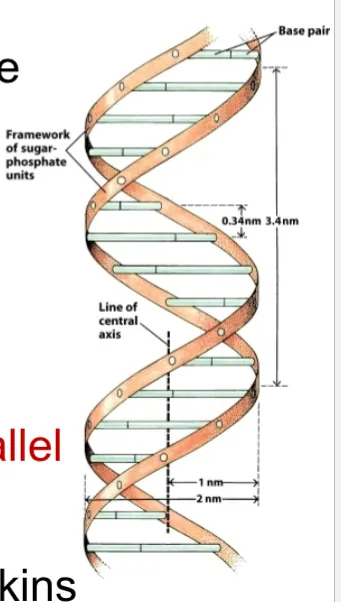 |
Ribonucleic Acid | A polymer consisting of several nucleotides, uses ribose(sugar), uracil(pyrimidine),and does not form helix(is single stranded), use primarily to synthesize proteins |
mRNA(messenger RNA) | The first type of RNA molecule, Codes for a specific amino acid sequence (protein structure), nucleotides are “read” in groups of three called codons 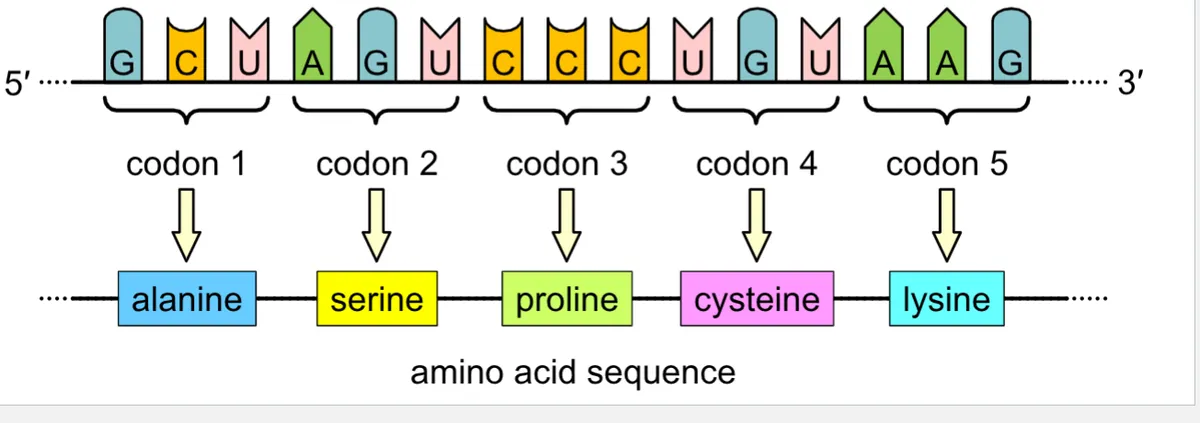 |
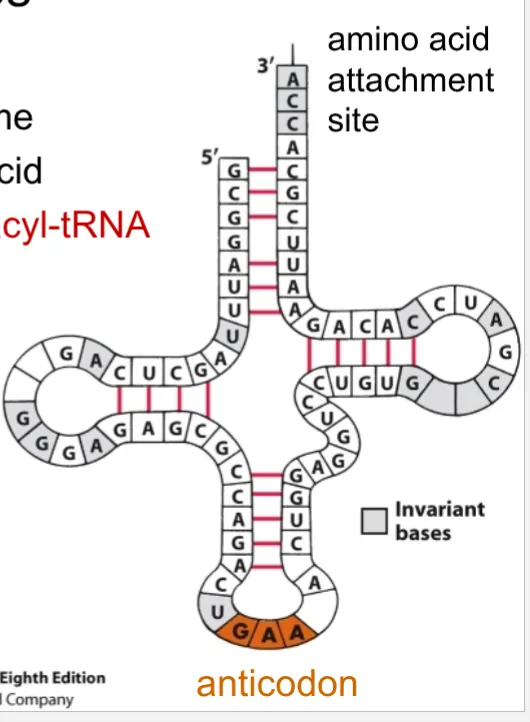
tRNA(transfer RNA) | The second type of RNA molecule, transports amino acid to ribosome
Each binds to a specific amino acid
tRNA + amino acid = aminoacyl-tRNA
Contains an anticodon
 |
rRNA(ribosomal RNA) | The third type of RNA molecule, Forms the ribosomes (site of protein synthesis)
Consists of a large subunit and a small subunit 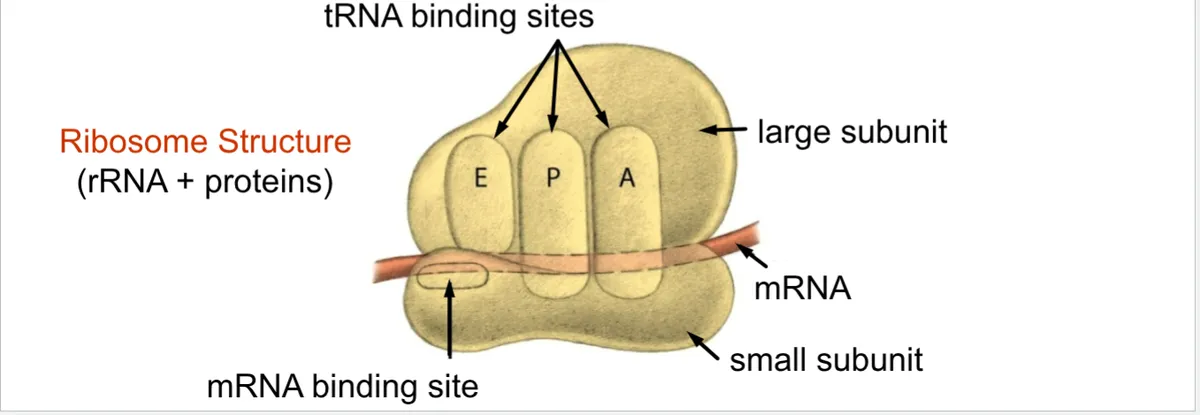 |
Central Dogma of Molecular Biology | The sequential flow of information
“DNA makes RNA, and RNA makes Protein”
Proteins are the physical expression of a gene
Involves three steps:
Replication, Transcription, and Translation 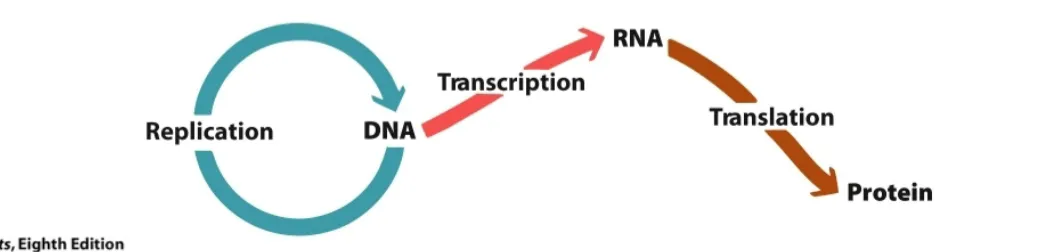 |
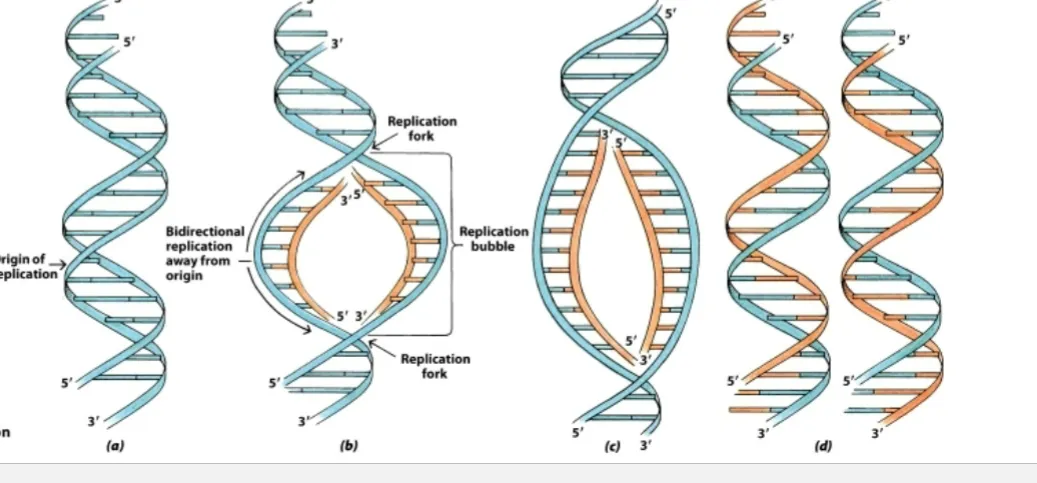
Replication | The first step of Central Dogma
Uses DNA to synthesize more DNA
Each strand acts as a template for new copies
Starts one of many origin of replication points
Replication is bidirectional, constructed 5′ to 3′
Performed by a replisome (complex array of proteins)
 |
The process of DNA replication | 1. DNA is unwound at the origin of replication
2. Helicase opens DNA forming two replication forks
3. SSB proteins attach to prevent rewinding of DNA
4. Topoisomerase binds to DNA ahead of replication
fork
5. Primase adds RNA nucleotides to form a primer
6. DNA Polymerase III adds DNA nucleotides
starting at the primer
7. Elongation of both leading and lagging strands
continues
8. DNA Polymerase I removes RNA Primers and
replaces them with DNA nucleotides
9. DNA Ligase fills the gaps between DNA fragments by forming the needed phosphodiester bonds,
making sure the new DNA molecule is complete |
First step of DNA replication | DNA is unwound at the origin of replication 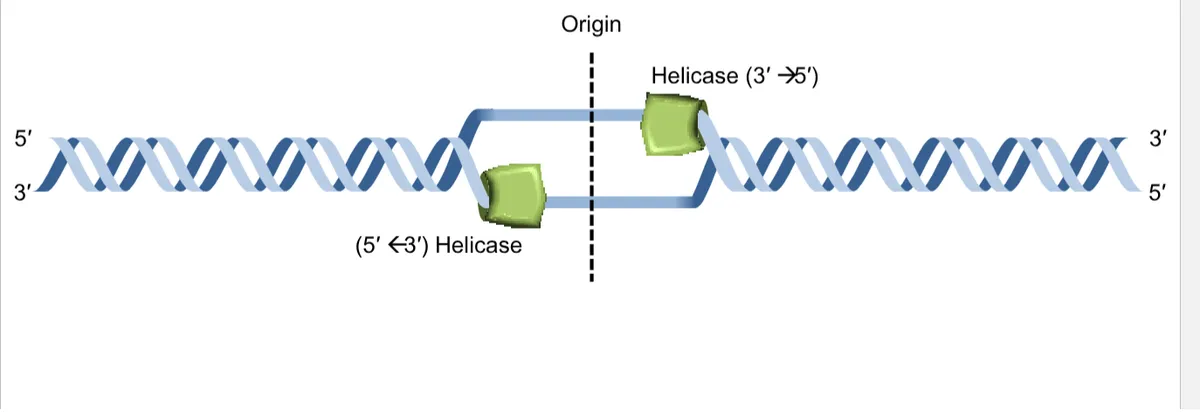 |
Second step of DNA replication | Helicase opens DNA forming 2 replication forks |
Third step of DNA replication | SSB proteins attach to prevent rewinding of DNA 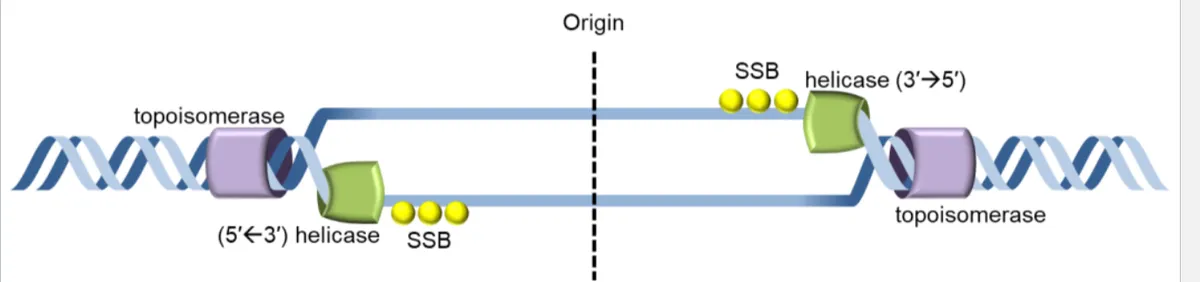 |
Fourth step of DNA replication | Topoisomerase binds to DNA ahead of replication
fork
|
Fifth step of DNA replication | Primase adds RNA nucleotides to form a primer 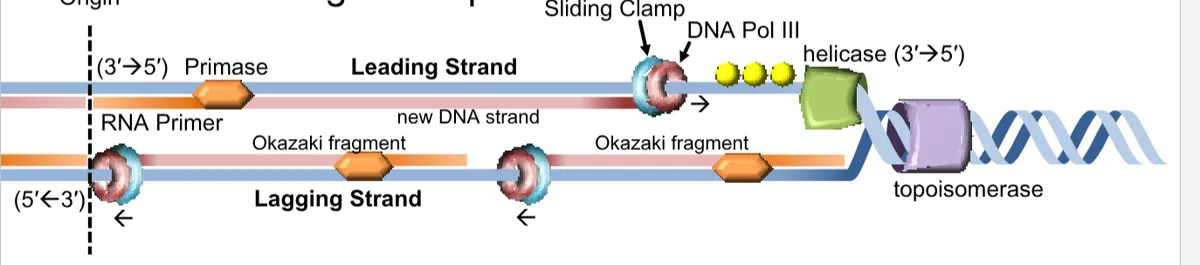 |
Sixth step of DNA replication | DNA Polymerase III adds DNA nucleotides
starting at the primer |
Seventh step of DNA replication | Elongation of both leading and lagging strands
continues |
Eighth step of DNA replication | DNA Polymerase I removes RNA Primers and
replaces them with DNA nucleotides 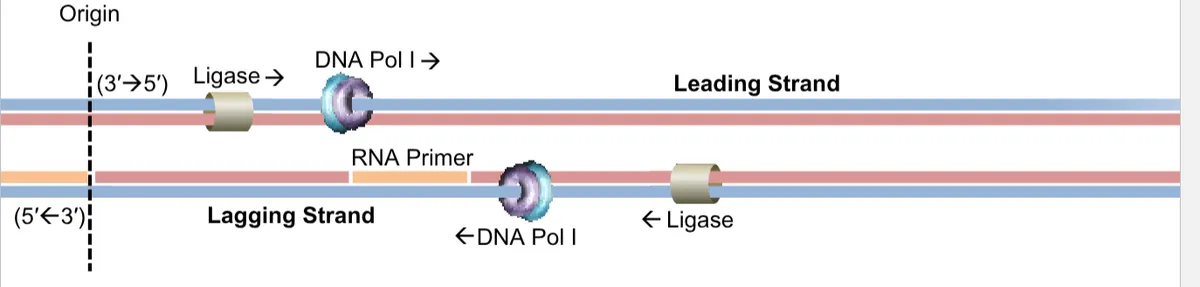 |
Ninth (and last) step of DNA replication | DNA Ligase fills the gaps between DNA fragments by forming the needed phosphodiester bonds,
making sure the new DNA molecule is complete |
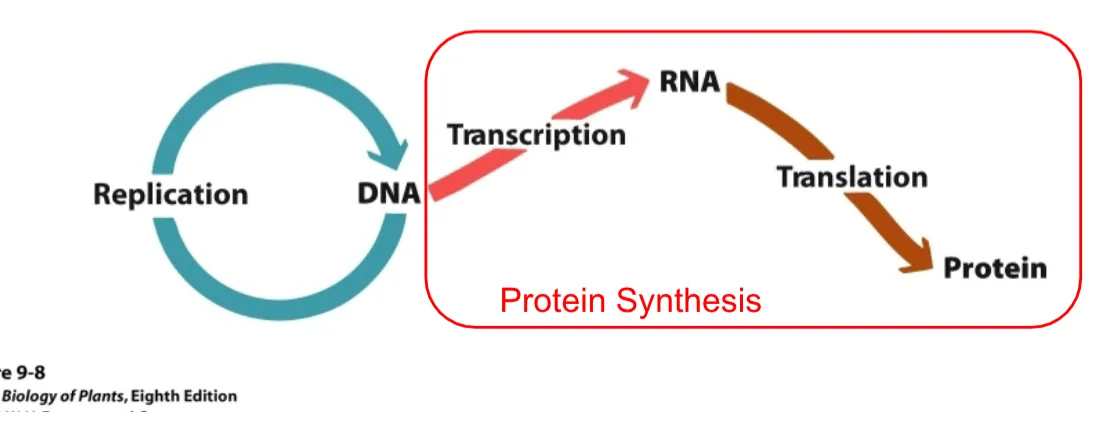
Protein Synthesis | The process of turning DNA into protein
Involves 2 steps:
Transcription and Translation
 |
Transcription | The first step in protein synthesis and gene expression
|
Deoxyribonucleic acid (DNA) | A polymer consisting of millions of nucleotides
Purine bases: Adenine and Guanine
Pyrimidine bases: Cytosine and Thymine
Nucleotides bonded 5′—3′
This forms a sugar—phosphate “backbone”
Forms a double helix
Hydrogen bonds hold strands together
Base pairing rule: A—T and C—G
Strands are complementary and antiparallelu |
Transcription | The first step of protein synthesis and gene expression.
Gene DNA is 'read' to make RNA
-Occurs in the Nucleus
DNA is used as a template for RNA synthesis
- Non-coding(anti sense) strand is the template strand
- Coding(sense) strand is the non-template strand
|
Translation | The second step of protein synthesis.
mRNA is 'read' to make a protein
-Occurs in the Cytoplasm, often on the Rough ER |
Genetic Code | When genes(DNA) code for proteins(amino acids)
It is universal to all life. |
How many nucleotides are in DNA and RNA? | 4 each |
What are proteins composed of? | They are composed of amino acids. |
How many nucleotides form a codon? | 3 |
How many possible codons coding for 20 amino acids? | 64 |
Transcription unit | -Coding sequence(gene)
-Regulatory sequences
-Promoters sequence(TATA box)
- Transcription start site(TSS)
- Terminator sequence(AATAAA) |
Promoters | Occur upstream of the coding sequence
Vary between 100-1000 bp long
Recognition of the promoter involves the TATA box |
Initiation step | Transcription factors(TF) bind to the promoter sequence
RNA polymerase binds to the Transcription factors
RNA polymerase forms a Transcription bubble |
Transcription step | RNA polymerase reads DNA 3'-5': adding nucleotides to growing RNA molecule 5'-3' |
Termination step | Transcription stops when Terminator sequence is encountered |
Post Transcription processing of mRNA(not in order) | 5' cap added (5 prime guanine cap)
Poly-A tail added to 3' end
-30-200 adenines
Introns removed
Exons spliced together |
Translation step(RNA-> protein) | Occurs after post transcription
Step 1. Initiation (1 start codon- AUG)
-Small subunit added to mRNA
-Initiation codon(AUG) codes for methionine
-Large subunit attaches to tRNA at P-binding site
Step 2. Elongation
-tRNA binds to A-binding site
- Peptide bond forms between amino acids
- Ribosome shifts 3'-ward, exposing A-binding site
-1st tRNA exits
Step 3. Termination (3 stop codons- UAA, UAG, UGA)
-Release factor enters A-binding site at stop codon
- Polypeptide and Ribosome subunits released |
First step in Translation | Initiation (1 start codon- AUG)
-Small subunit added to mRNA
-Initiation codon(AUG) codes for methionine
-Large subunit attaches to tRNA at P-binding site |
Second step in Translation | Elongation
-tRNA binds to A-binding site
- Peptide bond forms between amino acids
- Ribosome shifts 3'-ward, exposing A-binding site
-1st tRNA exits |
Third step in Translation | Termination (3 stop codons- UAA, UAG, UGA)
-Release factor enters A-binding site at stop codon
- Polypeptide and Ribosome subunits released |
Mutations | Altering the sequence of bases in the DNA
|
Gene Expression | Genes can be turned 'on' and 'off' as needed
Chromatin modification
- Histane acetylation
- DNA methylation
- Epigenetic inheritance (environmental change in genes)
RNA interference
-Noncoding RNA- involved with heterochromatin
- MicroRNA- binds to mRNA and prohibits translation |
DNA repeat sequences | Tandem repeats
-Satellite DNA
-Minisatellites
Trinucleotide repeats
Interspersed repeats
New gene formation |
Satellite DNA | Long arrays of tandem repeated, non-coding DNA
'Found mostly in centromeres, telomeres, and heterochromatin |
Minisatellites | Repeat units 10-60 bp long |
Microsatellites | Repeat units <10 bp long
-simple sequence repeats(SSRs) and short-tandem repeats(STRs)
-used in DNA finger printing(compares length of repeat region |
Trinucleotide repeats(triplet repeats)-3 bp repeats | -Trinucleotide repeat disorders(triplet number increases) |
Interspersed repeats | -Transposons
-Retrotransposons(very common in plant genomes) |
New gene formation | -Interspersed DNA elements can isolate alleles
-This allows for the (potential) development of new genes |