GDP
The total MONETARY value of all FINAL goods and services produced DOMESTICALLY within a YEAR.
| Term | Definition |
|---|---|
GDP | The total MONETARY value of all FINAL goods and services produced DOMESTICALLY within a YEAR.
|
GNI | The total income of a nation’s people and businesses.
GNI = GDP + (Inflows - outlfows) |
Nominal GDP vs Real GDP | nominal: GDP/GNI measured in current prices that does not account for inflation.
real: GDP/GNI that is adjusted for inflation.
|
Business Cycle | 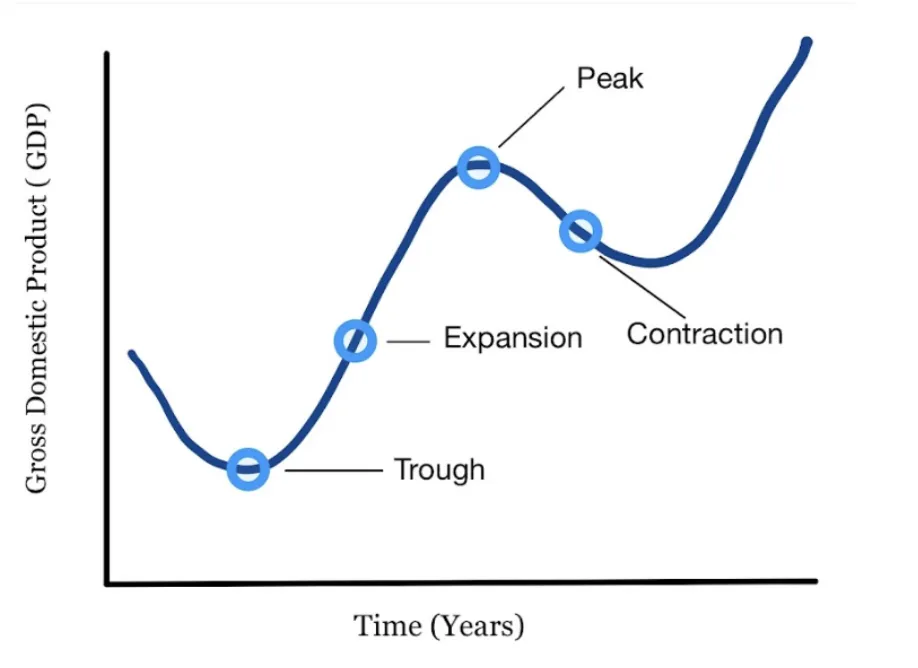 |
AD non price determinants (Consumption) | Consumer Confidence
Unemployment
Taxes
Interest Rates
Wealth
Indebtedness
Future Expectations
|
AD non price determinants (Investment) | Interest Rates
Business Confidence
Technology
Business Taxes
Corporate Indebtedness
|
AD non price determinants (Government and Net exports) | gov spending
Income of Trading Partners
Exchange Rates
Change in Trade Policies
Health and Safety Requirements |
Natural rate of Unemployment (full employment) | The rate of unemployment that occurs when the economy is producing at its potential output or full employment level of output.
|
SRAS Non price determinants | Cost and availability of resources
Gov intervention: subsidy, taxes, regulation
Supply shocks |
Neo classical | Assumes prices are flexible in the long-run. Didn't do well at prediction as prices and wages tended to be "sticky" (don’t change immediately to changes in supply/demand)
Enforces the idea that the market will fix itself and return to equilibrium (Full Employment).
|
Keynesian | States that wages/prices are "sticky" meaning they are slow to change due to labor laws, contracts, salaries, etc.
Argues the economy gets stuck in a short-run position. (Only one Aggregate Supply Curve) |
Shifts in LRAS | Change in Quality or Quantities of Factors of Production
Technological Improvements
Increase in Efficiency
Changes in Institutions |
Recessionary gap | When the equilibrium level of real output is less than potential output as a result of a decrease in AD.
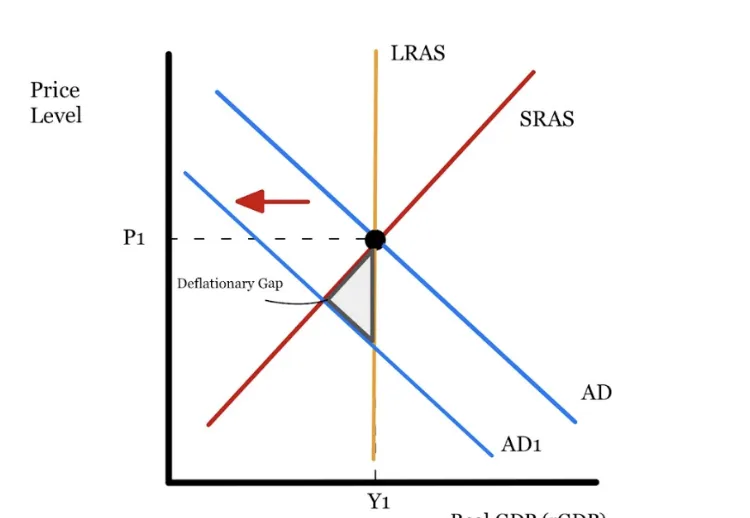 |
Inflationary gap | The case where equilibrium real output exceeds potential output as a result of an increase in AD.
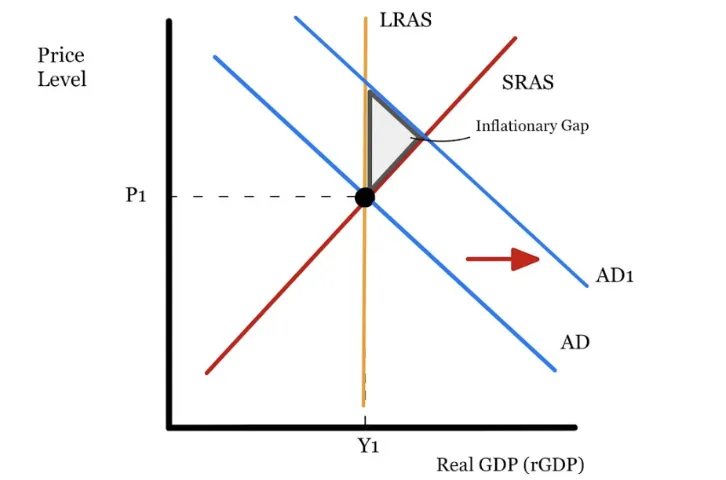 |
Cost push inflation | Inflation as a result of an increase in costs of production in the economy (Increase in price of raw materials, imports, or labour). Price Level is PUSHED UP.
|
Demand pull inflation | Inflation as a result of an increase in AD (C, I,G, Xn). Price Level is PULLED UP
|
Typed of unemployment | disequilibrium:
- cyclical: unemployed in a recession due to decreased AD
- real wage: wages are forced above equilibrium, creating excess supply of labor
Equilibrium (natural rate of unemployment)
- structural: immobility of labor
- Frictional: in between jobs
- seasonal: temp change ind demand for labor |
The Gini Coefficient
| Measure of distribution of income within an economy. This coefficient is usually used to determine the level of income inequality.
The higher the Gini - the more unequal the income distribution
The lower the Gini - the closer to income distribution equality
|
Monetary policy | The activities conducted by a central bank using the money supply and interest rates to regulate an economy. |
Money supply | total amount of money in circulation in an economy |
Goal of monetary policy | Low/stable inflation
low unemployment
growth and stability
external balance: imports=exports |
expansionary monetary policy | during a recession:
recessionary gap, money supply increase, lower interest rates, return to equilibrium |
contractionary monetary policy | during an expansion:
inflationary gap, money supply decrease, rising interest rates, return to equilibrium |
Fiscal Policy | The term for when the government intervenes in the market using taxation or government spending. |
Budget | The government creates a budget yearly that outlines their revenue and how they plan to spend money.
Budget Deficit = Government Spending > Government Revenue
Budget Surplus = Government Spending < Government Revenue
Balanced Budget = Government Spending = Government Revenue |
Expansionary fiscal policy | taxes decrease, government spending increase
|
Contractionary Fiscal policy | taxes increase, government spending decrease
|