Functions of Movement Perception
survival in environment
prey and predators use to locate
movement capturers our attention
| Term | Definition |
|---|---|
Functions of Movement Perception | survival in environment
prey and predators use to locate
movement capturers our attention |
real motion | object is physically moving |
Illusory motion (apparent movement) | stationary stimuli are presented in slightly different location
TVs |
Induced motion | other cues, movement of one object results in perception of movement in another object.
photo of someone running, blurry, photo of someone about to throw something |
motion aftereffect | look at video, video stops, see illusion of movement in opposite direction, imbalance of motion perception |
moving objects benefits | gives us more information about the object from motion signals |
structure from motion | fish cannot see 3d the way we can they use this, our ability to extract vivid impressions of an object's 3D shape from motion |
retina | mosaic of small receptive fields for retinal ganglion cell, Each provides very low-level information, reaching visual cortex signals from multiple small retinal receptive fields are combined into larger receptive fields |
Larger receptive fields | generally used to process more complex information as information passes along visual processing pathway |
motion | spatial displacement of object(s) over time: a spatial-temporal
phenomenon |
Visible movement | usually results in corresponding spatial-temporal changes in light patterns on retina - motion perception begins by extracting these patterns |
Motion Perception: Retinal Information | output unit is direction selective 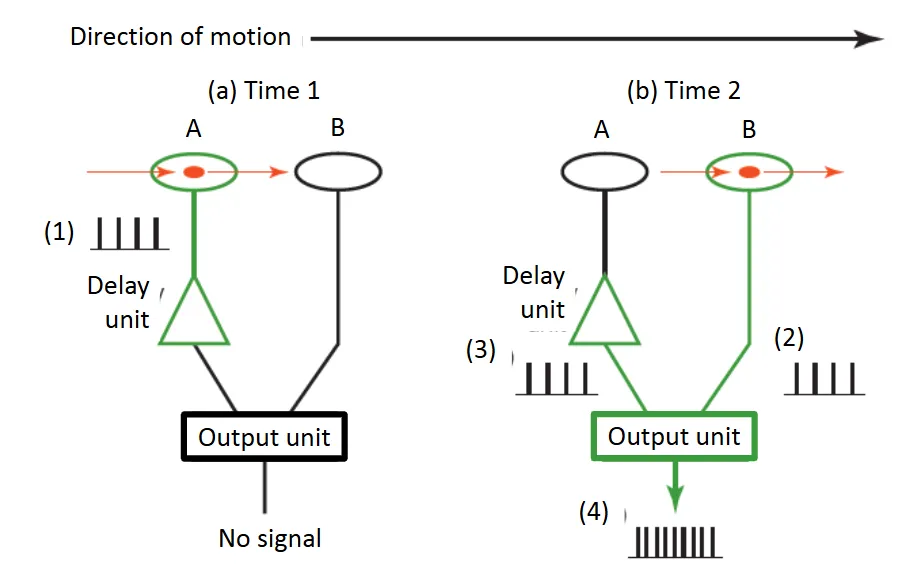 |
Motion Perception: Retinal Information, other direction | not enough signals to say there is motions 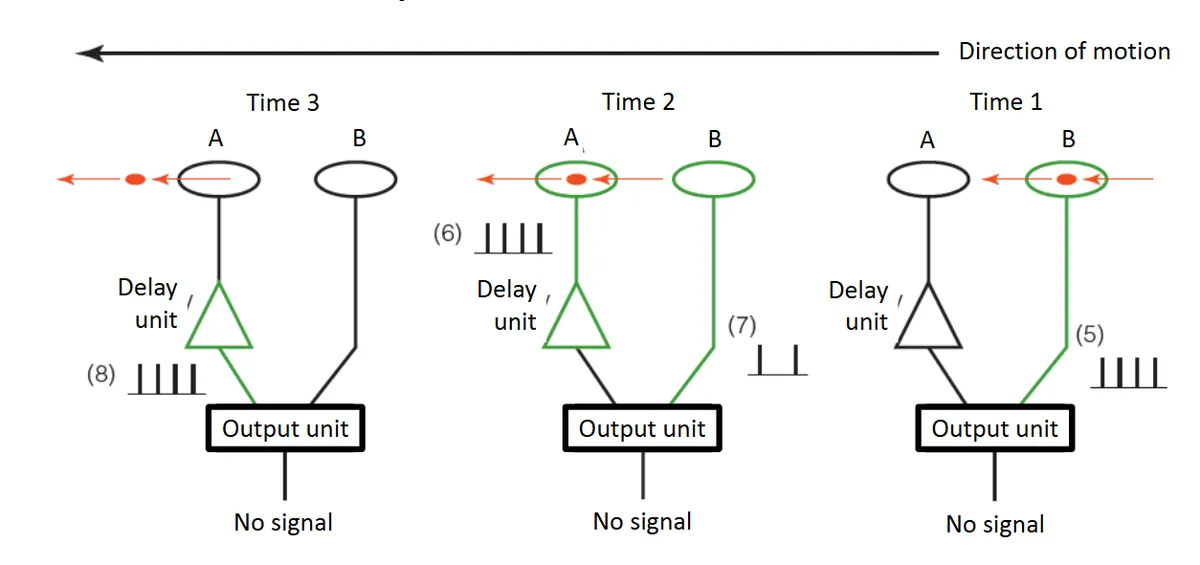 |
Motion direction processing | speed or villosity preferences in output units, low level motion |
Wertheimer (1912) | Found that the delay between frames determines if motion is
perceived
apparent motion perception even if one stimulus is presented to one eye and other is presented to other eye, Signals from two eyes segregated until reaching visual cortex → DS neurons must be located somewhere in cortex |
Fooling motion detectors | motion perception, real and apparent, involves DS neural mechanisms something like those proposed by Reichardt
If (time delay) and (spatial difference) associated with
DS neurons correspond to spatial separation and presentation
delay between stimuli, DS neurons will signal motion
or DS neuron apparent and real motion constitute equivalent events |
Larsen et al Comparison of Real and Apparent Motion | Control condition: each dot activated a separate area of visual cortex.
Apparent and real motion: activation of visual cortex from both sets of stimuli was similar
perception of motion in both cases is related to same brain mechanism. 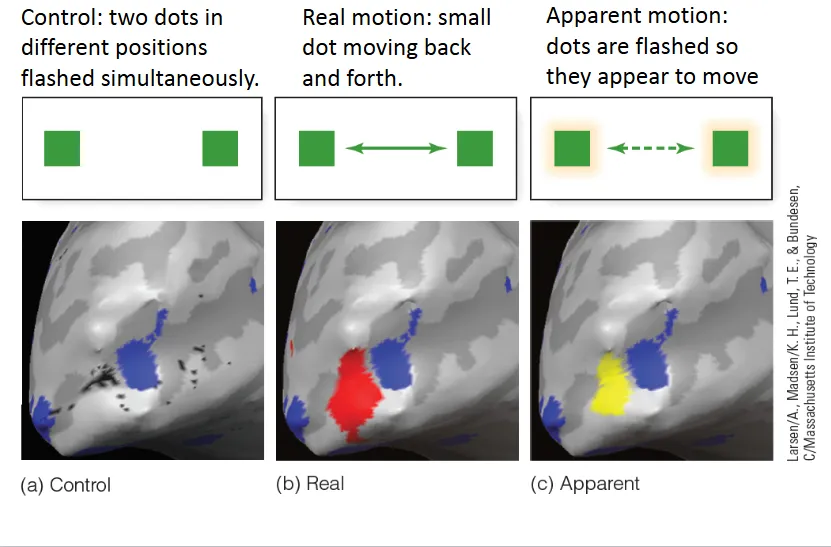 |
corollary discharge theory explains 3 conditions | An object moves, and observer is stationary
An object moves, and observer follows object with their eyes
An observer moves through a stationary environment |
corollary discharge theory | information is sent off to other brain parts to better process the visual information 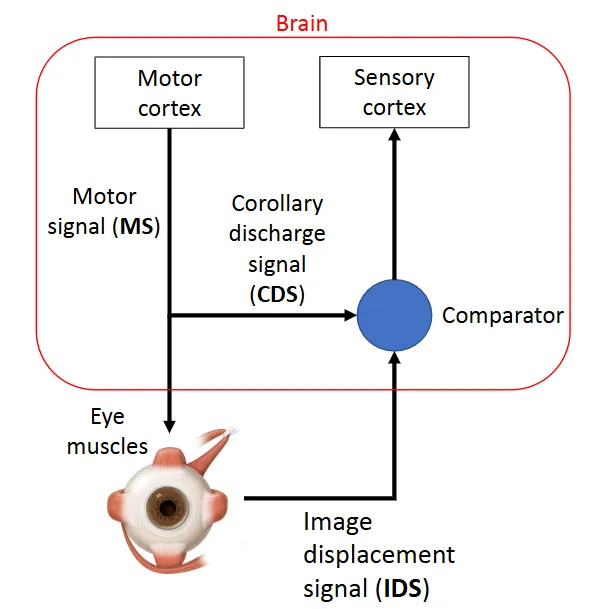 |
Image displacement signal | movement of image stimulating receptors across retina 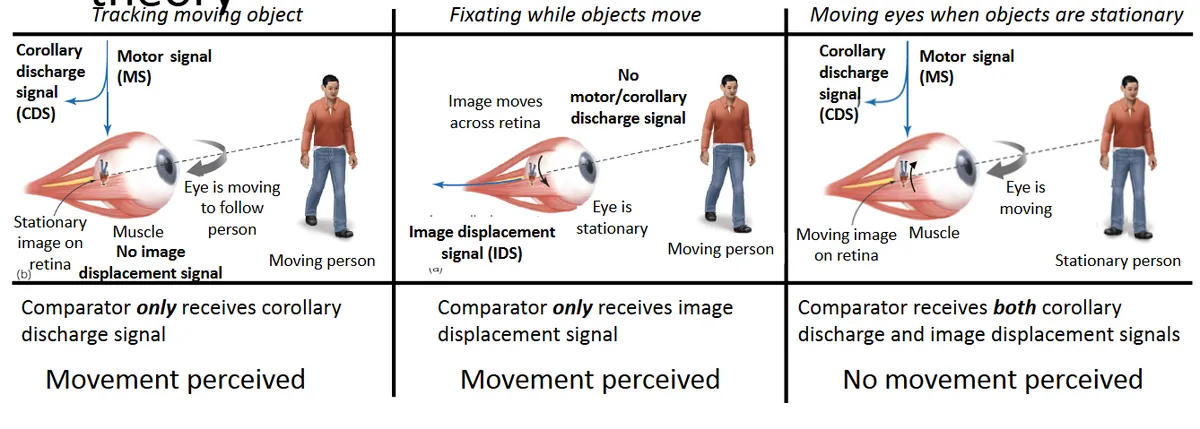 |
Motor signal | signal sent to eyes to move eye muscles |
Corollary discharge signal | split from motor signal, predictive neural signal from motor system |
Corollary Discharge Theory - Physiological Evidence | Damage to medial superior temporal area in humans:
perception of movement of stationary environment with movement of eyes.
Real-movement neurons found in monkeys respond only when a stimulus moves and do not respond when eyes move |
Firing and coherence experiment, Newsome et al | As coherence of dot movement increased, firing of MT neurons and judgment accuracy also increased
middle temporal lobe 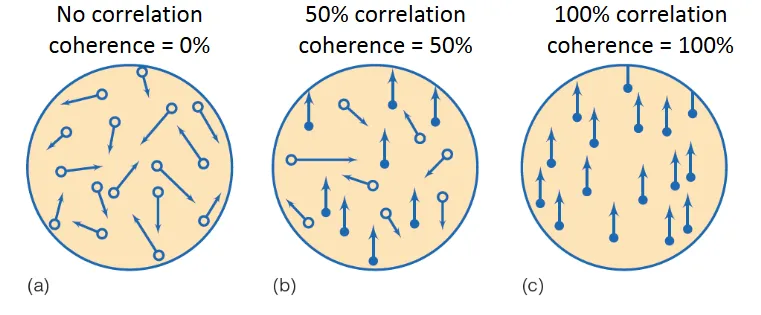 |
Motion Perception in the Brain | 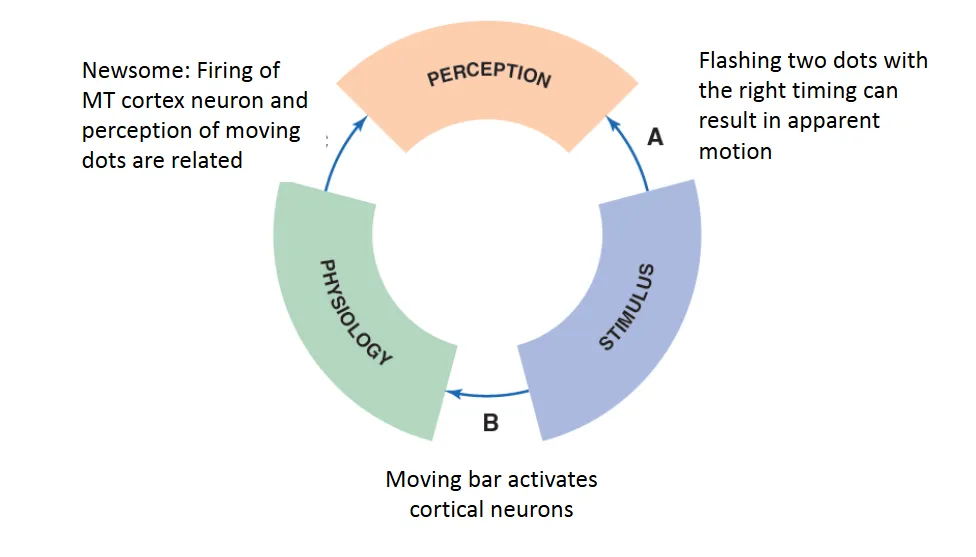 |
Aperture problem | observation of small portion of larger stimulus leads to misleading information about direction of movement#
Viewing only a small portion of a larger stimulus can result in misleading information about the direction in which the stimulus is moving. |
Aperture problem: role of MT | outputs from V1 directionally selective neurons are integrated to
form unified, coherent motion
MT receptive fields up to 10 times larger than V1, suggesting array of spatially distributed V1 neurons contribute to synthesis of individual MT receptive fields
directional selectivity of MT neurons differs from that of V1
neurons they receive signals from |
Movshon et al. (1986) | Recorded activity of V1 neurons sensitive to one of two orthogonal directions
MT appears to be capable of pooling the local motion signals it receives from V1 and calculating a separate pattern motion |
Motion aftereffect: role of MT | activity in V5/MT during stationary period, which gradually reduced, mirroring psychophysically measured MAE (V5, 5th visual area)
just a correlation |
Structure from motion: role of MT | MT cell most active when perceived rotation direction matched cell’s preferred direction, less active when perceived direction reversed |
Biological motion | motion events that distinguish animate from inanimate objects – a specific category of structure- from-motion |
Motion and the Human Body, Grossman et al. | dots on people while moving vs random dots
Noise was added to dots so they could only achieve 71% accuracy.
Transcranial magnetic stimulation applied to Superior Temporal Sulcus (STS) decreased ability to detect biological motion |
Striate Cortex (V1) | Direction of motion across small receptive fields |
Middle Temporal Area (MT) | Direction and speed of object motion |
Medial Superior Temporal Area (MST) | Processing optic flow; locating moving objects; reaching for moving objects |
Superior Temporal Sulcus (STS) | Perception of motion related to animals and people (biological motion |
Motion Preference Amongst Newborn Babies, Vallortigara et al (2005) | Perception of biological motion may not depend on visual experience, may be innate |
Motion Responses to Still Pictures – implied motion | Areas of brain responsible for motion perception fire in response
to pictures of implied motion |