| Term | Definition |
|---|---|
IVAN M. SECHENOV | |
Why is Ivan Sechenov important in psychology?
| He founded Russian objective psychology and argued that behavior could be explained physiologically through reflexes. |
What did Sechenov believe causes behavior?
| What did Sechenov believe causes behavior?
|
What is Sechenov’s concept of inhibition?
| Brain mechanisms can suppress or control reflexive responses. |
Why was inhibition important to Sechenov?
| It explained voluntary control, learning, and why responses are not automatic. |
How did Sechenov demonstrate inhibition?
| By stimulating frog brain areas that suppressed reflexes. |
How did Sechenov view psychology?
| Psychology should be studied objectively through physiology, not introspection. |
Why is Sechenov important historically?
| He helped bridge physiology and psychology and influenced Pavlov and behaviorism. |
IVAN PAVLOV | |
Why is Ivan Pavlov important in psychology?
| He discovered conditioned reflexes and helped establish objective behavioral research. |
What major award did Pavlov receive?
| The 1904 Nobel Prize for research on digestion. |
What was Pavlov originally studying before conditioning?
| Digestion and salivary reflexes in dogs. |
What was the gastric fistula used for?
| Observing digestive processes without harming the animal. |
What is a conditioned reflex?
| A learned reflex created through association between stimuli. |
What observation led Pavlov to discover conditioning?
| Dogs salivated before food appeared when they associated certain stimuli with feeding. |
What is an unconditioned stimulus (US)?
| A stimulus that naturally produces a response (ex: food). 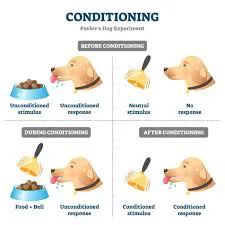 |
What is an unconditioned response (UR)?
| The natural reflex caused by the US (ex: salivation to food). |
What is a conditioned stimulus (CS)?
| A previously neutral stimulus paired with the US (ex: tone). |
What is a conditioned response (CR)?
| The learned response to the CS alone (ex: salivation to tone). |
What is excitation in Pavlov’s theory?
| Nervous system activity that promotes a response. |
What is inhibition in Pavlov’s theory?
| Nervous system activity that suppresses a response. |
What is the cortical mosaic?
| The shifting pattern of excitation and inhibition in the cortex that determines behavior. |
What is extinction?
| The weakening of a conditioned response when the CS is presented without the US. |
What is spontaneous recovery?
| The return of an extinguished conditioned response after rest. |
What is disinhibition?
| The temporary return of a conditioned response due to a strong unrelated stimulus. |
What is experimental neurosis?
| Behavioral breakdown caused by conflicting stimuli and confusion between excitation and inhibition. |
What did Pavlov learn from experimental neurosis?
| Stress and conflict can disrupt behavior and produce abnormal responses. |
What is the first-signal system?
| Direct conditioned responses to environmental stimuli. |
What is the second-signal system?
| Human use of language and symbols as conditioned stimuli. |
Why is the second-signal system important?
| It explains human language, abstract thinking, and symbolic learning. |
How did Pavlov think psychology should be studied?
| Through objective physiological methods, not introspection. |
What did Pavlov reject in psychology?
| Mentalism and introspection. |
Why is Pavlov historically important?
| He laid the foundation for behaviorism and experimental learning theory. |
VLADIMIR M. BECHTEREV | |
Why is Vladimir Bekhterev important in psychology?
| He developed reflexology, an objective approach to studying behavior through reflexes, competing with Pavlov’s conditioning theory. |
What is Bechterev’s reflexology?
| The study of behavior as a system of reflexes triggered by environmental stimuli. |
How did Bechterev differ from Pavlov?
| Bechterev emphasized motor reflexes and observable behavior; Pavlov focused on salivary conditioning and physiological reflexes. |
What was the main rivalry between Bechterev and Pavlov?
| Both claimed to explain learning and behavior through reflex systems, but used different methods and interpretations. |
ALEXANDER LURIA | |
Why is Alexander Luria important?
| He developed neuropsychology and studied how brain function relates to language and cognition. |
What was Luria’s main focus?
| Brain, language, memory, and higher cognitive functions. |
LEV VYGOTSKY | |
Why is Lev Vygotsky important?
| He developed sociocultural theory, emphasizing how learning is shaped by social interaction and culture. |
What is Vygotsky’s main idea about learning?
| Cognitive development happens through social interaction and language. |
What is Vygotsky’s key concept?
| The Zone of Proximal Development (ZPD) — what a learner can do with help. |
What unified Russian psychology contributions (Sechenov, Pavlov, Bechterev, Luria, Vygotsky)?
| A focus on objective, scientific study of behavior and mind, moving from reflexes to higher cognition and social development. |
JOHN B. WATSON | |
Why is John B. Watson important in psychology?
| He founded behaviorism and shifted psychology toward observable behavior and conditioning. |
What influenced Watson’s early psychology thinking?
| Functionalism (Angell), physiology (Loeb), and animal research at Chicago. |
What is Watson’s main idea in behaviorism?
| Psychology should study observable stimulus–response behavior, not consciousness. |
What are the goals of Watson’s psychology?
| To make psychology the science of predicting and controlling behavior using observable data. |
What methods did Watson use to study behavior?
| Observation, conditioned reflexes, testing, and verbal reports (treated as behavior). |
What are Watson’s four types of behavior?
| 1. Explicit learned (speaking)
2. Implicit learned (physiological conditioning)
3. Explicit unlearned (reflexes like blinking)
4. Implicit unlearned (internal bodily processes) |
How did Watson explain thinking?
| As subvocal speech (internalized speech movements). |
How did Watson view language?
| As learned behavior shaped by conditioning. |
What did Watson believe about instincts?
| He minimized their importance and emphasized learning and conditioning instead. |
What ended Watson’s academic career?
| A scandal involving his divorce and relationship with Rosalie Rayner. |
What did Watson do after academia?
| He worked in advertising, applying behaviorist principles to consumer behavior. |
What did Watson reject in psychology?
| Introspection, consciousness, and mental explanations. |
How did Watson define thinking and language?
| As subvocal (internal) speech, a form of observable behavior. |
What did the Little Albert experiment show?
| That emotions (fear) can be classically conditioned. |
What was conditioned in Little Albert?
| Fear of a white rat (and generalization to similar objects). |
What is stimulus generalization?
| When a learned response spreads to similar stimuli. |
What did Little Peter demonstrate?
| That fear can be unlearned through gradual exposure + positive association (counterconditioning). |
What was Watson’s view on child rearing?
| Children should be shaped through behavioral conditioning, reward, and punishment. |
What did Watson warn against in parenting?
| Excessive affection — it could make children emotionally dependent. |
What was Watson’s view on sex education?
| It should be early, factual, and scientific, not taboo-based. |
How did Watson explain learning?
| Through stimulus–response conditioning (associations formed by experience). |
What did Watson believe about instincts?
| They are largely unnecessary — behavior is mostly learned, not innate. |
What is Watson’s position on the mind-body problem?
| Mind is not a scientific concept; psychology should focus only on observable behavior. |
Why is Watson important in psychology history?
| He founded behaviorism, shifting psychology toward objective science. |
What was Watson’s lasting influence?
| Influenced behavior therapy, advertising, child psychology, and learning theory (e.g., Skinner). |
WILLIAM MCDOUGALL | |
How did McDougall define psychology?
| The study of behavior AND conscious mental life. |
What did McDougall emphasize in behavior?
| Behavior is purposive (goal-directed). |
What drives behavior according to McDougall?
| Instincts and emotional energy. |
What is an instinct (McDougall)?
| An innate, biologically based, goal-directed tendency to act. |
What are the 3 parts of an instinct?
| 1. Cognitive (perception)
2. Emotional (feeling)
3. Behavioral (action) |
Give an example of an instinct.
| Fear → perception of danger → fear emotion → avoidance behavior. |
What did McDougall criticize about Watson?
| That behaviorism ignores emotion, purpose, and motivation. |
What did Watson criticize about McDougall?
| Instinct theory is unscientific and untestable. |
What is the key difference between Watson and McDougall?
| Watson = behavior is learned & mechanical
McDougall = behavior is instinctive & purposeful |
Watson vs McDougall in one line?
| Watson = behavior is learned stimulus-response conditioning
McDougall = behavior is instinct-driven, purposeful, emotional |