What does Biological Psychology study?
How biological processes such as neurotransmission, hormones, experience, and genetics influence perception, cognition, emotion, and behavior.
| Term | Definition |
|---|---|
What does Biological Psychology study? | How biological processes such as neurotransmission, hormones, experience, and genetics influence perception, cognition, emotion, and behavior. |
What do biopsychologists and neuroscientists study? | The relationship between the nervous system and behavior. |
About how much does the human brain weigh? | Approximately 1.4 kg. |
How many neurons are in the human brain? | About 86 billion neurons. |
Name 3 common brain mapping methods. | EEG, MRI/fMRI, CT scan, PET scan, DBS, and TMS. |
What are the two main divisions of the nervous system? | Central Nervous System (CNS) and Peripheral Nervous System (PNS). |
What does the somatic nervous system do? | Processes sensory information and controls voluntary movement. |
What does the autonomic nervous system do? | Controls internal organs and critical bodily functions. |
Sympathetic nervous system | Speeds the body up for action (fight-or-flight). |
Parasympathetic nervous system | Slows the body down and promotes rest-and-digest. |
What structures make up the CNS? | The brain and spinal cord. |
What are the three most important forebrain regions to know? | Cortex, Basal Ganglia, and Limbic System. |
Main functions of the frontal lobe | Strategic thinking, social cognition, short-term memory, language, and voluntary movement. |
Motor cortex | Plans and coordinates movement. |
Prefrontal cortex | Higher-level cognition and impulse control. |
Broca's area | Language production. |
Parietal lobe | Complex visual and touch perception; contains the primary somatosensory cortex. |
Primary somatosensory cortex | Receives sensory information from the body. |
Occipital lobe | Visual pattern recognition; contains the primary visual cortex. |
Primary visual cortex | Receives visual information from the eyes. |
Temporal lobe | Hearing, language decoding, long-term memory, and face/object identification. |
Auditory cortex | Processes auditory information. |
Wernicke's area | Speech comprehension. |
Main functions of the limbic system | Emotion, memory, and learning. |
Thalamus | The brain's major relay station, routing sensory inputs. |
Hypothalamus | Regulates the Four F's and signals the pituitary gland. |
Hippocampus | Critical for memory storage and retrieval. |
Amygdala | Processes fear and emotional memories. |
Medulla | Controls heart rate and breathing. |
Pons | Links the brain, spinal cord, and cerebellum. |
Cerebellum | Balance, motor coordination, and motor learning (muscle memory). |
Dendrite | Receives signals from other neurons. |
Axon | Carries electrical impulses away from the cell body. |
Myelin | Fatty covering that speeds action potential conduction. |
Axon terminals | Release neurotransmitters to communicate with other neurons. |
Astrocyte | Star-shaped glial cell that supports the blood-brain barrier. |
Oligodendrocyte | Forms myelin around CNS axons. |
How is information communicated within a neuron? | Electrically through an action potential. |
How is information communicated between neurons? | Chemically at the synapse using neurotransmitters. |
Synapse | The tiny gap between neurons. |
Action potential | An electrical impulse traveling down the axon. |
Presynaptic neuron | The neuron that releases neurotransmitters. |
Postsynaptic neuron | The neuron that receives neurotransmitters via receptors. |
Excitatory neurotransmitter | Increases the likelihood that a neuron will fire. |
Inhibitory neurotransmitter | Decreases the likelihood that a neuron will fire. |
Reuptake | Reabsorption of neurotransmitters into the presynaptic neuron, ending their effect. |
Difference between neurotransmitters and hormones | Neurotransmitters signal between neurons; hormones travel through blood/body fluids. |
Agonist | Mimics a neurotransmitter and strengthens its effect (e.g., nicotine). |
Antagonist | Blocks a neurotransmitter's normal activity. |
What is the endocrine system? | A system of glands that produce hormones. |
How do hormones influence behavior? | They regulate processes such as aggression, mating, and parenting, often through feedback loops. |
How many chromosomes do humans have? | 46 total, with 23 inherited from each parent. |
Gene | A segment of DNA that contains instructions for making proteins. |
Natural selection | The process by which traits that improve survival and reproduction become more common over time. |
Genotype | An individual's genetic makeup; fixed at birth. |
Phenotype | Observable traits that can be influenced by genes and environment. |
Behavior genetics | The study of how genes and environment influence behavior and traits. |
Three methods used in behavior genetics | Family studies, adoption studies, and twin studies. |
What is the structure of the brain in A and what is one of its functions? 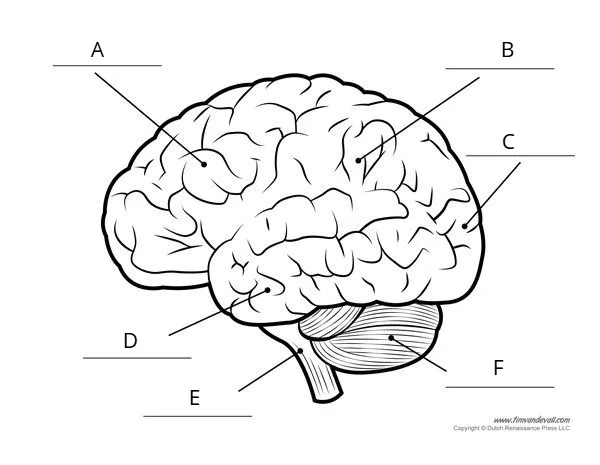 | Frontal Lobe – Strategic thinking |
What is the structure of the brain in B and what is one of its functions? | Parietal Lobe – Touch perception |
What is the structure of the brain in C and what is one of its functions? | Occipital Lobe – Visual pattern recognition |
What is the structure of the brain in D and what is one of its functions? | Temporal Lobe – Hearing and language decoding |
What is the structure of the brain in E and what is one of its functions? | Brain Stem – Controls breathing and heart rate |
What is the structure of the brain in F and what is one of its functions? | Cerebellum – Balance and motor coordination |