Anatomical planes
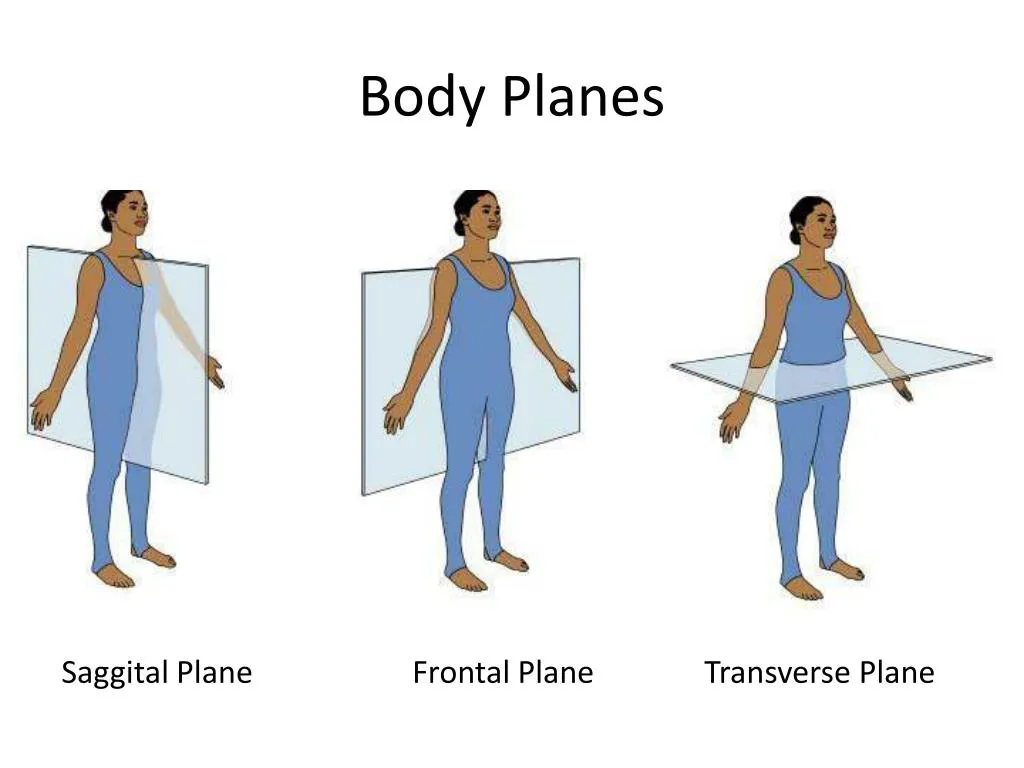
Hypothetical planes used to describe the location of structures, and direction of movement.
Saggital plane: Divides the body into right and left sections (can be uneven). Joint action flexion and extension.
Frontal plane: Divides the body into front and back. Joint action abduction, adduction, lateral flexion.
Transverse plane: Divides the body into top and bottom. Joint action rotation, horizontal flexion and extension.
| Term | Definition |
|---|---|
Anatomical planes | Hypothetical planes used to describe the location of structures, and direction of movement.
Saggital plane: Divides the body into right and left sections (can be uneven). Joint action flexion and extension.
Frontal plane: Divides the body into front and back. Joint action abduction, adduction, lateral flexion.
Transverse plane: Divides the body into top and bottom. Joint action rotation, horizontal flexion and extension. |
Anterior | Describes the location of a bodily segment towards the front of the body. |
Posterior | Opposite of anterior, describes location of a bodily segment towards the rear of the body. |
Inferior | Bodily segment below that of another. |
Superior | Bodily segment above that of another. |
Medial | Bodily segment that is closer or moves towards the midline of the body. |
Lateral | Bodily segment towards the outside of mother or moves towards the outside body. |
Proximal | Location of bodily segment being closer to the center point of the body than another. |
Distal | Location of an object being further from the body's center point than another. |
Supination | Bodily segment facing upwards. |
Pronation | Bodily segment facing downwards. |
Superficial | Close to the surface of the skin. |
Deep | Away from the surface of the skin. |
Unilateral | Uni means one, lateral means side.
An action taking place on a single side of the body |
Bilateral | Bi means two, lateral means side.
Action taking place on two or both sides of the body. |
Contralateral | An action taking place on the opposite side. |
Ipsilateral | Action taking place on a single side of the body. |
Flexion | Reducing the joint angle, normally involves bending actions.
On horizontal plane its called horizontal flexion |
Extension | Increasing the joint action, normally involves a straightening actions.
On horizontal plane its called horizontal extension |
Lateral flexion | Involves bending to the side (laterally) |
Adduction | To move towards the mid/centre line of the body. |
Abduction | To move away from the mid/centre line of the body. |
Rotation | Two or more bones moving around each other in a circular motion. |
Circumduction | Circular movement, usually the movement at the proximal end of the limb is smaller than the distal end. |
Elevation | To lift in a vertical plane |
Depression | To pull down in a vertical plane |
Plantarflextion | To point the toes, extending the ankle |
Dorsiflexion | To pull the toes up, flexing the ankle. |
Pronation | Movement of the forearm which turns the palm of the hand to face downwards. Or can occur at the ankle, making the knee move medially and the sole of the foot to face laterally. |
Supination | Movement of the forearm which causes the palm of the hand to face upwards. When occurring at the ankle knee moves laterally and sole of the foot faces medially. |
Inversion | Combination of plantar flexion and supination of the ankle, toes point exposing the sole of the foot medially. |
Eversion | Combination of plantar flexion and pronation of the ankle, where the toes are pointed the sole of the foot face laterally. |
Protraction | Occurs when a limb or body segment is moved anteriorly (jaw and shoulders). |
Retraction | When a limb or body segment is moved posteriorly (jaw and shoulders). |