| Term | Definition |
|---|---|
Integral proteins | for transport |
Peripheral proteins | receive and send chemical signals |
Carbohydrates | attachment to surfaces or other cells
(has GLYCOlipids and GLYCOprotins) |
Glycolipids | carbohydrates attached to phospholipids |
Glycoproteins | carbohydrates attached to integral proteins |
Cholesterol | holds the membrane together while promoting flexibility
|
Solute | dissolved particles |
Solvent | fluid/gas in which particles are dissolved |
Simple Diffusion | (passive)-solute particles from a region of high concentration to a region of low |
Hypertonic | describes a solution that possesses a higher solute concentration than another |
Hypotonic | describes a solution that possesses a lower solute concentration than another |
Isotonic | describes a solution that possesses an equal solute concentration to another |
Osmosis | (passive) movement of water molecules from low solute
concentration (high water concentration) to high solute concentration (low water concentration) |
Crenation | shriveling of cell due to excessive water loss
(animal cell)-hypertonic mixture |
Plasmolysis | cell membrane pulls inwardly away from cell wall due to excessive water loss
(plant cell)-hypertonic mixture |
Lysis | bursting of cell membrane due to excessive water intake
(animal cells) -hypotonic mixture |
Turgid | swell of cell due to excessive water intake
(plant cells favorite) -hypotonic mixture |
Normal | No net movement or osmosis-water move in both directions
(animals cells favorite) -isotonic mixture |
Flaccid | No net movement or osmosis-water move in both directions
(plant cells) -isotonic mixture |
Facilitated Diffusion | (passive) large solute particles from a region of high concentration to a region of low through an integral protein.
|
channel proteins | -Facilitated Diffusion- proteins always open 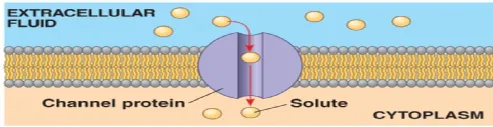 |
carrier proteins | -Facilitated Diffusion-protein change shape 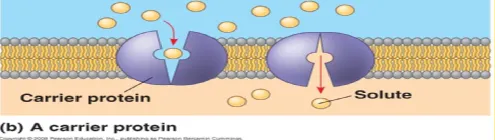 |
Passive Prosses | No ATP required
-simple diffusion
-osmosis
-facilitated diffusion |
Active Prosses | ATP(energy) required
-active transport
-endocytosis
-exocytosis |
Active Transport | (active) movement of solute particles from low solute concentration to high solute concentration through an integral protein |
Proton Pumps | (active transport) Protons (hydrogen ions) are pumped out through a cell membrane-- Low to High concentration |
Cotransport | (active transport is followed by) only pass through a cell membrane when accompanied by another solute |
Endocytosis | (active) movement of solutes into a cell through the formation of vesicles
3 types: Phagocytosis, Pinocytosis, and receptor-mediated endocytosis |
Phagocytosis | engulfment of large substances into a cell through vesicle formation
"cellular eating" "nom nom" (endocytosis) |
Pinocytosis | intake of small solutes and water through the formation of vesicles from invaginations that form along the cell membrane
"cellular drinking" (endocytosis) |
Receptor-mediated endocytosis | intake of specific solutes into a cell through vesicle formation
(endocytosis)  |
Clathrin | protein that surrounds the vesical (receptor) in Receptor-mediated endocytosis surrounds the Y |
Y | receptor surrounded by clathrin protein in receptor-mediated endocytosis |
Triangle | the solute the Y collects specifically in receptor-mediated endocytosis |
Exocytosis | movement of solutes out of a cell through the formation of vesicles
(active) 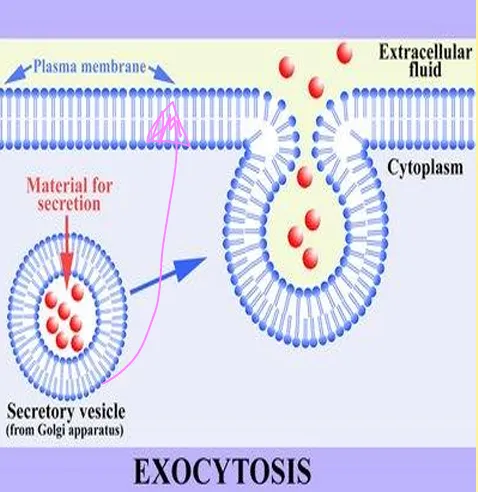 |
Secretory vesicles | vesicles used in exocytosis, from the Golgi for the release of cellular
waste out of a cell or of for cellular products that needed to be shipped to another location |