Variation
Individual members of a species vary in ways that affect their ability to compete for resources, some variation is heritable
| Term | Definition |
|---|---|
Variation | Individual members of a species vary in ways that affect their ability to compete for resources, some variation is heritable |
Selection | Differences in survival and reproductive success leads to over representation of successful forms in next generation |
Evolution | Selection over generations leads to change in the composition of the population, differential individual survival/ reproductive ability, can be from an inherited mutation |
Mendel's Principle of Segregation (Gregor Mendel, 1866) | Pea plants, mechanisms that give rise to variation, traced traits through several generations, cross bred pure generation, all dominant trait. Monohybrid cross, next generation different ratio consistently 3/1, dominant/recessive traits.
Each plant has two “factors” (genes) for any given characteristic, receive these “factors” from their parents, reproduces it only passes one of its two “factors” to its offspring |
Mendel's Principle of Dominance | Factors for certain traits seem to mask or hide the others when both are present in hybrids, always displayed when present are called “dominant, hidden called recessive only seen in purebreds |
Mendel's Principle of Independent Assortment | Inheritance of one gene is not affected by the inheritance of another gene, principle is violated in various circumstances |
Chromosomes | 20,000-25,000 human protein- coding genes are in 46 chromosomes (23 pairs). Two copies for each gene, passing these on is a random process |
Hereditary Transmission | A single pair of genes, one from each parent, determines a particular inherited characteristic, alleles the same homozygous, different heterozygous. Phenotype expression 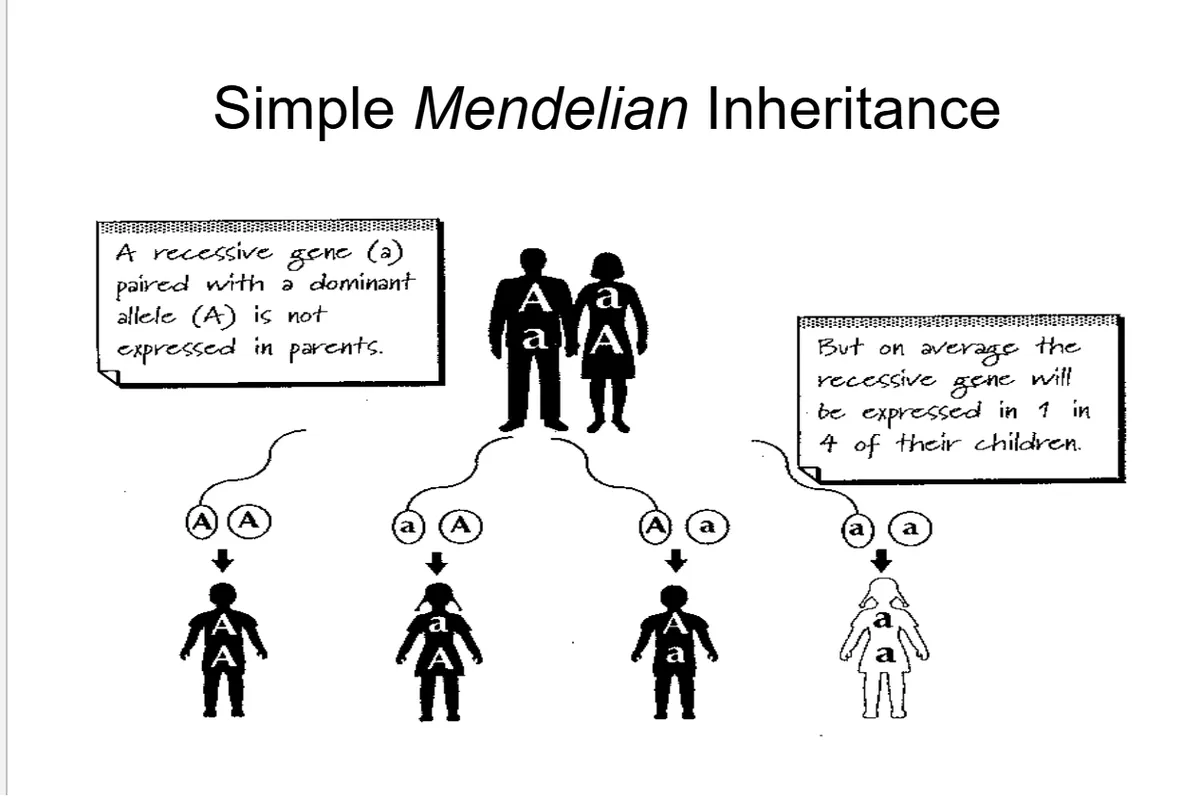 |
Human Diseases that follow Mendel’s laws | Huntington disease, knowing this genetic screen programs are available, however, exceptions in humans are prominent, not many follow laws |
Complex Disorders | schizophrenia, autism, depression, epilepsy, Alzheimer's and Parkinson's, Multifactorial” often used to describe the architecture of just the genetic component of a ‘disorder’ |
Polygenic Inheritance of Disorders | More than one gene is believed to contribute to disorder, aggregate in families 'proximity' risk increased but aren't segregated in Medelian inheritance, human skin colour is an example |
Unfounded Assumptions | Assumption that the disorder in question represents a single, biologically valid category, If the clinical diagnosis of a
specific disorder is based on superficial criteria, then this assumption is unlikely to hold |
Intellectual Disability | Common condition with very high underlying genetic heterogeneity, arises as part of a distinct and discernible genetic
syndrome, some other characteristic such as facial morphology. No physical would lump different types together |
Other Mental Health Disorders | Usually no expression to allow us to differentiate between different variants, defined on the basis of surface criteria: the patient's behavior and reports of their subjective experience. Symptom profiles do not differentiate underlying causes, sharing no diagnostic criteria |
Genome Wide Association Studies | What conditions are more prevalent in certain gene variants |
Autism and schizophrenia | Rare (high penetrance (large effect)) mutations appear to play the predominant role in the inheritance of such disorders and expression of it, can manifest in many different ways (same gene variant, different expression (autism, bipolar)) |
Sex Chromosomes- X linked | Humans possess 44 'autosomal chromosomes', and 2 'sex-linked
chromosomes’, designated as X and Y. Females carry X X males carry X Y. Males are susceptible to a number of disorders that do not affect females (e.g. red/green colour blindness) because If a female has a harmful recessive gene on one chromosome, she usually has a dominant 'normal' gene on the other chromosome to counteract it, so the recessive gene is not expressed. |
Haemophilia- X linked | A blood clotting disorder carried a recessive gene on one of her X
chromosomes. female descendants did not show the disease because the defective gene was paired with a dominant non-defective gene, male descendants who inherited
the defective X chromosome suffered from the disease, and passed it on to their daughters, who in turn then passed it down to their sons |
Fragile X syndrome (FXS)- X linked | inherited in an X-linked dominant pattern. one copy of the altered gene in each cell is sufficient to cause the condition, males experience more severe symptoms, by mutations in FMR1 gene, protein plays a role in the development of synapses.
Delayed development of speech and language, ADD, anxiety and 1/3 ASD most common single gene cause of autism, responsible for 2% to 6% of all cases |
FXS Incomplete Penetrance of Autism | 30% of males with FXS have full autism, significant heterogeneity, both cognitively and behaviorally, Mutations that control the growth and maturation of cells and synapses increase risk for autism, but are not strict determinants of autism, also consider environmental influences gene expression |