Definition 2.2.3 (Convergence of a Sequence)
A sequence (an) converges to a real number a if, for every positive number epsilon, there exists N in the natural numbers such that whenever n>=N it follows that |an-a|<epsilon
| Term | Definition |
|---|---|
Definition 2.2.3 (Convergence of a Sequence) | A sequence (an) converges to a real number a if, for every positive number epsilon, there exists N in the natural numbers such that whenever n>=N it follows that |an-a|<epsilon |
Definition 2.3.1 (Bounded Sequence) | A sequence (xn) is bounded if there exists a number M>0 such that |xn|<=M for all n in the natural numbers |
Theorem 2.3.2 | Every convergent sequence is bounded |
Theorem 2.3.3 (Algebraic Limit Theorem) | Let lim(an)=a and lim(bn)=b. Then,
(i) lim(can)=ca for all c in the real #s
(ii) lim(an+bn)=a+b
(iii) lim(anbn)=ab
(iv) lim(an/bn)=a/b when b not =0 |
Theorem 2.3.4 (order limit theorem) | Assume lim(an)=a and lim(bn)=b
(i) if an>=0 for all n in nat. #s, then a>=0
(ii) if an<=bn for all n in nat. #s, then a<=b
(iii) if there exists c in real #s for which c<=bn for all n in nat. #s, then c<=b. Similarly, if an<=c for all n in nat. #s, then a<=c |
Definition 2.4.1 (monotone sequence) | A sequence (an) is increasing if an<=an+1 for all n in nat. #s and decreasing if an>=an+1 for all n in nat. #s. A sequence is monotone if it is either increasing or decreasing |
Theorem 2.4.2 (monotone convergence theorem) | If a sequence is monotone and bounded, then it converges |
Definition 2.4.3 (convergence of a series) | 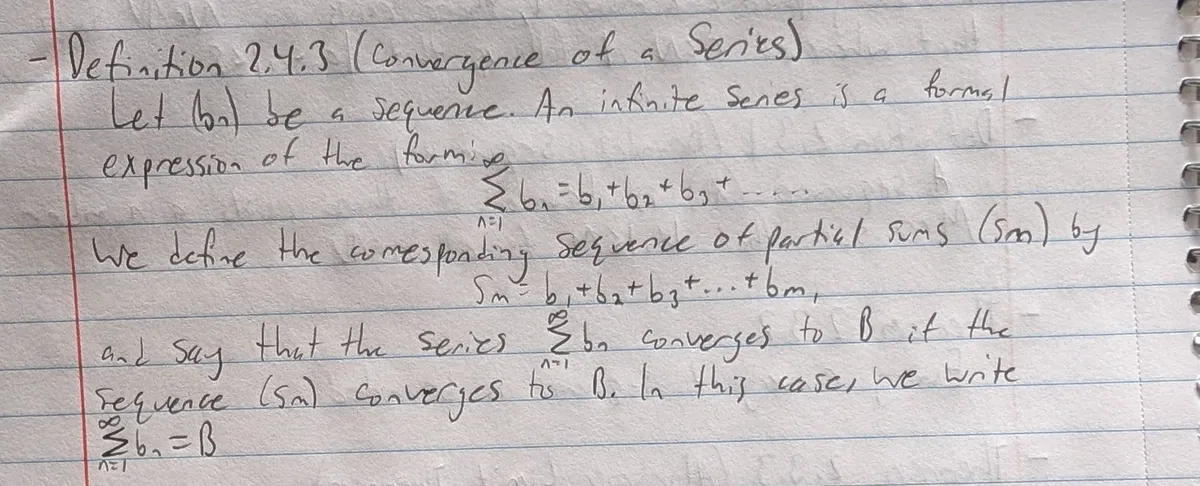 |
Theorem 2.4.6 (Cauchy condensation test) | 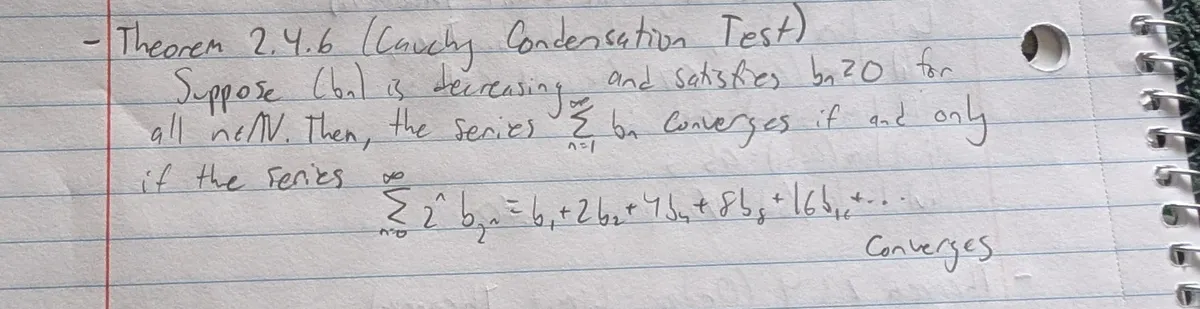 |
Definition 2.5.1 | Let (an) be a sequence of real numbers, and let n1<n2<n3<... be an increasing sequence of natural numbers. Then the sequence (an1, an2, an3,...) is called a subsequence of (an) and is denoted (ank), where k in the nat. #s indexes the subsequence. |
Theorem 2.5.2 | Subsequences of a convergent sequence converge to the same limit as the original sequence |
Theorem 2.5.5 (Bolzano-Weiestrass Theorem) | Every bounded sequence contains a convergent subsequence |
Definition 2.6.1 (Cauchy sequence) | A sequence (an) is called a cauchy sequence if, for every epsilon>0, there exists an N in the nat. #s such that whenever m,n>=N it follows that |an-am|<epsilon |
Lemma 2.6.3 | Cauchy sequences are bounded |
Theorem 2.6.4 (cauchy criterion) | A sequence converges is and only if it is a Cauchy sequence |