What is the difference between macrofossils and microfossils?
Macrofossils sizes range from 0.5mm to tree trunks (median size is 0,5-2,0mm). Microfossil is too small to see without using special equipment.
| Term | Definition |
|---|---|
What is the difference between macrofossils and microfossils? | Macrofossils sizes range from 0.5mm to tree trunks (median size is 0,5-2,0mm). Microfossil is too small to see without using special equipment. |
What are phytoliths? | A phytolith is a robust microscopic particles that occur in many plants |
How to extract a phytolith from sediments? | Deflocculation (to separate them from clay particles).
Heavy-liquid floatation (liquid that has a specific density that allows the phytolith to float to the top).
Centrifuging (spinning things that make things go to the bottom). |
What use are phytoliths to archaeology? | Phytoliths can be found in cooking residues, ritual offerings, grinding stones etc. This helps to interpretate human activity and the nature of past environments. Source of information where plant macrofossils and pollen come from, do not preserve. |
What are diatoms? | Aquatic, single-celled or colonial algae (phytolith). One of the most common types is phytoplankton. It is a popular tool for monitoring present day environmental conditions (water quality). In archaeology identifying marine transgessions. |
What is Palynology? | Study of pollen and spores -> used for reconstructing past environments. |
Why are Pollen useful? | They are produced in large quantities, good preservation and identifiable to their source plant. |
What are spores? | Reproductive structures adapted for dispersal and surviving unfavourable conditions. Produced by non-seed bearing plants (mosses and fungi), can be produced by meiosis or mitosis. |
What are coprophilous fungal spores? | Fungal spores that grow on animal dung (poop). They can indicate presence/change of large herbivores and animal husbandry |
How does pollen sampling work? | 1. Site selection -> obtain uncontaminated + representative sediment
2. Storage -> waterlogged sediments, store around 1-3 degrees celcius to reduce drying and microbial activity.
3. Preparation sequence -> subsample, disperse, sieve, chemical treatment, dehydrate, stain, mount. |
What are important techniques with pollen sampling and preparation? | 1. KOH: removes humic/fulvic acids and breaks down sediment.
2. HF: removes silicate/minerogenic material.
3. HCI: removes calcium carbonate
4. Acetolysis/oxidation: removes cellulose and lignin.
5. Alcohol: dehydration.
6. Stain: can improve surface detail.
7. Mounting medium: allows microscopy. |
What survives of the pollen? | The important part surviving is the Exine (outer pollen wall), mainly made of sporopollenin, which is highly resistant to chemical treatment. |
How does pollen identification work? | 1. Size
2. Apertures
3. Shape
4. Surface |
What are the apertures with Pollen identification? | 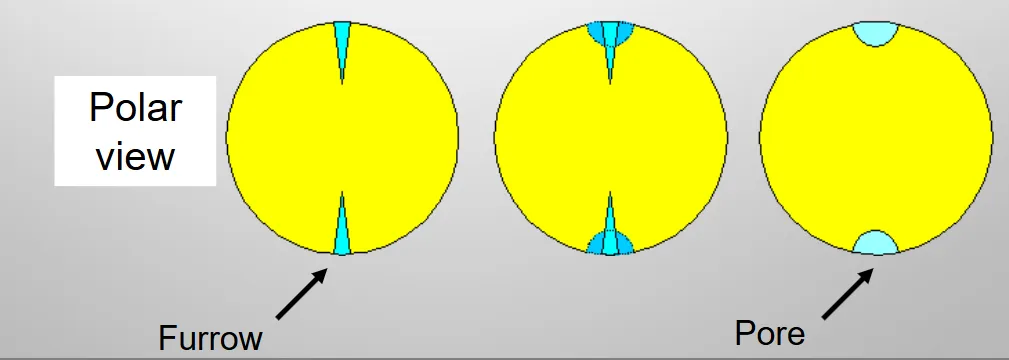 |
Psilate | 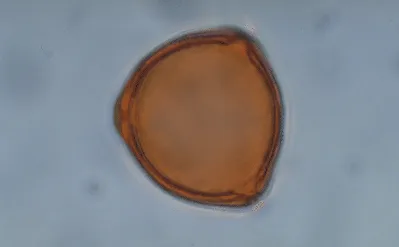 |