Common law liability
develops through case decisions generally arising due to breach of contract, negligence, and fraud.
| Term | Definition |
|---|---|
Common law liability | develops through case decisions generally arising due to breach of contract, negligence, and fraud. |
Statutory liability | develops when a governmental unit (e.g., a state or the federal government) passes laws and regulations that either implicitly or explicitly impose potential liability upon CPAs. |
breach of contract | The potential for liability occurs when there is a and when damages result due to a failure of one or both parties to a contract to perform in accordance with the contract’s provisions |
Negligence | also referred to as ordinary or simple negligence, is a violation of a legal duty to exercise a degree of care that an ordinary prudent person would exercise under similar circumstances. For the CPA, negligence is failure to perform a duty in accordance with applicable standards. |
Gross negligence | is the lack of even slight care, indicative of a reckless disregard for one’s professional responsibilities. Substantial failures on the part of an auditor to comply with auditing standards might be interpreted as gross negligence. |
Fraud | is defined as misrepresentation by a person of a material fact, known by that person to be untrue or made with reckless indifference as to whether the fact is true, with the intention of deceiving the other party and with the result that the other party is injured. |
Constructive fraud | differs from fraud as defined above in that constructive fraud does not involve a misrepresentation with intent to deceive. Gross negligence on the part of an auditor has been interpreted by the courts as constructive fraud. |
The Securities Act of 1933 | which applies to initial stock offerings, imposes liability on CPAs for their audit work relating to financial statements used to register the securities for sale. |
The Securities Exchange Act of 1934 i | imposes liability on CPAs for their work on the financial statements included with a company’s ongoing reports to the Securities and Exchange Commission. |
due professional care | Exercising is a complete defense against any charge of improper conduct |
in general, to establish CPA liability, a client must prove the following elements: | Duty. The CPAs accepted a duty of due professional care to exercise skill, prudence, and diligence.4
Breach of duty. The CPAs breached their duty of due professional care through negligent performance.
Losses (damages). The client suffered losses.
Causation (proximate cause). The damages were caused by the CPAs’ negligent performance. |
Causation | exists when damage to another is directly attributable to a wrongdoer’s act. |
contributory negligence | Demonstrating the client’s is one means of showing that the auditors’ negligence was not the cause (or sole cause) of the client’s loss. In jurisdictions (e.g., states) that follow pure doctrines, the auditors may entirely eliminate their liability to the client by establishing the defense of by the client. However, very few states follow the doctrine of pure . |
Comparative negligence/proportionate liability | permits juries to examine the issue of causation and assess a percentage figure of fault to the CPAs, any other defendants, and the client. This system permits the allocation of damages among the parties based on the extent to which each is at fault |
Joint and several liability | represents another approach to liability that in general benefits a plaintiff’s litigation against multiple defendants. Under joint and several liability, the defendants are liable for their pro rata share of any damages awarded (as is the case with proportionate liability), but they also may be held liable for damages of other defendants who prove to be unable to pay their share of the damages. Using our earlier example in which the CPAs were found to be 50 percent responsible for losses, if the management consultants did not have the ability to pay all of the losses attributed to them, the auditors as joint defendants would be required to make up the difference. |
Ultramares v. Touche & Co., 174 N.E. 441 (N.Y. 1931) | The most widely cited common law precedent stems from the landmark case . In this case, the defendant CPAs issued an unqualified opinion on the balance sheet of a company engaged in the importation and sale of rubber. On the basis of the CPAs’ opinion, Ultramares made several loans to the company. Shortly thereafter, the company was declared bankrupt, and Ultramares sued the CPAs for ordinary negligence. The New York Court of Appeals (the state’s highest court) ruled that the CPAs should be held liable for ordinary negligence only to their client and any third party (beneficiary) specifically identified as a user of the CPAs’ report. The court went on to indicate that the auditors should be held liable to unidentified third-party users of the audit report for gross negligence or fraud. In the Ultramares case, the audit was performed “primarily for the benefit” of the client; Ultramares was not specifically identified as a user of the audit report. Therefore, to recover its losses, Ultramares would have been required to prove that the CPAs were grossly negligent in performing their audit. The case eventually was settled out of court, with no determination of whether the auditors had been grossly negligent. |
Credit Alliance Corp. v. Arthur Andersen & Co., 65 N.Y.2d 536 (1985)/ near privity | he New York Court of Appeals upheld and interpreted the Ultramares precedent in the case of . The court stated that before auditors may be held liable for ordinary negligence to a third party, they must have been aware that the financial statements were to be used for a particular purpose by a known party or parties, and must have taken some action to indicate that knowledge. Because the auditors are not technically contracted with the third party, this approach is often referred to as . |
the American Law Institute’s (ALI’s)
Second Restatement of the Law of Torts (Restatement) | The principle of auditor liability for ordinary negligence to third parties is expanded by . Restatements of law are compilations of the majority view of the common law of the states on various topics such as contracts and torts and are meant to serve as guides for judges when they are issuing opinions in which there are common law issues. The Restatement approach to third-party liability, also referred to as the foreseen third-party approach, expands the auditors’ liability for ordinary negligence to include third parties who are foreseen users of the audited financial statements. The specific identity of foreseen users need not be known to the CPAs. |
1983 New Jersey Supreme Court case Rosenblum v. Adler (93 N.J. 324), | This approach was based originally on the which rejected the approaches arising out of Ultramares and the Second Restatement of Torts and established a very different standard. In this case, the defendant CPAs issued an unqualified report on the financial statements of Giant Stores Corporation, which showed the corporation to be profitable. In reliance upon these statements, Rosenblum sold a catalog showroom business to Giant in exchange for shares of Giant’s stock. Shortly afterward, Giant filed for bankruptcy and the stock became worthless. Rosenblum sued Giant’s CPAs, alleging ordinary negligence. The case was dismissed by the trial court on the premise that the CPAs were not liable to unidentified third parties for ordinary negligence. However, the New Jersey Supreme Court reversed the lower court, finding that CPAs can be held liable for ordinary negligence to any third party the auditors could “reasonably foresee” as recipients of the statements for routine business purposes. While the approach has the potential to increase auditor liability, few states have elected to follow it; indeed, New Jersey subsequently overturned its findings and moved towards the Ultramares approach. |
Summary of Third-Party Common Law Liability for Ordinary Negligence | 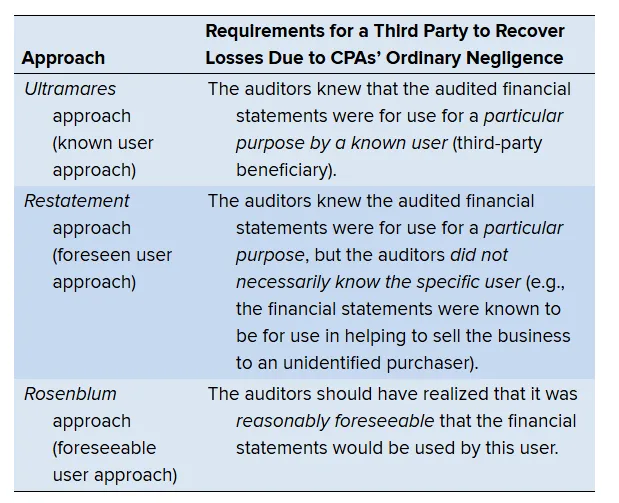 |
Securities Act of 1933 (the 1933 Act) | requires a company intending to offer its securities for sale to the public to first file a registration statement.7 This registration statement, filed with the SEC, includes audited financial statements and numerous other disclosures. Under the 1933 Act, both the company filing the registration statement and its auditors may be held liable to purchasers of the securities in the event that the registration statement is found to contain material misstatements or omissions.8 The wording of Section 11(a) of the act provides as follows:
In case any part of the registration statement, when such part became effective, contained an untrue statement of a material fact or omitted to state a material fact required to be stated therein or necessary to make the statements therein not misleading, any person acquiring such security (unless it is proved that at the time of such acquisition he knew of such untruth or omission) may . . . sue. |
Plaintiffs’ Rights under the 1933 Act | The Act offers protection to only a limited group of investors—those who initially purchase a security offered for sale under the registration statement.9 For those investors, however, the 1933 Act shifts much of the burden of proof from the plaintiff to the defendant. The plaintiffs (security purchasers) need only prove that
they sustained a loss and
the registration statement was misleading.
They need not prove10 that they relied upon the registration or that the auditors were negligent. |
Auditors’ Defenses under the 1933 Act | If auditors are to avoid liability for the plaintiffs’ losses, they generally must affirmatively prove that
they conducted the audit with due diligence,
the plaintiffs’ losses were not caused by misstated financial statements,
the plaintiffs knew of the financial statement misstatement when the securities were purchased, or
the statute of limitations—one year after the discovery of the misstatement, but no more than three years after the security was first offered to the public—had expired. |
the Securities Exchange Act of 1934 | requires all companies under SEC jurisdiction to file annual audited and quarterly reviewed financial statements with the SEC.11 The act also creates potential liability for the filing company and its auditors to anyone who buys or sells the company’s securities in the event that these annual statements are found to be misleading. While the 1933 Act creates liability only to those investors involved in the initial distribution of a public offering, the 1934 Act expands that liability to subsequent purchasers and sellers of the stock. The two primary liability Sections of the act are Sections 10 and 18. |
Section 10, with Rule 10b-5 promulgated by the SEC under Section 10(b) of the act, reads as follows: (SEC 1934) | It shall be unlawful for any person, directly or indirectly, by the use of any means or instrumentality of interstate commerce or of the mails, or of any national securities exchange . . .
to employ any device, scheme, or artifice to defraud,
to make any untrue statement of a material fact or to omit to state a material fact necessary in order to make the statements . . . not misleading, or
to engage in any act, practice, or course of business which operates or would operate as a fraud or deceit upon any person, in connection with the purchase or sale of any security. |
Section 18(a) of the 1934 Act, which relates to misstated financial statements, provides for liability to [emphasis added] | any person (not knowing that such statement was false or misleading) who, in reliance upon such statement, shall have purchased or sold a security at a price which was affected by such statement, for damages by such reliance, unless the person sued shall prove that he acted in good faith and had no knowledge that such statement was false or misleading. |
Plaintiffs’ Rights under the 1934 Act | The 1934 Act offers protection to both original and subsequent purchasers and sellers of securities. Under both Section 10 and Section 18, the plaintiffs (security purchasers and sellers) must prove that
they sustained losses,
the financial statements were misleading, and
they relied upon the financial statements. |
Ernst & Ernst v. Hochfelder, 425 U.S. 185 (1976), | require that the plaintiffs prove scienter (intent to deceive, manipulate, or defraud) on the part of the auditors. |
The Private Securities Litigation Reform Act of 1995 | was designed to limit frivolous securities lawsuits. Prior to passage of this act, plaintiffs could proceed with minimal evidence of scienter and then use pretrial discovery to seek further proof. In Tellabs, Inc. v. Makor, 551 U.S. 308 (2007), the Supreme Court defined the standard that the plaintiff should meet in order to proceed with a case alleging securities fraud litigation. The court concluded that a complaint must show “cogent and compelling” evidence of scienter. |
scienter | (intent to deceive, manipulate, or defraud) on the part of the auditors. |
Auditors’ Defenses under the 1934 Act | Under Section 18, the auditors may avoid liability by proving “good faith,” which they will normally be able to establish unless they have been guilty of gross negligence or fraud. Under Section 10, the auditors will attempt to prove that there was no scienter. That is, the auditors did not perform the audit with the intent to deceive, manipulate, or defraud. In addition, to avoid liability for the plaintiffs’ losses under either Section 10 or 18, the auditors may rely on causation—that the losses experienced by the plaintiffs were caused by factors other than the auditors’ behavior. |
Proportionate Liability under the 1934 Act | Under Section 18, the auditors may avoid liability by proving “good faith,” which they will normally be able to establish unless they have been guilty of gross negligence or fraud. Under Section 10, the auditors will attempt to prove that there was no scienter. That is, the auditors did not perform the audit with the intent to deceive, manipulate, or defraud. In addition, to avoid liability for the plaintiffs’ losses under either Section 10 or 18, the auditors may rely on causation—that the losses experienced by the plaintiffs were caused by factors other than the auditors’ behavior.
Congress passed the Securities Litigation Uniform Standards Act in 1998 to establish uniform standards for bringing class action securities suits in both state and federal courts. Under these standards, plaintiffs and their lawyers must follow certain certification procedures and there are consolidation rules with regard to the trial of these cases. |
Comparison of the 1933 and 1934 Acts | The 1933 Act offers recourse only to individuals acquiring the initial distribution of securities, whereas the 1934 Act offers recourse to any person buying or selling the securities at a later date.
both of the federal securities acts shift significant burdens of proof from the plaintiffs to the defendants. However, some differences exist between the defendant’s burden under the 1933 Act and the 1934 Act. Under the 1933 Act, plaintiffs need not prove reliance upon the audited financial statements. The 1934 Act, however, generally requires plaintiffs to prove that they relied upon the misleading statements.
Next, both acts place the burden of proving adequate performance on the defendants. The 1933 Act requires the auditors to prove “due diligence”; if they were ordinarily negligent, they will not be able to establish this defense. The 1934 Act is more lenient in that Section 10 requires the existence of scienter, while Section 18 requires auditors to prove that they acted in good faith. Because it requires the existence of gross negligence or fraud, the “good faith” defense is considerably easier to establish than is “due diligence.”
|
Summary of Auditor Civil Liability under the 1933 Securities Act (Section 11) and the 1934 Securities Exchange Act (Sections 10 and 18) | 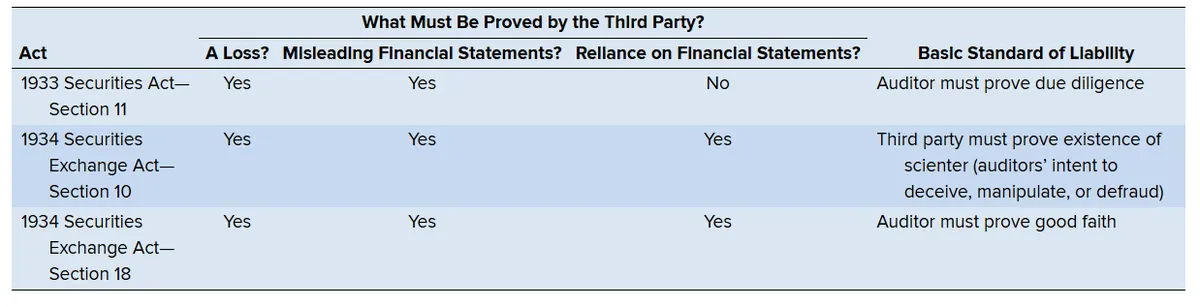 |
provisions for criminal charges (SEC 1933, 1934) | Most directly relevant are Section 24 of the Securities Act of 1933, Section 1106 of the Sarbanes-Oxley Act, and Section 32(a) of the Securities Exchange Act of 1934. In addition, in extreme cases, CPAs can be prosecuted under the criminal provisions of RICO, where it can be shown that the CPAs actually participated in the management or operation of a company that is indicted under RICO. |
SEC Rule of Practice 102(e), actions under which are often referred to as “102(e)” or “2e” proceedings, gives the SEC the power of suspension and disbarment, and has the following wording: |
Page 144
The Commission may censure a person or deny, temporarily or permanently, the privilege of appearing or practicing before it in any way to any person who is found by the Commission . . .
not to possess the requisite qualifications to represent others, or
to be lacking in character or integrity or to have engaged in unethical or improper professional conduct. |
compilation of financial statements | The term refers to an accounting service performed by CPAs with the objective of assisting management in presenting financial information in the form of financial statements without obtaining or providing any assurance on those statements. |