| Term | Definition |
|---|---|
What is Deoxyribonucleic acid (DNA)? | A polymer of deoxyribonucleotides. |
What bases are found in DNA? | -Adenine
-Guanine
-Cytosine
-Thymine |
What bases found in RNA? | -Adenine
-Guanine
-Cytosine
-Uracil |
What type of bond links the two polynucleotide chains to form DNA? | Phosphodiester bond. 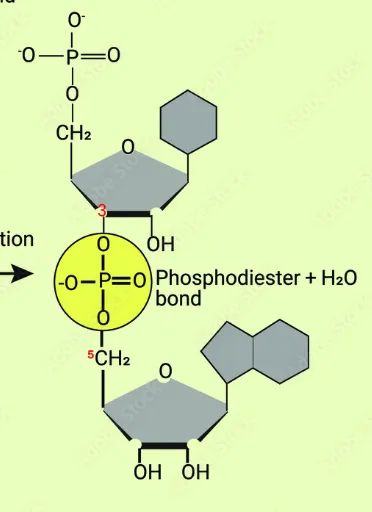 |
What kind of chemical bond is phosphodiester bonds? | It's a covalent bond. |
What does a phosphodiester bond consist of? | A phosphate forms an ester linkage between 3-hydroxyl of one sugar and the 5-hydroxyl of the other sugar. |
What is the complimentary pairing for the DNA bases? | Adenine goes with thymine
Guanine goes with cytosine |
Which complimentary base pair can be represented with 2 hydrogen bonds? | Adenine and thymine 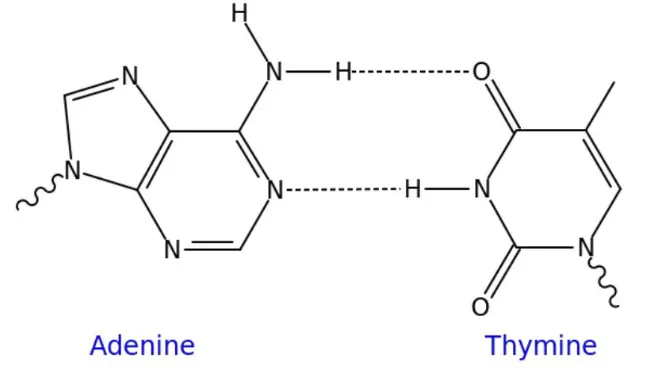 |
Which complimentary base pair can be represented with 3 hydrogen bonds? | Cytosine and guanine 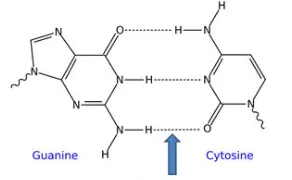 |
What does it mean when DNA strands are described to have antiparallel orientation? | The two stands run in opposite direction with respect to the orientation of their sugars.
So one side runs from 5' to 3' and the other side of the strands runs 3' and 5'. 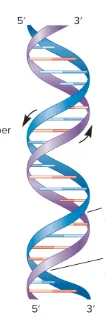 |
What is does it mean when saying DNA bases have complementary pairing? | Simply each base has a specific partner they will always match up with. |
What is supercoiling? | A property of DNA that allows the DNA helix to coil onto itself. |
What type of supercoiling does bacteria have? | Generally negative supercoiling. |
What does negative supercoiling imply? | The supercoiling is decreasing the number of base pairs per turn. |
What is the purpose of supercoiling for DNA? | -Makes DNA easier to seperate
-Helps compress DNA to fit and reduce strain in the molecule. |
What does positive supercoiling imply? | The supercoiling increases the number of base pairs per turn. |
How are amino acids different from each other? | Their side chains. |
What is a peptide bond? | The carbon-nitrogen bonds linking amino acids together. 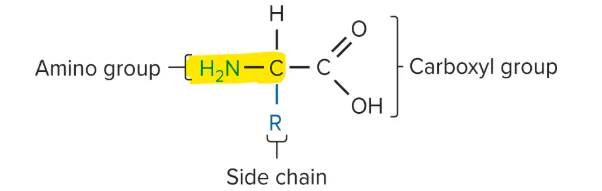 |
What is another name for the amino group in the polypeptide? | N terminus. |
What is another name for the carboxyl found in the polypeptide? | C terminus. |
What is primary structure of a protein? | A linear chain of amino acids linked through peptide bonds. 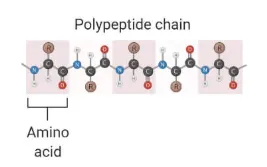 |
What is secondary structure of proteins? | 2 amino acids chains bond together through hydrogen bonds to form either alpha-helix or beta-pleated formations. 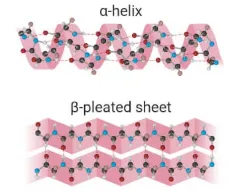 |
What is tertiary structure of proteins? | The chains through multiple type of bonds form into a 3D structure. This will form a polypeptide. 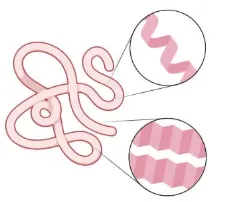 |
What is quaternary structure for proteins? | When 2 or more polypeptides interact to form one collective functional protein. 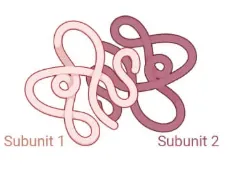 |
DNA replication can be describe as a _____ and ______ process. | Very accurate and semiconservative process. |
What does it mean when DNA replication is described as "semiconservative"? | Both of the 2 DNA molecules contain 1 old strand and 1 new strand. |
In bacteria, replication rates approach ____ base pairs per second. | 1000 |
Where does replication of chromosomal DNA begin? | The origin of replication (oriC). |
What two proteins are helpful in the replication of DNA? | DnaA and IHF |
What is DnaA? | The initiator protein. |
DnaA will bind to a ____-bp sequence that is repeated ____ times in oriC. | 9bp; 12 times. |
What is IHF? | The nucleoid-associated protein. |
What is the separation at the origin referred to as? 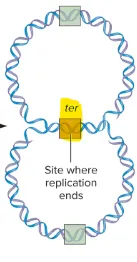 | Replication bubble. |
What is the replication fork? | The place at which the parental DNA helix is unwound, and the two strands are replicated. |
What is the replicon? | The portion of the genome that contains an origin and is replicated as a unit. |
E. coli is a ___-bp region. | 260 |
E. coli requires at least ____ proteins for DNA replication to form a replisome at the replication fork. | 12 proteins for a replisome. |
What is a replisome? | A large protein complex that copes the DNA double helix to form 2 daughter chromosomes. |
What ezyme is required to seperature parental DNA strands beyond the DUE? | Helicase. |
What is DUE? | The DNA unwinding element, adjacent to oriC. |
How does helicase work? | It will encircle a DNA strand and force the replisomes to move while using ATP. 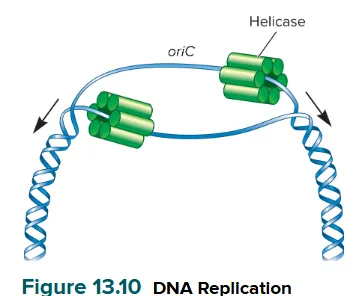 |
What do DNA polymerases do? | Catalyze DNA synthesis. |
DNA synthesis occurs in what direction? | 5' to 3'. |
What nucleotide is added during DNA synthesis? | Deoxyribonucleoside triphosphate (dNTP). |
What does DNA polymerase require? | -A template
-3'-OH group from the growing chain |
What is a template? | A parental DNA (or a RNA strand) that specifices the base sequence of a new complementary strand of DNA/RNA. |
What does primase do? | It's an enzyme that will synthesize short 10 base RNA molecules complementary to the template. |
What is primosome? | The multiprotein complex that includes helicase and primase. |
How many DNA polymerases are found in E. coli? | 5 DNA polymerases. |
Which DNA polymerase is a major component in DNA replication and which polymerase assists in the process? | Polymerase 3 is critical; Polymerase 1 assists. |
What is a clamp for DNA synthesis? | A donut-shape protein that attaches to each polymerase and stabilizes the enzyme on the DNA template. 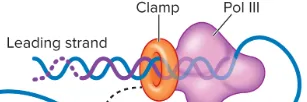 |
What component mediates the polymerase attachments to the primosome? | Clamp loader complex (CLC). 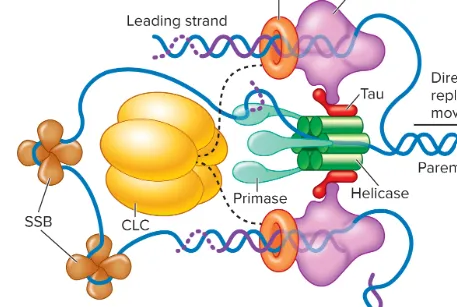 |
What are Single-stranded DNA binding proteins (SSBs)? | Proteins that coat single-stranded DNA to protect it from damage. |
What are topoisomerases? | Proteins that break and reseal one or both strands without altering the nucleotide sequence. |
Why are topoisomerases neccessary? | They prevent tangled chromosomes. |
What is the leading strand? | The strand that is synthesized continuously as DNA polymerase's enzymes move in the same direction as the replication fork. It synthesizes in the 3' to 5' direction. 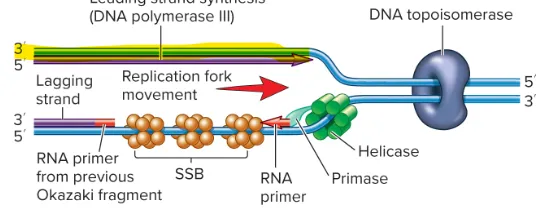 |
What is the lagging strand? | The strand that can't be extended in the same direction as the replication fork because it can't access a free 3'-OH. It will synthesize discontinously in the 5' to 3' direction. 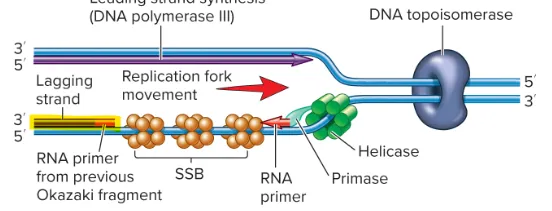 |
What are Okazaki fragments? | A series of short DNA strands produced by the lagging strand. 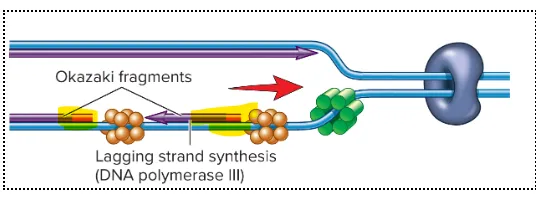 |
What is DNA ligase? | The enzyme that connects Okazaki fragments back together. |
How does DNA ligase join the Okazaki fragments? | It will form a phosphodiester bond between 3'-OH of the growing strand and the 5' phosphate of an Okazaki fragment. 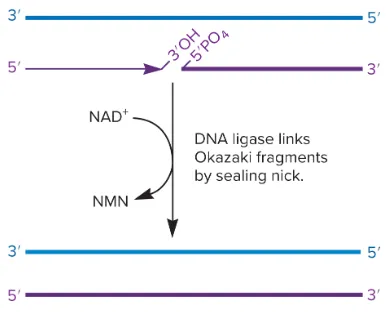 |
What does DNA polymerase 1 do? | It will remove the RNA primers starting at the 5' end and then fill in the gap between Okazaki fragments using an adjacent 3'-OH group. |
What is the special ability DNA polymerase 1 has? | Exonuclease activity (snips off RNA primers). |
What is an important function DNA polymerase 3 have? | Proofreading. |
What is proofreading in DNA synthesis? | The removal of a mismatched base immediately after it happened. |
Exonuclease activity can only remove mismatched bases if its still at ________. | The 3' end of the growing strand. |
What does holoenzyme do during proofreading? | It will back up and add the correct nucleotide in place of the mismatched nucletoide. |
________ is the cell's second line of defense against the potential harm caused by mismatched nucleotides. | The mismatch repair system. |
What are catenames? | A formation of interlocked chromosomes. 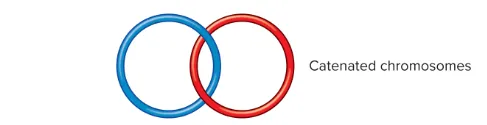 |
What is Tus? | A protein that binds to the "ter" site and halts progression of the forks. |
How are catenames resolved? | Two daughter cells will seperate with the help of other topoisomerases, swap a DNA molecule to each other and then recombined with one another. 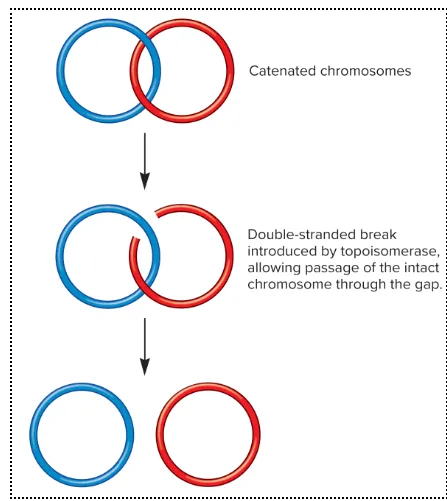 |
What are dimerized chromosomes? | Two chromosomes joined together to form a single, longer chromosome. 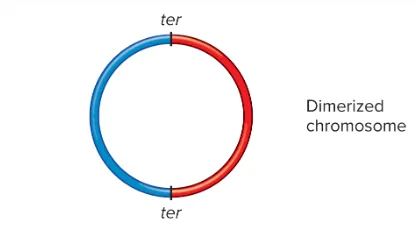 |
How are dimerized chromosomes formed? | During DNA replication between 2 daughter cells. |
How are dimerized chromosomes resolved? | XerCD catalyzes an intramolecular crossover that separates the 2 chromosomes. 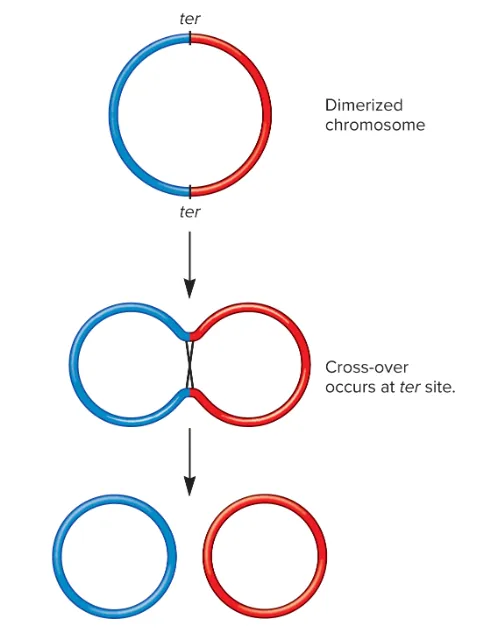 |
What are 2 issues that arise during DNA replication? | Catenames and dimerized chromosomes. |
What is XerCD? | A recombinase enzyme that will separate dimers apart. |
What can genes encode? | -Proteins
-Ribosomal RNA
-Transfer RNA |
What is transcription? | Synthesis of RNA from a DNA template. |
______ bears the message for protein synthesis. | Messenger RNA. |
What is the definition of a gene? | A polynucleotide sequence that codes for 1+ functional products. |
What is the name for genes that encode proteins? | Structural genes. |
What is a sense strand? | The complementary strand to the template. |
Template strand and ____ are complimentary to one another. | mRNA. |
What is a promoter? | A binding site for RNA polymerase located at the START of the gene. |
_____ is neither transcribed or translated. | Promoter. |
What does the promoter do? | -Orients RNA polymerase
-Selects what strand is transcribed
-Decides where transcription begins |
What is the transcription start site? | It is a leader that is transcribed into mRNA but NOT translated into amino acids. |
What is the Shine-Dalgarno sequence? | A region that orients mRNA on the ribosomes, making it helpful for the beginning of translation. |
Where is the Shine-Dalgarno found? | A section of the leader/transcription start site. |
What is the coding region? | The site where the first amino acid of polypeptide is encoded by the gene and then specifies the sequence for the rest of the protein. |
How does the coding region begin? | DNA template sequence 3'-TAC-5". |
What is the trailer sequence? | Sequences that prepare RNA polymerase to be separated from the template strand. |
What is the terminator sequence? | A sequence that signal RNA polymerase to end transcription. |
The trailer is _____ but not _______. | Is transcribed but not translated. |
The coding region is _____ but not ______. | Is transcribed but not translated. |
What is posttranscriptional modification? | When one or more tRNA is transcribed from the promoter and coding regions are separated by short spacer sequences. |
What helps enable posttranscriptional modification? | Ribonucleases enzymes. |
Bacterial cells usually have more than one ______ gene. | rRNA. |
Precursor rRNA encodes for _____ and ______. | tRNA and rRNA. |
What is an operon? | Multiple genes controlled by a single promoter. |
What is the role of an operon? | Yields polycistronic mRNAs during transcription. |
What are polycistronic mRNAs? | mRNAs with a leader followed by a coding region that's separated from a second coding region. The final sequence of nucleotides are the trailer. |
What is unique about polycistronic mRNAs? | Each coding region is defined by start and stop codons, this will produce separate polypeptide per region during translation. |
Operons in eukaryotes usually produce _____. | Monocistronic mRNAs. |
What is the RNA polymerase core enzyme? | A complex unit with 5 polypeptides:
-2 alpha subunits
-Beta
-Beta'
-Omega |
What is the role of the sigma factor? | Functions as a transcription factor that helps the core enzyme recognize the promoter. |
What is the RNA polymerase holoenzyme? | A RNA polymerase core enzyme combined with a sigma factor. |
Which component begins transcription? | The holoenzyme. |
Which component completes RNA synthesis. | The core enzyme. |
What are the 3 processes involved in transcription? | -Initiation
-Elongation
-Termination |
What is the usual sequence of bases found at the -35 site of the bacterial promoter? | TTGACA |
What is the usual sequence of bases found at the -10 site of the bacterial promoter? | TATAAT |
What the consensus sequences? | -10 and -35 sequences recognized by sigma factor^70. |
What is the transcription bubble? | A region of denatured DNA (16-20 base pairs). |
What is the role of the transcription bubble? | Moves with RNA polymerase as it synthesizes mRNA during elongation. |
Elongating RNA polymerase will briefly stop every ______ bases. | 100-200 bases. |
When does transcription termination begin? | When core RNA polymerase dissociates from the template DNA. |
What is intrinsic termination? | A mechanism where signals within the RNA transcript itself. |
What does termination factor rho need? | ATP. |
What does termination factor rho do? | Moves along transcript and physically pulls RNA out of the open complex. |
What enzymes catalyzes transcription? | RNA polymerase. |
What allows the -10 promoter region to separate strands? | It's AT- rich with fewer hydrogen bonds between the strands. |
What happens when ribonucleoside monophosphates are incorporated into a growing RNA chain? | Pyrophosphate is produced. |
Inside a transcription bubble a temporary _____ molecule is formed during the transcription cycle. | RNA:DNA hybrid. |
The energy to fuel transcription comes from where? | Pyrophosphate hydrolysis. |
What direct is the new RNA strand created in during transcription? | 3' to 5'. |
What is the reading frame of an mRNA molecule? | The way triplets of bases are read to code for individual amino acids. |
What does RNA polymerase require topoisomerase? | To adjust the superhelical tension. |
What is each codon on mRNA bounded by? | An anticodon present on the tRNA molecule. |
What are the UGA, UAG, and UAA codons for? | 3 possible stop codons at the end of the reading frame of mRNA. |
AUG is almost always what? | The 1st codon in the reading frame of mRNA molecules. |
What specifies which set of triplet nucleotides will be used to synthesize proteins? | The reading frame of mRNA. |
What is wobble? | The phenomenon of correct translation of nucleic acid sequence to amino acid sequence can occur with a match of ONLY TWO out of three bases in a codon-anticodon pairing. |
Where is the amino acid added to on a tRNA? | The acceptor stem. |
What will a triplet codon do during translation? | Corresponds to a read "word" from mRNA to translate into a particular amino acid in the polypeptide. |
Amino acids are always bounded to terminal ____ on the acceptor stem. | Terminal A. |
What bonding is between terminal A and the acceptor stem of tRNA? | A covalent bond. |
What does wobble indicate in translation? | There's a mismatch between 5' base in the anticodon and 3' base in the codon. |
What is code degeneracy? | When there's several different codons to specify a single amino acid. |
Which process occurs at the ribosome? | Translation. |
How many bases long is a n average tRNA molecule? | 70-95 bases. |
What is a synthetase enzyme? | An aminoacyl-tRNA enzyme. |
What is the function of synthetase? | It will covalently bond an amino acid to tRNA to make the molecule charged/activated. |
What tool produces polypeptides through decoding mRNA? | Ribosomes. |
How many synthetases do bacterial cells have? | About 20. |
Why do bacterial cells need 20 aminoacyl tRNA synthetases? | There's needs to be one synthetase per amino acid. |
What is fMET-tRNA? | An N-formylmethionine-tRNA molecule. |
What does N-formylmethionine do? | It delivers the initial amino acid to the ribosome. |
How does fMet differ from Met? | fMet has a formyl group covalently bonded to the amino group of methionine. |
What are the 3 sites important to the translational domain of the ribosome? | -A
-P
-E |
What is the modified amino acid used to begin protein synthesis in Bacteria? | N-formylmethionine. |
The N-terminus of every polypeptide synthesized needs ____ to be removed. | A formyl group. |
What are AUG codons everywhere else from the first position matched with? | A normal Met-tRNA. |
What makes fMet-tRNA only available for initiating protein synthesis? | Prescence of a formyl group. |
What is the 1st step in translation? | Initiation factors help fMet-tRNA to bind to a free 30-S ribosomal subunit. |
What is the purpose of the A site? | receives tRNAs carrying the next amino acid to be added. |
Where does the 16S rRNA portion of the 30S subunit line up with? | The Shine-Dalgarno sequence. |
What happens during translation's initiation step? | 50S ribosomal subunit bounds to 30S on mRNA, positions the fMet-tRNA in the P site. |
What facilitates the correct assembly of 70S initiation complex? | Initiation factor 3. |
What starts the protein translation? | Initiation factors help fMet-tRNA assemble 16S rRNA within 30S subunit. |
What forms the 70S ribosome? | 50S + 30S subunits. |
What is the energy source for translation initiation? | Hydrolysis of GTP to GDP. |
What assembles the correct assembly of 30S initiation complex? | Initiation factors 1 and 2. |
What are the 3 phases of the translation elongation cycle? | -Aminoacyl-tRNA binding
-Transpeptidation reaction
-Translocation |
Where is an amino acid matching the mRNA codon added to in translation elongation? | The C-terminus/Carboxyl terminus. |
What direction does the ribosome moves down the mRNA during translation elongation? | 5' and 3' direction. |
Where is the existing polypeptide cycle present in the beginning of the elongation cycle? | P site. |
What does elongation factor "Tu" do during translation? | Binds GTP first then brings amino acid to site A of the ribosome. |
What is the 1st phase of translation elongation cycle? | Aminoacyl-tRNA is brought to A site and its anticodon aligns with mRNA's codon. |
What happens during transpeptidation reaction? | A peptide bond is formed between 2 amino acids. |
Where is the energy from breaking covalent bonds between amino acids and tRNA found in? | The P site. |
What is the final phase of translation elongation cycle? | Ribosomes shift to one codon down the mRNA sequence. |
What is the energy source for the last phase of translation elongation cycle? | GTP hydrolysis. |
When does translation termination occur? | When one out of three stop codons is reached by the ribosome. |
What ensures the accuracy of the protein synthesis process? | The large amount of energy require. |
Which replisomes must navigate around the 1000s of transcribing RNA polymerases? | -DNA polymerase
-accessory proteins |
The replisome always moves _____ on the chromosome. | A specific direction. |
What is NusG? | A protein factor. |
What is the role of NusG? | It will interact with RNA polymerase and 30S to keep mRNA single-stranded. |
What is another term for a stop codon? | A nonsense codon. |
For each amino acid 4 ____ are hydrolyzed and ____ are required for amino acid activation. | 4 GTPs hydrolyzed; 2 ATPs used. |
How many replisomes do chromosomes have? | A few. |
How many transcribing RNA polymerases do chromosomes have? | Thousands. |
Where does transcription occur in a bacteria cell? | In the nucleoid and RNA polymerase. |
Where does translation occur in bacteria cells? | In the cytoplasm with a 30S ribosomal subunit. |
What are considered to be post-translation events? | -proper folding of proteins
-association with other subunits
-delivery to correct extracellular sites |
What helps unfolded/partly denatured proteins to fold into 3D, functioning proteins? | A molecular chaperone. |
What can cause improper folding/aggregation of polypeptides? | The linear format of proteins may not allow correct assembly. |
What is protein translocation? | The movement of proteins from cytoplasm to/across the plasma membrane. |
What can supply energy to the secretion systems? | -Proton motive force
-Hydrolysis of ATP |
What do proteins do after they are secreted across the plasma membrane of diderm/bacteria cells? | -Pass through the peptiodogylcan layer
-Embedded into the peptiodogylcan layer |
When do secondary protein structures form? | As the polypeptide exists the ribosome. |
What is protein secretion? | The movement of proteins from cytoplasm to the external environment. |
What does the secretion system translocate? | Unfolded proteins across the plasma membrane. |
What is an obstacle for proteins secreted by monoderm bacteria cells? | Moving across the plasma membrane and outer membrane. |
What is specific to a type of secretion system? | A signal peptide. |
What helps guide membranes proteins when being translocated to the plasma membrane? | Hydrophobic signal peptide. |
What does SecYEG do? | Forms a channel in their membrane for the preprotein to pass through. |
What does SecA do? | Acts as a motor to hydrolyze ATP for energy. |
What does SecDF do? | Uses a proton motive force to help fuel translocation. |
What is a signal peptide? | A short amino acid sequence that tags N-terminus of a protein. |
What is detected by a signal recognition particle in integral membrane proteins? | A very hydrophobic N-terminus. |
When is the hydrophobic N-terminus detected? | When the integral membrane protein exits the ribosome and is escorted by the membrane. |
What detects the N-terminus portion of an integral membrane protein? | A signal recognition particle. |
What does SRP recognizes? | A transmembrane a-helix. |
_____ and ______ actively translate ribosomes at the same time. | SRP and trigger factor survey |
What bacteria uses SecA2-Y2 transport system as part of its protein transport mechanism? | Streptococci. |
Signal peptides of Tat-secreted proteins contain what? | 2 arginine residues. |
Proteins secreted by Tat system must _______ in the cytoplasm. | Completely fold. |
SecA recognizes ______ peptides versuses SRP. | Less hydrophobic signal peptides. |
A signal peptide is what? | A short amino acid sequence tagged at the N terminus of a protein. |
Which bacteria is the tat system found in? | Both mono and di-derm cells. |
What is signal peptidase? | An enzyme that removes signal peptide from the preprotein after it emerges from the plasma membrane. |
What occurs after the polypeptide has been translocated out of the cell? | -Removal of signal peptide
-Cysteine oxidation to disulfide |
What is sortase? | A monoderm enzyme that catalyzes a reaction between the sorting signal and Lipid 2. |
What is the peptidoglycan precursor? | Lipid 2. |
What can't the chemical environment of cytoplasm NOT support? | Cysteine oxidation. |
Proteins secreted by T9SS are ______ in the cytoplasm. | Unfolded. |
When does the major and minor grooves form of DNA? | When the 2 DNA strands twist around each other. |
What is a nucleosome? | The combination of DNA and proteins. |
What is the organization of DNA in Archaea and most bacteria? | Supercoiled-ds-circular. |
Where is the replication fork? | Where DNA is unwound. |
How do small circular genomes (viruses and plasmids) are replicated? | Rolling circle replication. |
How much of DNA is transcribed? | Only a short segment. |
Where do consensus sequences come up on the strand? | With the promoter, before transcription starting point. |
What are the termination mechanisms? | -Intrinsic termination
-Factor dependent (rho-dependent) |
What does RNA polymerase 2 do? | Catalyzes production of heterogeneous nuclear RNA (hnRNA) which undergoes posttranscriptional modification to generate mRNA. |
What is RNA polymerase 2? | A large aggregate contains 10+ subunits. |
What is an exon? | Expressed sequences; region in a gene that is retained in mRNA after introns are removed by silcing. |
What are introns? | Noncoding intervening sequences; a gene that codes for pre-mRNA and is removed (spliced) from the final RNA product. |
What is the spliceosome? | A large complex where splicing of the pre-RNA occurs. |
What is alternative splicing? | When a pre-mRNA is spliced so different patterns of exons remain. |
How many sense codons are there? | 61 codons. |
How many different codons can code for a single amino acid? | 6 codons. |
What is the A (Acceptor) site? | Where the tRNA carrying amino acid is received. |
What is the P (peptidyl) site? | Where tRNA attached to growing polypeptide is held. |
What is the E (exit) site? | Where tRNA leaves the ribosome. |
What is a polyribosome? | A complex of mRNA with several ribosomes. |
How do bacteria increase efficiency in DNA replication? | By coupling RNA polymerase activity and translation. |
What are release factors? | Proteins the aid ribosome in recognizing stop codons (UAG, UAA, UGA). |
How many release factors are active in prokaryotes? | 3; one for each possible stop codon. |
Why are release factors necessary for the termination process? | Because ribosomes do not have cognate tRNA for the stop codon.
So, when the ribosome reaches a stop codon, it just haltss. |
How many release factors are active in eukaryoties? | only 1. |
What component helps transport proteins across the membrane? | Chaperones. |
Gram positive and gram negative bacteria both use which pathway? | Sec-dependent pathway/general secretion pathway. |
What is the sec system? | A system found in all domains of life that transport a protein through or inserts it into a membrane. |
What happens during the general secretion pathway? | -translocate protein from cytoplasm to plasma membrane
-delays folding
-chaperone proteins keep preproteins unfolded
-removed once pre-protein emerges from plasma membrane. |
What are gram-negative specific protein secretion systems? | -Type 1(ABC) secretion pathway
-Type 3
-Type 4 |
What is Type 1 secretion? | Transports proteins from periplasm through the outer membrane. |
What is Type 3 secretion? | Diderm bacteria that secrete virulence factors and inject them into host cells. |
What special component does type 3 secretion systems use? | Injectosomes; molecular syringes used by pathogens to inject proteins into eukaryotic host cells. |
What is type 4 secretion? | A diderm system that secretes proteins and sometimes transfers DNA during bacterial conjugation to monoderm cells. |
What is type 6 secretion? | A protein secretion in diderm bacteria, similar to machinery bacteriophages use to insert DNA into host cells. |
What is type 7 secretions? | A monoderm protein secretion that translocates proteins across the plasma membrane. |