| Term | Definition |
|---|---|
Cash normally includes | general, payroll, petty cash, and, less frequently, savings accounts |
General accounts | are checking accounts similar in nature to those maintained by individuals. |
compensating balance | Under the terms of a bank loan agreement, the cash in a company’s general account sometimes must be maintained at a specified minimum balance, referred to as a . |
Cash equivalents | include money market funds, certificates of deposit, savings certificates, and other similar types of deposits. |
investment, a receivable, or a prepaid expense, | Any item that cannot be converted to cash on short notice should be classified as an rather than as a cash equivalent. |
The auditors’ OBJECTIVES in the audit of cash and cash transactions are to
| 1. Use the understanding of the client and its environment to consider inherent risks, including fraud risks, related to cash.
2. Obtain an understanding of internal control over cash.
3. Assess the risks of material misstatement of cash and design tests of controls and substantive procedures that
A. Substantiate the existence of recorded cash and the occurrence of cash transactions.
B. Determine the accuracy of cash transactions.
C. Establish the completeness of recorded cash.
D. Verify the cutoff of cash transactions.
E. Determine that the client has rights to recorded cash.
F. Determine that the presentation and disclosure of cash, including restricted funds (such as compensating balances and bond sinking funds), are appropriate. |
finance, treasurer | Most of the processes relating to cash handling are the responsibility of the department, under the direction of the . These processes include handling and depositing cash receipts; signing checks; investing idle cash; and maintaining custody of cash, marketable securities, and other negotiable assets. In addition, the department must forecast cash requirements and make both short-term and long-term financing arrangements. |
Ideally, the functions of the finance department and the accounting department should be integrated in a manner that provides assurance that | 1. All cash that should have been received was in fact received, recorded accurately, and deposited promptly.
2. Cash disbursements have been made for authorized purposes only and have been properly recorded.
3. Cash balances are maintained at adequate, but not excessive, levels by forecasting expected cash receipts and payments related to normal operations. The need for obtaining loans or for investing excess cash is thus made known on a timely basis. |
These guidelines for achieving internal control over cash may be summarized as follows: | 1. Separate cash handling (custody) from record keeping.
2. Centralize receiving of cash to the extent practical.
3. Record cash receipts on a timely basis.
4. Encourage customers to obtain receipts and observe cash register totals.
5. Deposit cash receipts daily.
6. Make all disbursements by check or electronic funds transfer, with the exception of possibly small expenditures from petty cash.
7. Have monthly bank reconciliations completed by employees not responsible for making cash payments or custody of cash. The completed reconciliation should be reviewed promptly by an appropriate official.
8. Monitor cash receipts and disbursements through review by management or the internal auditors. This process may be facilitated with the use of data analytics software which can identify unusual transactions and significant deviations from expected (budgeted) amounts. |
The protective features of cash registers or electronic point-of-sale systems include | 1. visual display of the amount of the sale in full view of the customer;
2. a printed receipt, which the customer is urged to take with the merchandise; and
3. accumulation of the total of the day’s sales. |
universal product code (UPC) | product barcode |
Typical internal control over cash received through the mail is described below. | 1. Incoming mail usually is opened in the mailroom, where an employee endorses the checks “for deposit only” to the company’s account and prepares a control listing (manually or electronically) of the incoming cash receipts. This listing shows the amount received from each customer and identifies the customer by name or account number.
2. A copy of the control listing is transmitted to the controller.
3. Another copy of the control listing and the cash receipts are transmitted to the cashier.
4. The remittance advices and a copy of the control listing (shown below) are transmitted to the employee responsible for the customers’ accounts. 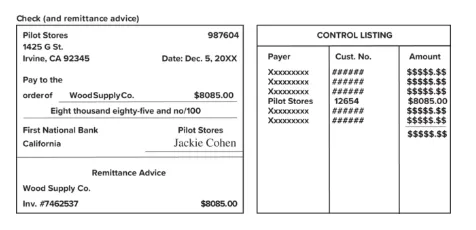 |
Control is exercised over the cashier | by periodic reconciliation of the operations control copies of the mailroom control listings with the cash receipts journal and the details of the validated deposit slips received from the bank. |
lockbox | Businesses receiving a large volume of cash through the mail may use a system to strengthen internal control and hasten the depositing of cash receipts. The is actually a post office box controlled by the company’s financial institution. The financial institution accesses the box and processes the checks, providing the company with a listing of the receipts. Internal control is strengthened by the fact that the financial institution has no access to the company’s accounting records. |
Electronic funds transfer (EFT) | systems process funds-related transactions for customers as an alternative to paying by check |
electronic data interchange (EDI) | systems, which allow the interchange of data from one company’s computer to another’s, are electronically transferring funds between companies’ bank accounts. |
The division of responsibilities, sequence of procedures, and controls over cash sales and collections from customers are illustrated in the systems flowchart in | 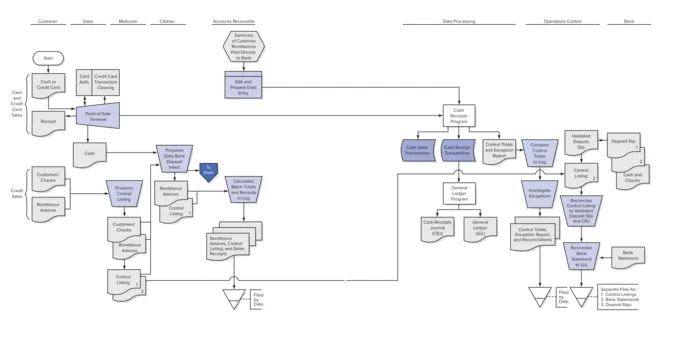 |
A principal advantage of requiring disbursement by check is obtaining evidence of receipt from the payee in the form of an endorsement on the check. Other advantages include:
| 1. the centralization of disbursement authority in the hands of a few designated officials—only persons authorized to sign checks;
2. a permanent record of disbursements; and
3. a reduction in the amount of cash kept on hand. |
Voided checks | should be defaced to eliminate any possibility of further use and filed in the regular sequence of paid checks |
voucher system | is a system that conveys vouchers through the performance and authorization functions. Authorization functions include such procedures as extending and footing the vendor’s invoice; determining the agreement of the invoice, purchase order, and receiving report; and recording the transaction in the accounts.
On the payment date, the voucher and supporting documents are removed from the tickler file and the check is prepared but not signed. The voucher, supporting papers, and the check (complete except for signature) are forwarded to the finance department for signature.
A is one method of achieving strong internal control over cash disbursements by providing assurance that all disbursements are properly authorized and reviewed before a check is issued. In a typical , the accounting department is responsible for assembling the appropriate documentation to support every cash disbursement. For example, before authorizing payment for merchandise purchased, the accounting department assembles copies of the purchase order, receiving report, and vendor’s invoice and determines that these documents are in agreement. After determining that the transaction is properly supported, an accounting employee prepares a voucher, which is filed by date due. |
voucher register | Transactions are recorded in a (which normally replaces a purchases journal) by an entry debiting the appropriate asset, liability, or expense account and crediting Vouchers Payable. |
accounting (accounts payable) | In a computerized purchasing system, vendor invoice information will be entered by the department and it may be matched by the computer with purchase order and receiving information that was entered by the other departments. |
The monthly balancing of the detailed records of accounts payable (or vouchers) to the general ledger control account | Another control the auditors may expect to find in a well-managed accounts payable department is . These reconciliations are saved as evidence of the performance of this procedure and as an aid in locating any subsequent errors or fraud. |
Vendors’ statements | , received monthly, should be reconciled promptly with the accounts payable ledger or list of open vouchers, and any discrepancies should be fully investigated |
Flowchart of a Cash Disbursements Cycle (Voucher System)* | 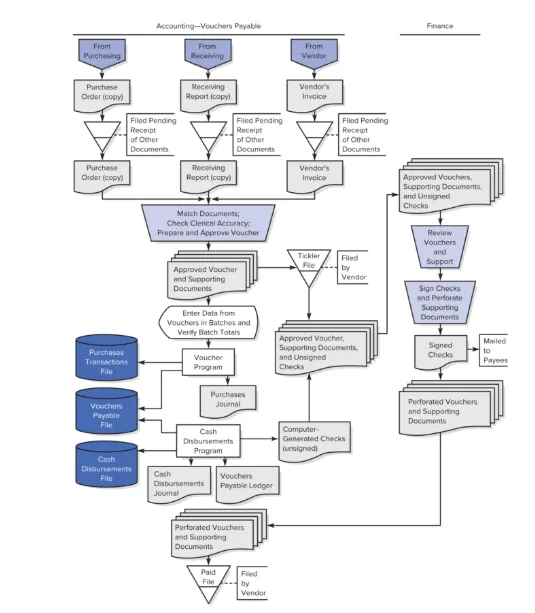 |
Management review | controls are key to identifying cash receipts and disbursements that potentially may be misstated. As an example, management may perform periodic reviews of cash journal and ledgers for unusual transactions or entries. |
The following steps indicate the general pattern of work performed by the auditors in the audit of cash. | A. Use the understanding of the client and its environment to consider inherent risks, including fraud risks, related to cash.
B. Obtain an understanding of internal control over cash.
C. Assess the risks of material misstatement and design further audit procedures.
D. Perform further audit procedures—tests of controls.
1. Examples of tests of controls:
a. Test controls over the accuracy and completeness of accounting records and bank reconciliations.
b. Test controls over the accuracy and completeness of processing cash receipts and recording them in the accounting records.
c. Test controls over the accuracy and completeness of cash disbursements and recording them in the accounting records.
d. Test management review controls.
2. If necessary, revise the risk of material misstatement based on the results of tests of controls.
E. Perform further audit procedures—substantive procedures for cash transactions and balances.
1. Obtain analyses of cash balances and reconcile them to the general ledger.
2. Confirm cash balances with financial institutions.
3. Obtain or prepare reconciliations of bank (financial institution) accounts as of the balance sheet date and consider the need to reconcile bank activity for additional months.
4. Obtain a cutoff bank statement containing transactions of at least seven business days subsequent to the balance sheet date.
5. Identify and investigate unusual cash receipts and disbursements.
6. Count and list cash on hand.
7. Verify the client’s cutoff of cash receipts and cash disbursements.
8. Analyze bank transfers for the last week of the audit year and the first week of the following year.
9. Investigate payments to related parties.
10. Evaluate proper financial statement presentation and disclosure of cash. |
The following are examples of typical further tests of controls. | a. Test controls over the accuracy and completeness of accounting records and bank reconciliations.
b. Test controls over the accuracy and completeness of processing cash receipts and recording them in the accounting records.
c. Test controls over the accuracy and completeness of cash disbursements and recording them in the accounting records.
d. Test management review controls.
2. If Necessary, Revise the Risk of Material Misstatement Based on the Results of Tests of Controls.
E. Perform Further Audit Procedures—Substantive Procedures for Cash Transactions and Balances.
1. Obtain Analyses of Cash Balances and Reconcile Them to the General Ledger.
2. Confirm Cash Balances with Financial Institutions.
3. Obtain or Prepare Reconciliations of Bank (Financial Institution) Accounts as of the Balance Sheet Date and Consider the Need to Reconcile Bank Activity for Additional Months.
4. Obtain a Cutoff Bank Statement Containing Transactions of at Least Seven Business Days Subsequent to the Balance Sheet Date.
5. Identify and Investigate Unusual Cash Receipts and Disbursements.
6. Count and List Cash on Hand.
7. Verify the Client’s Cutoff of Cash Receipts and Cash Disbursements.
8. Analyze Bank Transfers for the Last Week of the Audit Year and the First Week of the Following Year.
9. Investigate Payments to Related Parties.
10. Evaluate Proper Financial Statement Presentation and Disclosure of Cash. |
detail | The of cash receipts refers to a listing of the amount of each individual check and the total amount of currency composing the day’s receipts. |
Lapping | is the concealment of a cash shortage by delaying the recording of cash receipts. The table below provides an illustration. |