| Term | Definition |
|---|---|
What is ecology? | study of interactions between organisms and their environments |
What is an organism? | A living thing that is composed of one or more cells and reproduces using DNA. It acquires energy from its environment to support metabolism |
What is a community? | Multiple populations of different organisms that live together in an environment. A community lives in an ecosystem |
What is included in an ecosystem? | Includes the living communities (biotic components) and physical environment (abiotic components) |
What is a biosphere? | The part of Earths environment in which living organisms are found |
What are some of the factors that influence the stability of an ecosystem? | 1. Abiotic factors, such as temperature, humidity, geology also biogeochemical cycles.
2. biotic factors, A) intraspecific relations (individuals of the same species in a population). B) interspecific relations (between different species) |
What can cause a crisis in an ecosystem? | Changes in abiotic or biotic factors. Such as climate change, eruptions, fires (abiotic factors). Or pressure from over-population, genetic mutations or increased predation (biotic factors). |
What are some physiochecmical/environmental factors? | Topography, edaphic factors, temperature, light, precipitation. |
What is an energy pyramid? | At the base the sun provides energy, so its 100% energy. Then primary consumers is at 10%. With each step to the next trophic level around 90% of energy is lost. 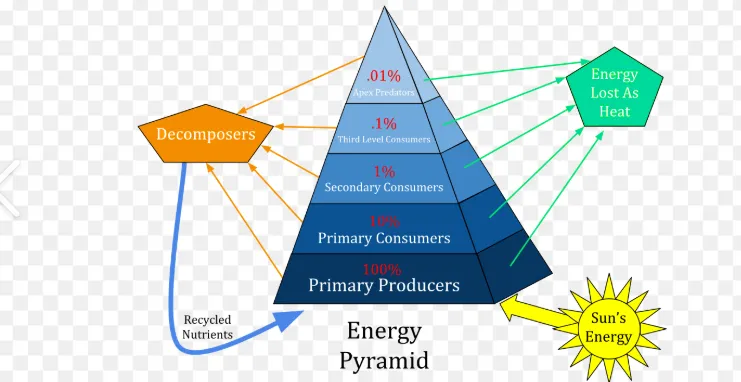 |
What are trophic levels? | They define the position of an organism within the foodweb. Primary producers are TL1, primary consumers TL2, and secondary consumers TL3. Organisms often feed at more than one trophic level. |