The 5 principles of exercise and fitness training
1) Progressive overload
2) Specificity
3) Reversibility
4) Variety
5) Individuality
| Term | Definition |
|---|---|
The 5 principles of exercise and fitness training | 1) Progressive overload
2) Specificity
3) Reversibility
4) Variety
5) Individuality |
Principle 01: Progressive overload | - The process of exercise sessions being more challenging over time so the body is forced to adapt and improve
- Too much load, too quick = risk of tissue damage & injury => overload should be calculated so body is forced to adapt but not get injured : Increase of 5% per week
- Factors effecting overload : Repetitions, sets, resistance, range of movement, rest, rate/speed, complexity |
Principle 02: Specificity | The nature of adaptations that follow application of overload
Principle of specificity :
S = specific
A = adaptions to
I = imposed
D = demands |
Principle 03: Reversibility | Body is always responding to its environment in a pattern of stimulus-response
Stimulus = overload
Response = short/long term changes within the body
When stimulus stops the previous gains start to reverse and measurable decline will be evident in 2-3 weeks.
'use it or lose it' |
Principle 04: Rest and recovery | Period of inactivity between training sessions crucial to the recovery process
A person cannot recover without rest
During recovery the body makes numerous anatomical and physiological adaptations necessary to support improvements and progression
Performance reduction and risk of injury if no 48hr recovery |
Additional training considerations 01: Variety | Body retains information in a memory like form to cope more effectively in future. This is muscle memory.
Muscle memory allows the body to perform repeated actions in an unconscious manner => performing the same task often enough leads to lack of challenge.
Exercises need variety to stop body from predicting future workouts : different loading patterns , volumes & training frequencies |
Additional training considerations 02: Individuality | Exercises should be modified to who is doing them.
Exercise groups should be organised according to their ability.
Workouts too difficult are frustrating and not useful.
Professionals should plan based on what their clients need with a range of modifications, alternatives & progression ready for more personalisation. |
Additional training considerations 03: Plateau | Training plateau occurs when an exerciser fails to make progress
This can occur from : poorly constructed programme, too much/little rest, lack of variety, poor diet.
To avoid this planning and constant reviewal and the FITT principle should be used. |
Additional training considerations 04: programme regression | Sometimes it is necessary to reduce intensity to better meet clients needs.
Examples: Returning to exercise post-injury/post-illness, returning after a break, providing the body rest between events, active recovery.
All elements of FITT principle can be adapted. |
What are modifications, progressions and alternatives? | Modifications: Different exercises easier than the original exercise or a variation
Progressions: Exercises harder than the original
Alternatives: Different exercises that achieve the same or similar training effect. |
FITT principle | Acronym to tailor exercise to clients needs irrespective of mode of training (gym, yoga, pilates etc).
Frequency: number per week and rest. Even distribution in a week
Intensity: Resistance, repetitions, range of movement, rest in a set, speed, complexity.
Time: length of time exercise is performed.
Type: Specific equipment (bike) or training method (interval). |
Modifying the FITT principle | To ensure individuals needs must consider the following:
- Medical needs
- Fitness level
- Skill & technical ability
- Experience
- Environment
- Confidence & motivation
- Availability
|
Exercise speed/rate | Increasing speed is not always appropriate to increase intensity.
Before exercising at speed must do exercise at perfect from at slower speeds.
High speed mainly for conditioned and skilled exercisers.
Resistance exercises are better slow as time of muscle(s) under tension is extended and you have greater control. |
How to monitor exercise intensity | Must monitor participants response throughout the session.
Can be fatal if intensity is too high.
RPE(Rating of perceived exertion (0-10))
0: no exertion at all
4: somewhat hard
7: very hard
10: maximal extersion |
Exertion monitoring methods | Talk test = participants should talk to check they are breathing and not too fast or slow.
Heart rate monitoring: Need a heart rate monitor, maximum heart rate equation : 220-age = MHR
RPE: On previous card - simplest way. Participants scale as they go.
Observation: Most common, observe for indicators of overexertion.
|
Signs of overexertion | Occurs when overload is too high or stress on body for too long.
Signs include:
- inability to talk
- impaired ability to concentrate
- dry mouth/dehydration
- dizziness
- muscle cramps
- joint pain
- nausea
- loss of coordination |
Delayed onset muscle soreness (DOMS) | DOMS is pain and stiffness in active muscles some 24-72 hours post exercise.
Occurs as a consequence of microscope 'friction burns' on muscle fibres.
Common triggers: Heavy resistance training, downhill running, new exercises, change in volume and type, increase of duration/intensity.
When present: rest the inflamed area and drink plenty of water. |
Avoiding DOMS and overtraining | Any progressive exercise, some DOMS is inevitable 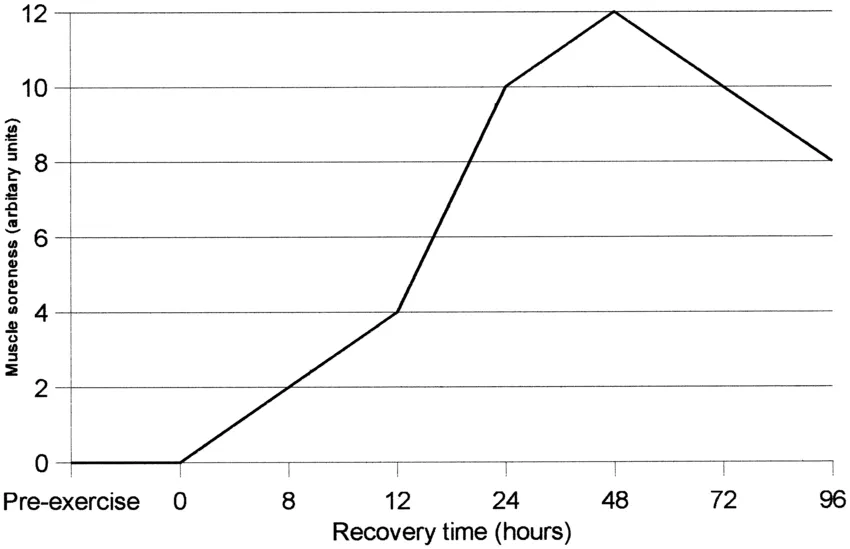 |
Overtraining syndrome | Period of performance and progress diminishing despite training frequency, time and/or intensity increased.
Imbalance of : training programme = workout + recovery.
Common signs: lack of progress, lethargy, depression, irritability, difficulty concentrating, weak to colds and illness, elevated resting pulse.
Effects long term : structural injury, metabolic dysfunction, bone loss and more. |
Factors effecting health and fitness | According to world health organisation determinant of health includes:
- income and social status
- education
- physical environment
- employment and working conditions
- Social support networks
- Culture
- Genetics
- Personal behaviour
- Health services
- Gender |