"Rationale" Model of Science & Policy
- threat realized (by scientist)
- public gets support for change
1. Scientists & Businesses look for solutions
2. Government adopts and implements laws and regulations
| Term | Definition |
|---|---|
"Rationale" Model of Science & Policy | - threat realized (by scientist)
- public gets support for change
1. Scientists & Businesses look for solutions
2. Government adopts and implements laws and regulations |
Why does science have legitimacy & authority? | - history of successful technology and explanations
- ideals (objectivity, peer reviews, standards)
- seen as "above"/separate from politics
- governments, businesses, ENGOS rely on science to support arguement |
What is reducing the legitimacy of science? | - information is often uncertain (environment = complex)
- conflicting interpretations and disagreements
Bias, hidden interest from industry
- seen as very overly political |
Science Knowledge (Popper) | what survives repeated attempts at falsification |
Reliable Scientific Knowledge | - social activity done by humans
- individuals contribute in a variety of ways including criticism and cooperation |
CUDOS (academic science) | norms of science (Merton)
C = communalism
U = universalism
D = disinterested
O = Organized skepticism
efforts to realize these norms are important to creating reliable scientific knowledge but aren't easy to create |
What drives the CUDOS norms? | Priority, Rank & Prestige
- the first to discover & publish a novel idea wins the fame (but not necessarily the fortune)
e.g. Rosalind Franklin and Watson and Crick |
Communalism | The essence of this is the “prohibition on secrecy”
- all science discoveries should be shared |
Universalism | inclusion into the scientific community should not be based on race, religion, sex, nationality |
Disinterestedness (humility) | - neutral, impersonal and passive
- humility - credit others for their work |
Organized Skepticism | critical approach to scientific claims, manifested in peer review |
"Steady-State" Science | roughly constant levels of total funds available for science
- shift from research driven by scientific curiosity to choices between equally good projects based on budget decisions
- fixed and carefully monitored spending
- increased and tightened intellectual, personal and institutional connections
- impatience by the public to see results directly
- in steady state funding, institutions and scientist receiving funding for science increasingly need to demonstrate
1. focus on accountability
2. economic efficiency
3. scientific excellence
4. social benefits of research
5. cost cutting measures
- increased need for international collaboration on large expensive projects
|
Issues with Scientific careers in steady state conditions | - However, this can be risky for a country that does not perform its
own research in a promising field
- jobs are constantly changing and increasing
- expansion rate of science cannot be throttled back |
Scientific Careers in a steady state | - increases average age of new professor
- increasing short term contract positions and decreasing or abolishing tenured positions
- increasing competition for enrollment throughout career;
• decreasing security and stability;
• decreasing autonomy in problem selection and method formulation; and
• increasing administrative and managerial functions of scientists. |
Recent trends in scientific careers | - Lack of tenure-track positions
• More contract positions (casualization)
• Increased teaching load for academic researchers
• Increased “Up or out” competition at every stage of career
• Increased competition for research funding
• Overall loss in security and stability in research careers |
PLACE (industrial science) | The traditions of “academic science” as idealized by the CUDOS norms
are changing from steady-state science (i.e., no longer continual
expansion of science
• PLACE (Ziman)
• P = proprietary
• L = local
• A = authoritarian
• C = commissioned
• E = expert |
Implications of cudos and place being difficult to reconcile | Positive
• Scientific knowledge is being produced in a variety of institutional
domains
• (see Mode 1 & Mode 2 knowledge production on next slides).
Negative
• Conflicts between institutional norms (e.g., CUDOS & PLACE) |
Mode 1 vs Mode 2 | 1:
university-based
◼ ‘pure research’ - oriented
◼ discipline-based
◼ homogeneous and ‘depth’ seeking expert-led
◼ supply-driven
◼ hierarchical
◼ peer reviewed from within a ‘Community of scholars’
2:
problem-solving around a
particular application and context
◼ transdisciplinary (appropriate for
solving a problem rather than an
academic interest)
◼ heterogeneity in the way the
problem-solving conditions;
range of organisations involved
◼ Sensitivity to social
accountability and reflexivity
◼ More inclusive quality control |
Peer Review | skepticim is manifested
reviewed: methods, theory, results
peers: editors, friends, others, |
Blind reviews | Pros:
• Deals with the priority issues that Zuckerman raises in acceptance and publication
• Helps ensure that assessments are objective and honest (disinterested)
• Helps promote the open nature of science – it’s the ideas not the people that count.
Cons:
• Anonymous referees may minimize the work they do to review a manuscript
• Anonymity may encourage personal or political attacks (especially when an author can
be guessed)
• “Removing the name and affiliation of the author does not make a manuscript
anonymous. A competent reviewer can tell at a glance where the work was done and by
whom or under whose guidance.” Merton & Zuckerman, p. |
Mode 2 | When a publication covers a broad array of topics (e.g. climate
science), who is competent to judge the work. How are these
people chosen? |
Epistemology | studying how we know what we know |
ways of knowing | science
systems
experiential
indigenous
cultural
magic
religions |
Indigenous Knowledge | - place based
- holistic
- relational & accountable
- intergenerational
- dynamic & learning |
Religion | faith-based knowledge
• Sacred texts
• Spiritual experience
• Authority & tradition |
Experiential knowledge |
• Learning through experience and practice
• Tacit knowledge
• Professionals & tradespeople |
Cultural Knowledge
| -Social norms, “common sense”
• shared traditions, local knowledge, socialization |
Systems approaches | -Seeing systems as: elements, connections, function
• Systems feature diversity, feedback loops, nonlinearity, and
emergent behaviour
• Seek to understand how parts of system interact, to understand
complex problems (holistic) |
How does knowledge arrive from | Observation (systematic observation, everyday experience)
• Authority (religion, tradition, Elders, experts)
• Systematic inquiry (science & academic research)
• Relationships (Indigenous knowledges, systems thinking,
ecological thinking)
• Sense making (culture, religion, myth, magic |
Uncertainty vs. Risk | - lack of confidence in our knowledge
- chance of some harm or lass |
Two value frame & null hypothesis | In science, we also use an ACCEPT/REJECT frame for questions
(the two-value frame):
• ACCEPT: the hypothesis is provisionally accepted
• REJECT: the hypothesis has been falsified
• Science is conservative: would rather report nothing than report
something that is later shown to be incorrect.
• The default assumption of science is to accept the null hypothesis
(the no-effect hypothesis is true until proven beyond a reasonable doubt to be false)
Where there is uncertainty, science frames questions to accept
the null (no effect) hypothesis.
• The burden of proof then falls to those
scientists/environmentalists who hypothesize some effect.
• Assumes no relationship between GHGs and climate change until proven
• Assumes no relationship between PFAS and cancer.
• Assumes no relationship between controlling an ecological variable and
gradual loss of ecological resilience. |
Pacal's Wager | 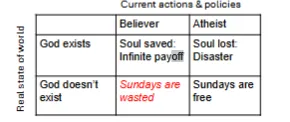 |
Precaution | Precaution is important for addressing the problems associated
with the two-value framing of science, but it is not a panacea for
environmental decision making.
• Some difficulties
• Some risks are required for innovation that might help environmental
problems (e.g., carbon capture, gene editing, AI)
• Everyone will have a different idea of how big of safety factor is required.
• We are often making risk/risk trade offs (e.g., nuclear energy/waste for
GHG reductions) |
Post Normal science | Traditional (or normal) science assumes facts are certain, objective,
and value-free, but many modern environmental and policy
problems do not fit this model.
Post-Normal Science applies when facts are uncertain, values are
contested, stakes are high, and decisions are urgent.
In these situations, science alone is not enough; other forms of
knowledge and public participation are needed. |
Challenge 1: trust can be fragile | If the public feels scientists are not being transparent or honest,
the public trust in science can be lost. This would be big trouble.
• E.g., Climategate in 2009
In this case, the “blogosphere” (i.e., early social media) became the
extended peer/affected community. But they had an axe to grind.
Thought Question: how do these new platforms influence public
trust in science. |
Climategate | In 2009, thousands of emails and documents were leaked from
scientists at the University of East Anglia and released online just
before the Copenhagen climate summit.
• Critics said emails proved researchers had manipulated data and
exaggerated evidence for climate change.
• There were references to a "trick" and to "hiding the decline” but these
were taken out of context.
Numerous investigations in the UK and the United States found no
evidence of scientific fraud or data fabrication. Evidence of climate
change remained sound. |
Challenge #2: affected communities can be
irrational | Science has trouble understanding complex systems:
• Natural systems are nonlinear and, hence, complex
• They are not amenable to laboratory science with controlled variables
• Hence, uncertainty is inherent to environmental & social systems
• There is a pathology of resource management that requires a different
approach and understanding of nature: adaptive or ecosystem
management |
Social Traps | Social Traps occur when the immediate feedback that a person
receives encourages them to continue what is a perverse activity at
another level of complexity... |
Holling's pathology of resource management | Natural & biophysical systems are non-linear and complex
• For decades, humans have relied on science to predict and control
ecosystems for human benefit (i.e., economic production prefers
predictability and control)
• Control of key variables tends to work in short term but, in long term, can
reduce ecological resilience
• This creates a social trap, where short term ecological feedback
convinces us that things are OK when ecological resilience may actually
be gradually declining |
Adaptive management | Two decision making strategies for uncertainty to consider:
• Precaution (related to the two-value frame of science, Pascal’s Wager, principles
of precaution)
• Adaptive management / ecosystem management
What is adaptive?
• Learning by doing
• Experimentation & rigorous monitoring
• Continual improvement |
risk | Technical definition:
risk = probability X consequence
• But Paul Slovic says (1999):
• “There is no such thing as ‘real risk’ or ‘objective’ risk.”
• Risk is both scientifically/empirically & socially defined |
Hazard | something that has the potential to create -ve outcome |
Exposure | How often you are exposed to the hazard |
Consequence | What are you worried about happening? Death, injury, cancer, loss of
income, etc? |
Types of Risk | Natural
Technological |
Academic science vs. mandated science/expert assessment | academic:
Questions (normally) posed by researchers in a discipline.
• Published in academic journals. Peer-reviewed by a community of similar scholars.
• Audience is other researchers.
• Mode 1 & Mode 2 science captured here too.
Mandated:
advice provided by experts
• E.g., what is the “safe” level of microplastics?, who should get the COVID vaccine?
• Problem solving. Interdisciplinary, sensitive to social context.
• Audience is policy makers and public.
• Professional and expert judgement are explicitly important |
Types of risk assessments | • Toxicological risk assessment (e.g., PFAS, PCBs, microplastics)
• Pharmaceutical risks (e.g., covid vaccine, cancer drugs)
• Ecological risk assessment (fate of chemicals in ecosystems)
• Environmental site assessment (e.g., contaminated land)
• Environmental imapct assessment (e.g., mines, pipelines, roads)
• Technology assessment (e.g., GenAI)
• Product assessment (e.g., hockey helmets)
• Activity risk assessment (e.g., field trips, playing football)
|
Why do people see risks differently | Expert:
- Scientific
• Probabilistic
• Acceptable risk
• Changing knowledge
• Comparative risk
• Population averages
• A “death is a death”
Public
- Intuitive, emotional
• Yes/no- Is it or is it
not?
• Safety
• Discrete events
• Personal consequences
• It matters how we di |
What makes environmental risks controversial? | Differing perceptions of severity & acceptability
• Expert assessment vs. public assessment
• Professional risk managers vs public
• Attempts to “spin” risk communications
• Differing levels of individual control
• Voluntary vs. involuntary
Unequal (unjust?) apportioning of risks
• Unequal responsibility and burden for management
• Uncertainty is difficult to accept
• May never be resolved
• When do we act with precaution? |
Risk Perceptions | how people perceive risk |
Factors of risk perceptions | Some factors that can affect risk perception
• voluntary vs involutary
• control vs no control
• distribution of benefits, fairness
• immediacy vs delay
• horror factor, memorable, recent event
• familiar vs unknown
• natural vs artificial
• anything involving children |
Who should qualify as an expert? | example: Imagine a hearing concerning a nuclear waste repository in Ignace.
• Who should be recognized as an expert witness?
• Hydrogeologist with 30 years of research
• Nuclear engineer employed by AECL
• Indigenous knowledge holder with lifelong knowledge of the region
• Local resident who has followed the issue for 20 years
• Are they all experts?
• What kind of expertise does each possess?
• Should they be given equal weight?
Collins and Evans argue that technical expertise remains important and
shouldn’t be seen as equal to all other forms of knowledge.
Contributory vs Interactional |
We often think of science communicating as
helping the public understand complicated |