Posture definition
"Good posture is that state of muscular and skeletal balance which protects the supporting structures of the body and uses muscles efficiently." - American academy of orthopaedic surgeons 1947
| Term | Definition |
|---|---|
Posture definition | "Good posture is that state of muscular and skeletal balance which protects the supporting structures of the body and uses muscles efficiently." - American academy of orthopaedic surgeons 1947 |
Posture control mechanisms - Passive | A variety of structures (bones, ligaments, joint capsules, connective tissue, cartilage, spinal discs and the passive mechanical properties of muscle and fascia.)
creates tension and stability through passive opposition movement => all work on this system is free. |
Posture control mechanisms - Active | Skeletal muscles which are energetically expensive as muscle need energy to contract. |
Posture control mechanisms - Neural | Sensory receptors in the body and nerves to detect changes (tension, force etc) so the nerves signal receptors to contact motor units in order to recruit muscles. |
How to correct poor posture | Generally - Tight muscles must be lengthened and long muscles need to be shortened and weak muscles need to be strengthened.
Corrective exercise is a specialist skill and should only be performed by qualified individuals. |
What to avoid for persons with bad posture | Those with lordosis and kyphosis usually experience irritation of the coccyx during seated activities - these activities and try kneeling or standing variations.
Those with kyphosis (Caused by osteoporosis) should avoid forward flexion (sit ups and crunches) as their spinal discs are probably already wedge like and the vertebrae will be vulnerable => risk of spinal fracture. |
Neutral spine features | 1. The head should be well balanced, looking forward with LOG passing through rear portion of earlobe
2. LOG passes through acromion process and head of humerus.
3. Anterior-superior iliac spine (ASIS) and the posterior-superior iliac spine (PSIS) should be relatively parallel to each other.
4. LOG runs slightly posterior to greater trochanter of hip joint.
5. LOG passes directly through middle of the knee joint.
6. LOG runs through apex of the arch, slightly anterior to the calcanecubiod bone. 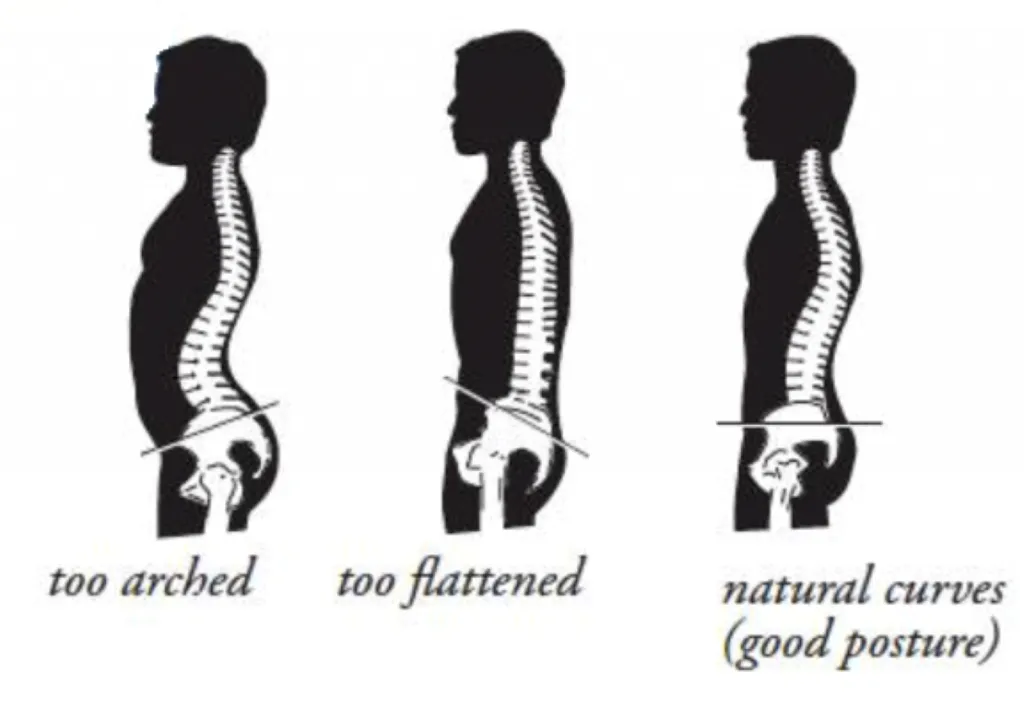 |
Lordosis (lower cross(ed) syndrome) | Excessive curvature of the lumbar spine. May also have kyphosis alongside. Can increase risk of low back pain.
Tight muscles to be lengthened - thoracic (lumbar extensors), Rectus femoris, Hip flexors.
Weak muscles to be strengthened - Abdominals, obliques, gluteals.
**Hamstrings may be lengthened by not necessarily weak. 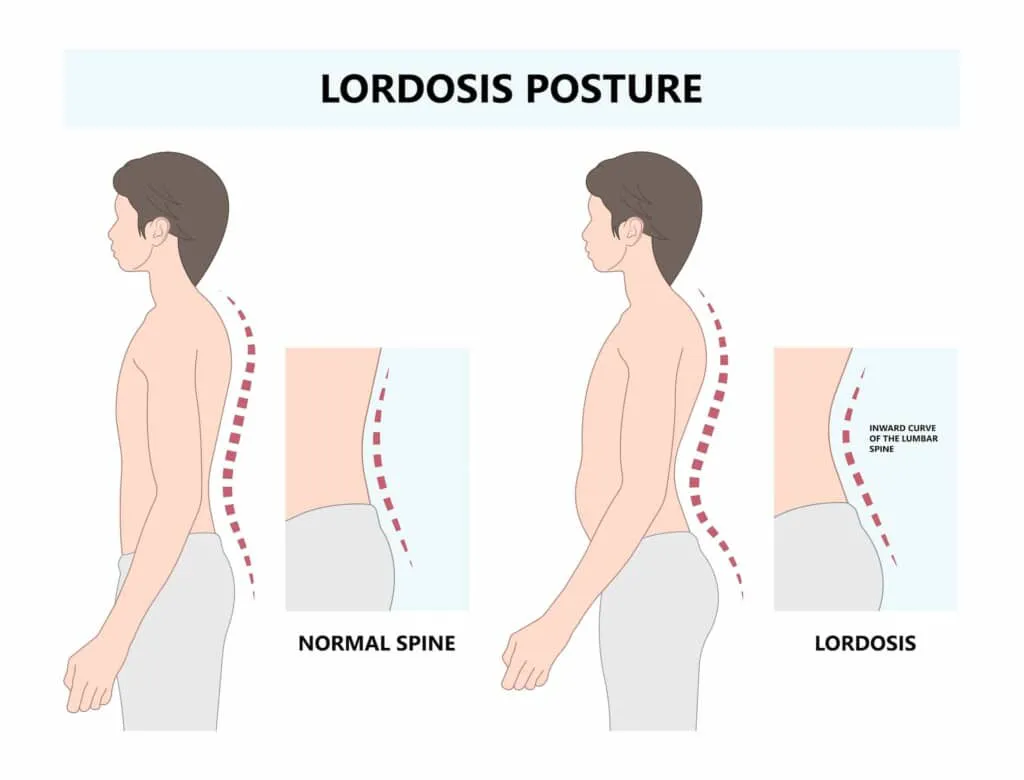 |
Kyphosis (upper cross(ed) syndrome) | Excessive curvature of upper thoracic and lower cervical spine (hump). Often results in forward head position.
Tight muscles to be lengthened - Upper trapezius, neck extensors, pectorals, anterior deltoids.
Weak muscles to be strengthened - neck flexors, mid-lower trapezius. 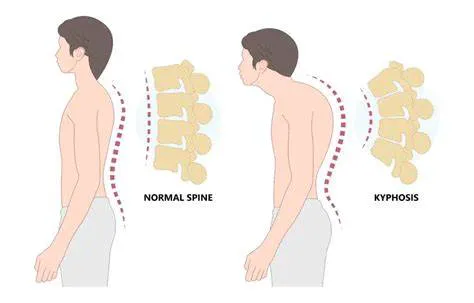 |
Flat back | Loss of lumbar curvature creating flatness in the low back and gluteal areas. Shoulders and head are commonly forward with cervical spine somewhat extended.
Tight muscles to be lengthened - Ham strings, abdominals, tibilais anterior.
Weak muscles to be strengthened - Hip flexors, spinal erectors (long not weak). 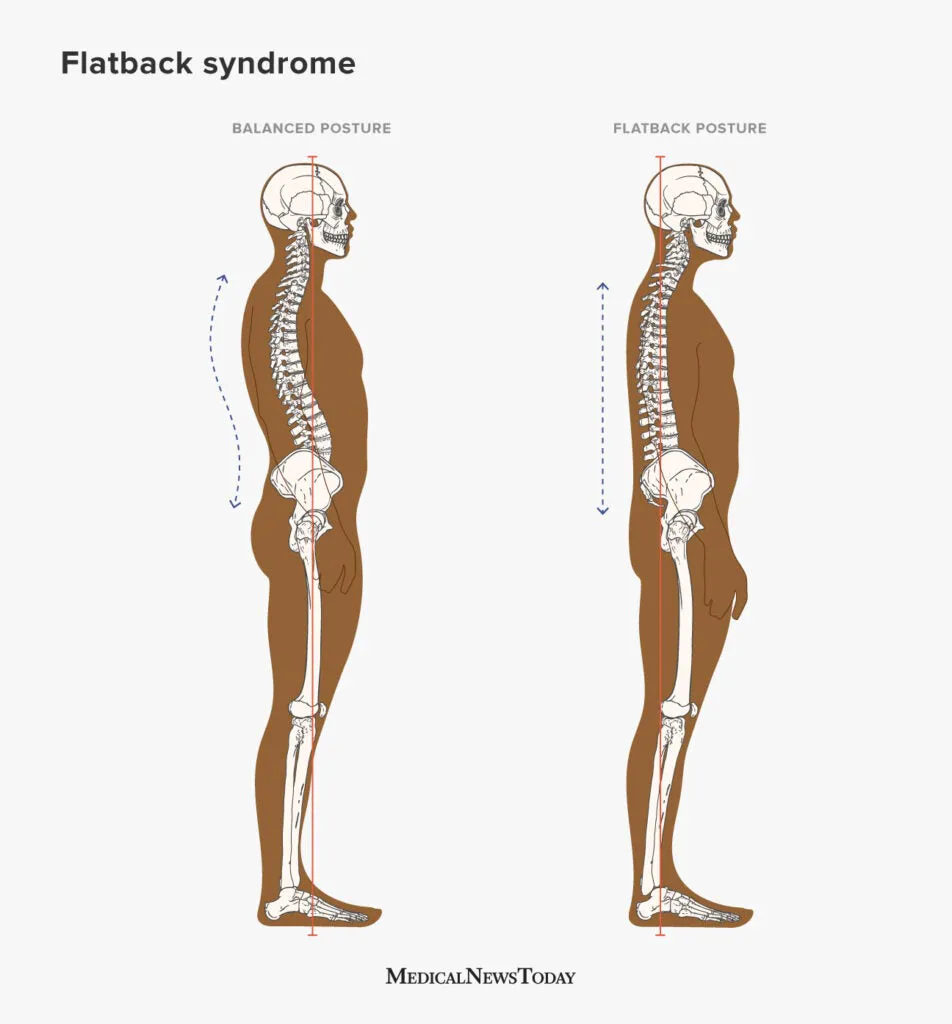 |
Sway back (slouchy/teenage posture) | Can be confused with lordosis.
Hips are displaces anteriorly, thorax and shoulders are displayed posteriorly. Cervical spine is typically extended - affects women more than men.
Tight muscles to be lengthened - Lower spinal extension (strong), internal obliques, hamstrings (causing knee hypertension)
Weak muscles to be strengthened - Upper spinal extension, external obliques.
**More habitual so postural awareness can be more effective than fixing muscle imbalances. 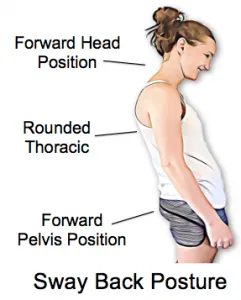 |
Scoliosis | Excessive lateral curvature and/or rotation of the spine. Various causes including birth defects, infection, neuromuscular conditions or idiopathic.
Specific exercises are unlikely to improve the condition but general exercise in most cases encouraged.
Exercise professionally only identify scoliosis not treat it, and must emphasise extreme cause and refer to a medical professional. |
Core stability defintion | "Ability to maintain optimal alignment of the spine, pelvis and shoulder girdle during movement"
This is why standing work is important as helps people understand and get familiar with integrating their core stability into their daily lives. |
Local muscles | The deep stabilising muscles form a muscular cylinder to support spine and pelvis.
Key local muscles:
- Transverse abdomnis
- Multifidus
- Quadtratus lumborum
- Internal obliques
- Pelvic floor
- Diaphragm |
Global muscles | The more superficial muscles are involved with moving the limbs and the trunk.
Key global muscles:
- Erector spine
- Rectus abdominis
- External obliques |
Intra-abdominal pressure (IAP) | Intra-abdominal pressure (IAP) = gentle pressure created inside the abdomen to support and stabilise the spine.
“Core canister / cylinder” = 4 parts working together:
- Top: diaphragm
- Bottom: pelvic floor
- Front & sides: transverse abdominis (deep abs)
- Back: multifidus (deep spinal muscles)
How IAP works:
- Inhale → diaphragm moves down
- Pelvic floor responds (slight lengthen)
- Abdomen expands → pressure builds evenly (360°)
- Creates internal support like an air-filled cylinder
On exhale:
- Diaphragm lifts
- Pelvic floor gently lifts
- Deep abs engage → maintain support without bracing
Key idea for Pilates:
- Not “sucking in” or gripping
- It’s balanced, responsive pressure for stability + movement
Why it matters:
- Protects spine
- Improves control and efficiency
- Supports load transfer during movement
- Cue: “Breathe into a 360° cylinder, keep gentle lift and support” |