| Term | Definition |
|---|---|
All living organisms are- | -composed of cells |
The cell is the- | -most basic unit of life |
All cells arise from- | -preexisting, living cells |
All cells come from- | -cell division |
Cell division involves- | -dividing the contents of a cell between two daughter cells |
Cell division passes on- | -exact copies of the cells DNA |
Plant Meristems | Embryonic tissues of rapidly growing cells |
Apical Meristems | Increase length of stems and roots (buds are dormant) |
Lateral Meristems | Increase girth of stems and roots |
Another word for Meristematic cells | Initials ("stem cells") |
Derivatives | Cells that develop from Meristems (initials), they do not usually divide |
Cyclin-dependent kinases | Regulate and control progress of the cell cycle |
Cell growth | A cycle of dividing and developing (enlarging) |
Interphase | One of two steps of the cell cycle hat is the cell development (growth) |
M-Phase | One of two steps of the cell cycle that is cell division, includes mitosis (division of the nucleus), and cytokinesis (division of the cytoplasm) |
First step of Interphase | Nucleus migrates to center of the cell (G1-Phase) |
Second step of Interphase | Phragmosome begins to form (Phragmo means barrier/fence) |
Third step of Interphase | Preprophase band forms (G2-Phase) |
M-Phase | When cell division occurs (Mitosis), includes Prophase, Metaphase, Anaphase, Telophase, and Cytokinesis |
Prophase 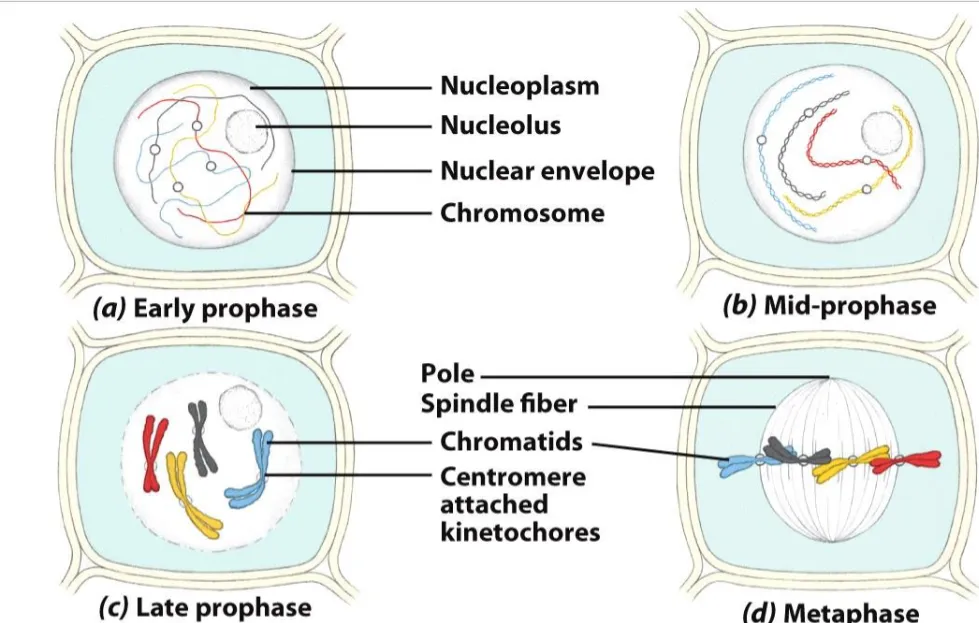 | The first step in Mitosis
1. Chromosomes condense
2. Prophase spindle forms
3. Nuclear envelope "breaks up" |
Metaphase 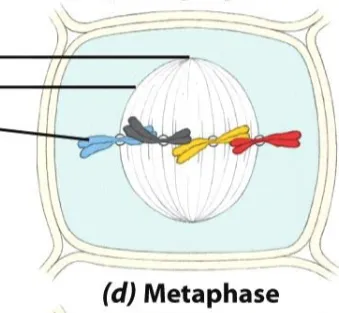 | The second step in Mitosis
1. Mitotic spindle attaches to kinetochores
2. Chromosomes align on Metaphase plate |
Anaphase 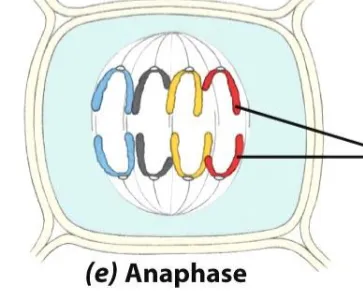 | The third step in Mitosis
1. Sister chromatids separate into daughter chromosomes |
Telophase 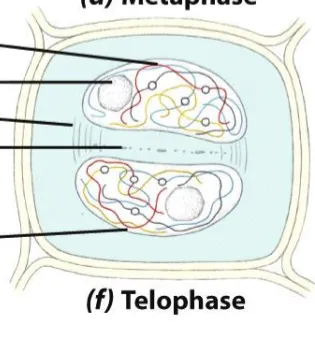 | The fourth step in Mitosis
1. Reverse of Prophase
2. Cytokinesis begins |
Cytokinesis (in plants) 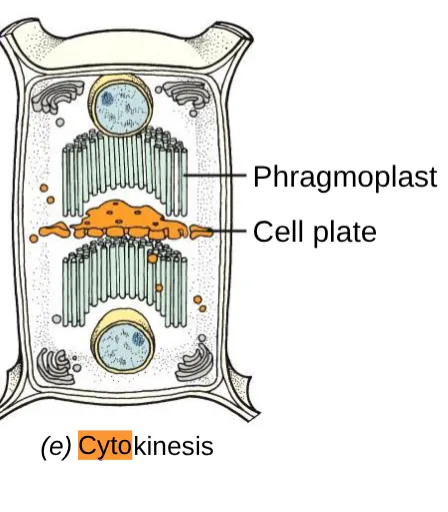 | The final step in Mitosis
1. Phragmoplast forms during Telophase
2. Cell plate forms from vesicles and grows outward
|
A chromosome is a- | -single DNA molecule |
Chromatin is the- | -DNA-histone complex in the nucleus (Eurchromatin and Heterochromatin) |
A genome is the- | -complete set of DNA in a cell |
Structure of a chromosome 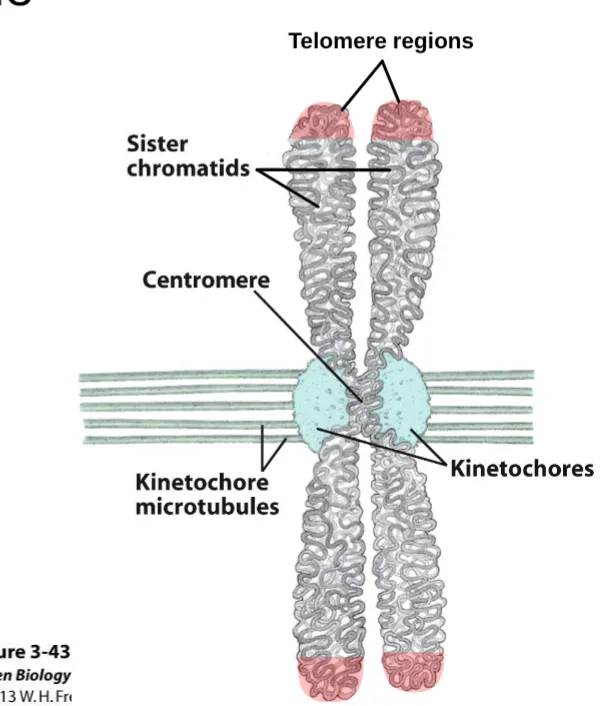 | Chromatids, Centromere, Telomere, and Kinetochore |
Genomes have a- | -set number of chromosomes (the human genome has 46 per cell, 23 pairs) |
Ploidy | The number of sets of chromosomes in a cell, haploid cells have one full set and diploid cells have two full sets |
Plants are- | -flexible as to ploidy, they may be diploid, triploid, teteaploid, to polyploid |
Typically somatic cells (body cells) are- | -diploid |
Typically gametic cells (germ cells) are- | -haploid |
Sexual Reproduction | Syngamy
-Gamete
-Zygote
-Embryo |
Asexual Reproduction | -Spore
-Vegatative reproduction/propagation
-Apomixis |
Meiosis | Consists of Meiosis 1 (Reduction %) and Meiosis 2 (as in Mitosis) |
Meiosis 1 | (Reduction step), consists of Prophase 1, Metaphase 1, Anaphase 1, and Telophase 1 |
Prophase 1 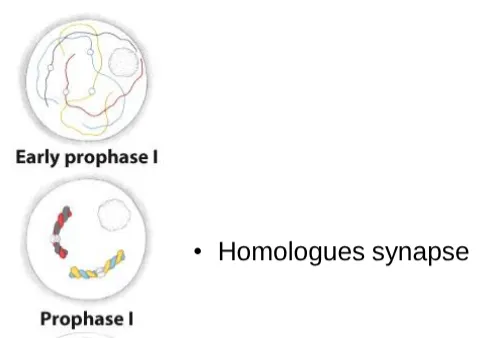 | The first step in Meiosis 1
1.Homologues synapse (forming covalents, synaptonemal complex)
2. Crossing over (chiasma) |
Metaphase 1 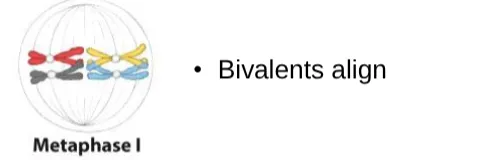 | The second step in Meiosis 1
1. Bivalents align
|
Anaphase 1 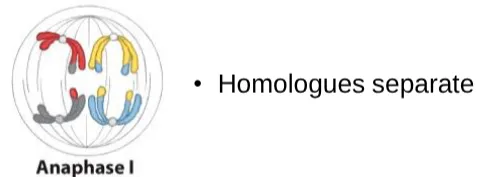 | The third step in Meiosis 1
1. Homologues separate |
Results of Meiosis | -Formation of 4 haploid cells
-Genetic recombination (Mitosis results in identical nuclei and Meiosis results in different nuclei) |
Inheritance | The passing of traits from one generation to the next |
Traits are coded for by- | -genes |
Genes are segments of- | -DNA on a chromosome |
The location of a gene on a chromosome | Locus |
Alleles are- | -alternative forms of a gene, they are located at the same locus on homologous chromosomes |
Genetics | The study of heredity |
The principle of segregation (Mendel's 1st law) | Genes (traits) segregate during gametogenesis (Meiosis), some alleles mask the expression of other alleles |
Dominant alleles | The expressed trait |
Recessive alleles | The unexpressed trait |
Phenotype | The physical expression of a trait |
Genotype | The genetic makeup that produces a trait |
Homozygous genotype | Both alleles are the same (Homozygous dominant (AA) and Homozygous recessive (aa)) |
Heterozygous genotype | Both alleles are different (Aa) |
The principle of independent assortment (Mendel's 2nd law) | The segregation of genes (and their alleles) is independent of other genes/and their alleles, this is demonstrated using a dihybrid cross |
Pleiotropy | Genes with multiple phenotypic effects (like sickle cell disease) |
Mutation | A change to the hereditary makeup of an organism |
Cytoplasmic Inheritance | Maternal inheritance |
Mutation | A change to the hereditary make-up of an organism |
Point Mutation | Changes to the DNA sequence that is caused by mutagens |
Mutagens | Cause mutations |
Chromosome Mutations | Changes of the chromosomes |
Deletions | A chromosome mutation that is the loss of regions of a chromosome |
Duplications | A chromosome mutation that is the doubling of part of a chromosome |
Inversions | A chromosome mutation that is the inverting of a segment of a chromosome |
Translocations | A chromosome mutation that is the exchange of non-homologous pieces of DNA |
Position Effects | Change in the location of segments of the DNA |
Transposons | ('jumping genes') Movable genetic elements |
Genome Mutations | Changes to the genome |
Anueploidy | Adding or subtracting individual chromosomes |
Polyploidy | Adding or subtracting whole sets of chromosomes |