Which of the following statements is FALSE according to Dalton's Atomic Theory?
a. Atoms combine in simple whole-number ratios to form compounds.
b. All atoms of chlorine have identical properties that distinguish them from other
elements.
c. One carbon atom will combine with one oxygen atom to form a molecule of carbon
monoxide.
d. Atoms of sodium do not change into another element during a chemical reaction with
chlorine.
e. An atom of nitrogen can be broken down into smaller particles that will still have the
unique properties of nitrogen
E- Atoms cannot be broken down
| Term | Definition |
|---|---|
Which of the following statements is FALSE according to Dalton's Atomic Theory?
a. Atoms combine in simple whole-number ratios to form compounds.
b. All atoms of chlorine have identical properties that distinguish them from other
elements.
c. One carbon atom will combine with one oxygen atom to form a molecule of carbon
monoxide.
d. Atoms of sodium do not change into another element during a chemical reaction with
chlorine.
e. An atom of nitrogen can be broken down into smaller particles that will still have the
unique properties of nitrogen | E- Atoms cannot be broken down |
Which of the following statements about subatomic particles is TRUE?
a. Neutral atom contains the same number of protons and electrons.
b. Protons have about the same mass as electrons.
c. Electrons make up most of the mass of an atom.
d. Protons and neutrons have opposite, but equal in magnitude, charges.
e. Neutrons and electrons are found in the nucleus of an atom | A- A neutral atom has no overall electrical charge & Neutral atom → protons = electrons |
Which of the following is a metal?
a. chlorine
b. mercury
c. iodine
d. carbon
e. silicon | B- Mercury (Hg) |
A sample has a mass of 819 g and a volume of 60 cm3. What is the identity of the
sample?
a. aluminum (density = 2.7 g/cm3)
b. silver (density = 10.5 g/cm3)
c. copper (density = 8.92 g/cm3)
d. iron (density = 7.86 g/cm3)
e. mercury (density = 13.6 g/cm3) | E- D=M/V (819/60)=13.6g |
An element containing 27 protons, 27 electrons and 29 neutrons will have the symbol:
a. 83Co. b. 54Co. c. 54Cu. d. 56Cu. e. 56Co | E- Mass number = protons + neutrons
27 + 29 = 56/atomic number 27 = cobalt |
Which of the following is not a typical property of an ionic compound?
a. comprised of two non-metals
b. comprised of a metal and a non-metal
c. consists of anions and cations in a crystal lattice
d. has a high melting point
e. has a high boiling point | A- metal + a non-metal |
Which of the following contains the MOST atoms? You shouldn't need to do a
calculation here.
a. 10.0 g Ne
b. 10.0 g He
c. 10.0 g Ar
d. 10.0 g Kr
e. 10.0 g Mg | B- The element with the smallest atomic mass will have the most atoms in the same mass.
(Same grams → smaller atomic mass = more atoms) |
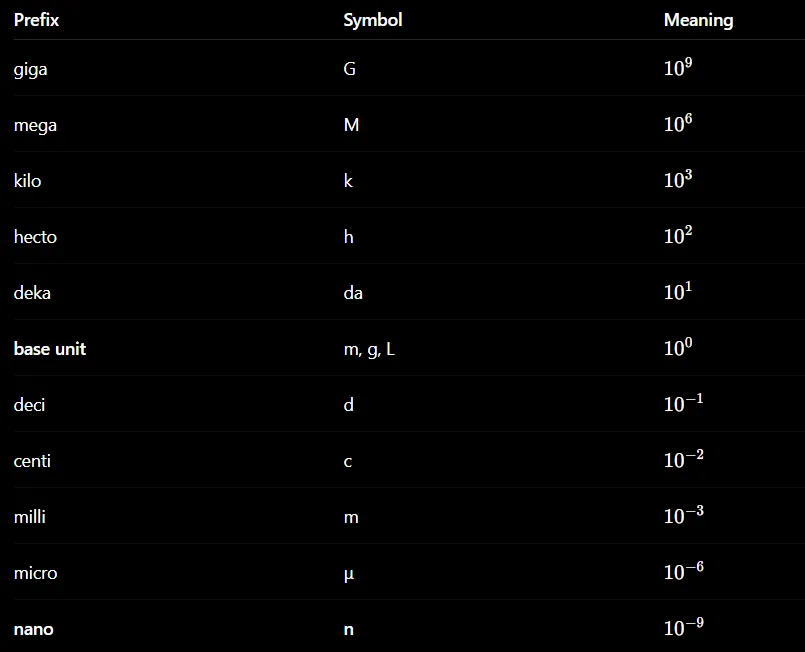
Convert 52 mg to grams. | 0.052 g
KHDBDCM (3 to the left)
 |
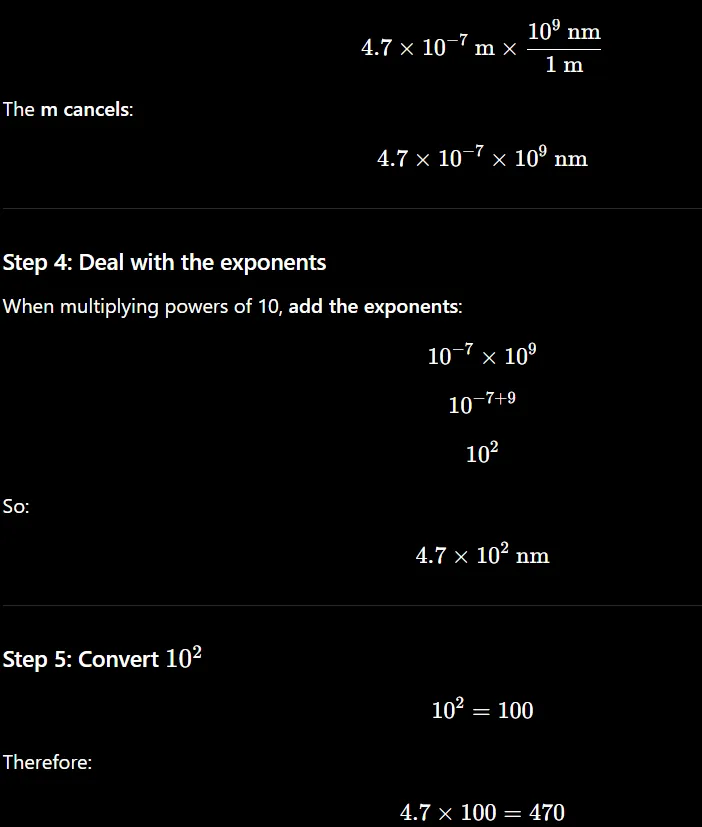
Convert 4.7 x 10⁻⁷ m to nm | 470nm
 |
MATCH:
_____accuracy
_____anion
_____cation
_____kilo
_____nano
_____precision
a. 10-9
b. 103
c. negatively charged ion
d. positively charged ion
e. closest to actual value
f. close to other measurements | E
C
D
B
A
F |