AICPA Statements on Auditing Standards
issued by the Auditing Standards Board (ASB) for audits of nonpublic companies.
| Term | Definition |
|---|---|
AICPA Statements on Auditing Standards | issued by the Auditing Standards Board (ASB) for audits of nonpublic companies. |
Public Company Accounting Oversight Board (PCAOB) Auditing Standards | issued for audits of public companies that have securities registered with the Securities and Exchange Commission (“issuers”). |
International Auditing and Assurance Standards Board (IAASB) International Standards on Auditing (ISAs), | which are infrequently used in audits performed in the United States. But, as discussed in Chapter 1, the ISA standards framework (numbering and ordering of sections of standards) has been adopted with some modification for auditing standards for nonpublic company audits. |
Regulation of the Profession PCAOB | 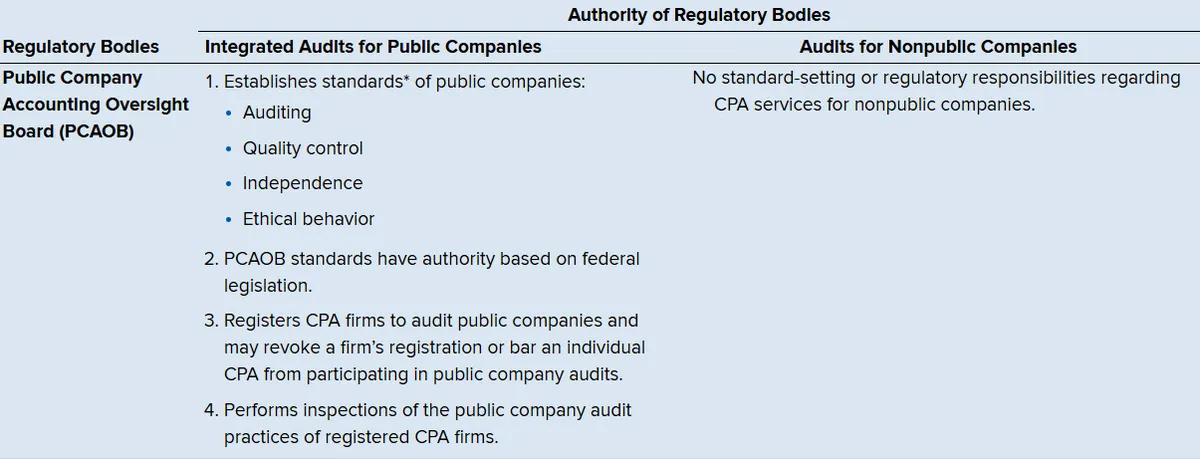 |
Regulation of the Profession AICPA (American Institute of Certified Public Accountants) | 5. The AICPA’s Private Companies Practice Section (PCPS) supports CPA firms in the everyday intricacies of running a practice. PCPS partners with firms of all sizes, creating targeted and customizable practice management resources and networking opportunities, and is a strong, collective voice within the CPA profession. 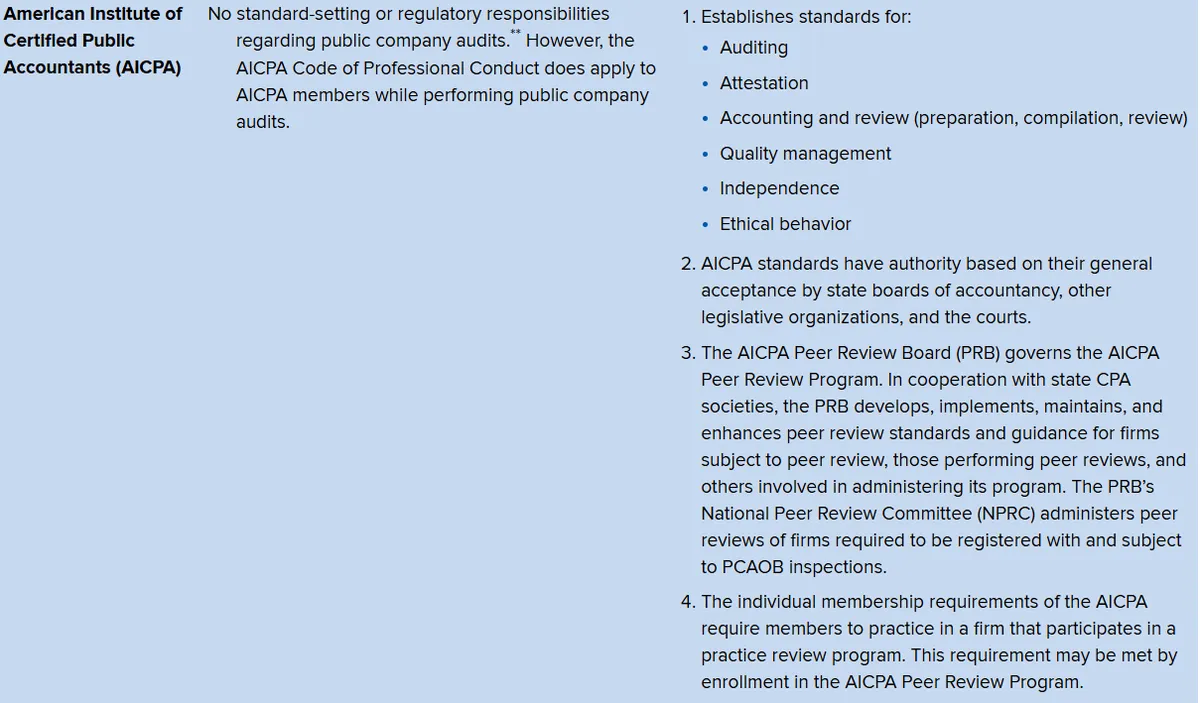 |
Regulation of profession State board of accountancy |  |
Clarified Statements on Auditing Standards (SASs) | The AICPA’s Auditing Standards Board (ASB) issues auditing standards in the form of |
Principles Underlying an Audit Conducted in Accordance with Generally Accepted Auditing Standards* Part 1 | 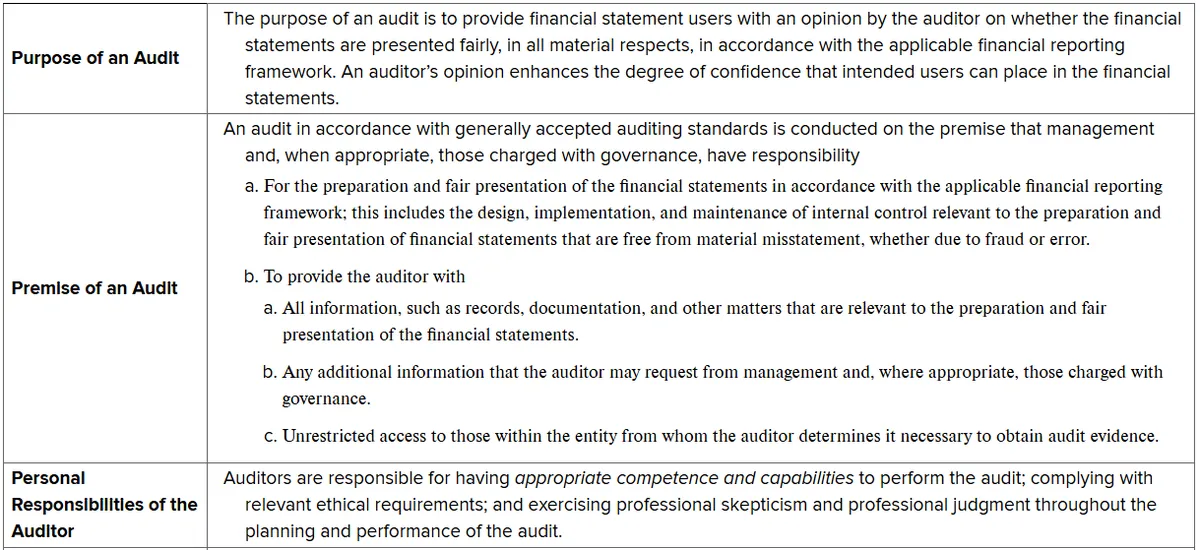 |
Principles Underlying an Audit Conducted in Accordance with Generally Accepted Auditing Standards* Part 2 | 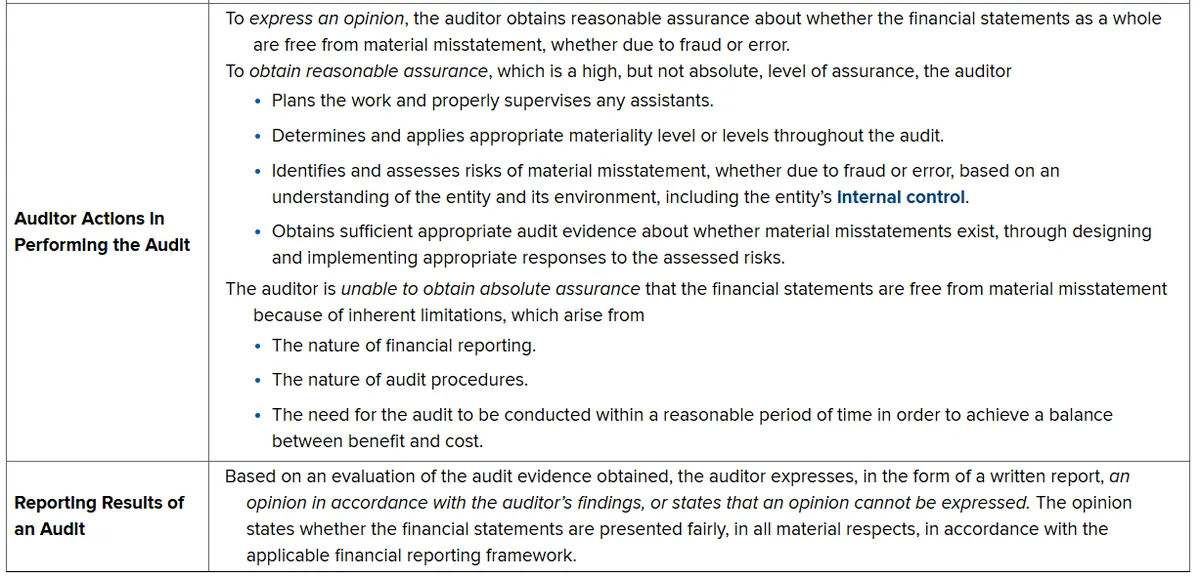 |
. Professional skepticism | includes a questioning mind, being alert to conditions that may indicate possible misstatement due to fraud or error, and a critical assessment of audit evidence. |
Reasonable assurance | implies that there is a low level of risk remaining that the auditors express an opinion that the financial statements are properly stated when they are not. |
Obtaining absolute assurance is not possible due to | the nature of financial reporting (e.g., the necessary use of judgment),
the nature of audit procedures (e.g., they often do not provide absolutely conclusive evidence), and
the need to conduct an audit within a reasonable period of time and at a reasonable cost. |
referred to as an “unconditional responsibility” | some audit requirements apply under all circumstances |
(“presumptively mandatory responsibility”) | while others are required unless the auditors can show that alternative actions are sufficient |
Professional Responsibilities: Terminology Used in Auditing Standards: PCAOB (Rule 3101) and Auditing Standards Board (AU-C 200) Combined | 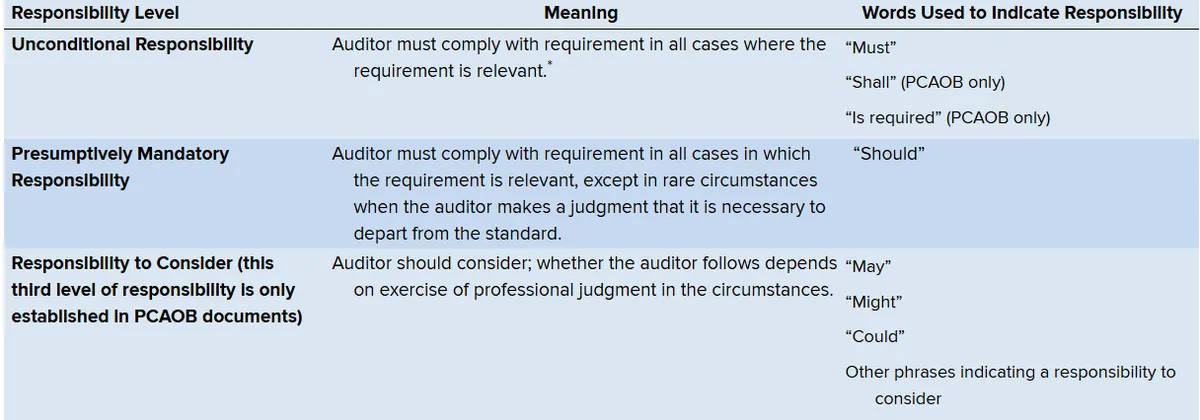 |
GAAS Hierarchy (generally accepted auditing standards) | 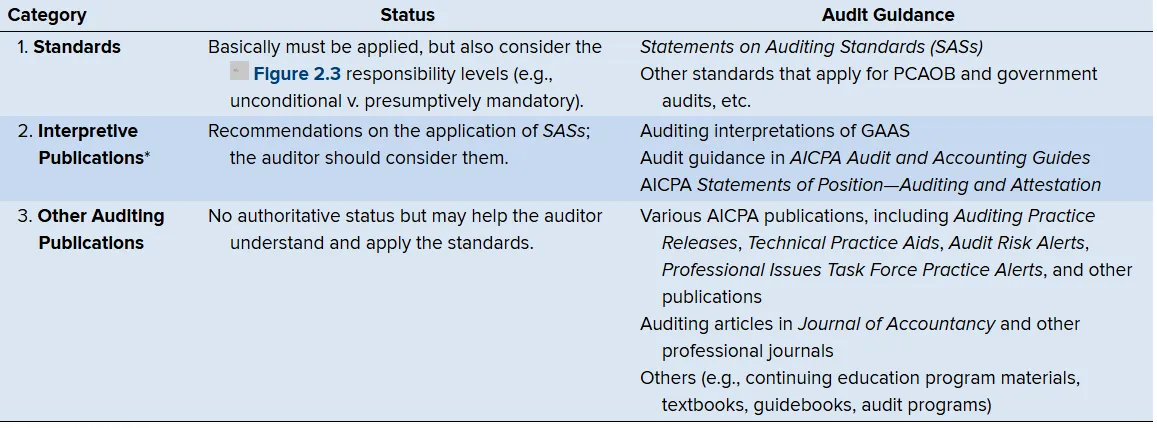 |
audit risk | the risk that the auditor expresses an inappropriate opinion when the financial statements are materially misstated, is at an acceptably low level. |
errors | as unintentional misstatements or omissions of amounts or disclosures in the financial statements. |
Fraud | as the term is used in financial statement auditing (AICPA AU-C 240; PCAOB AS 2401), relates to intentional acts that cause a misstatement of the financial statements. Misstatements due to fraud may occur due to either
fraudulent financial reporting or
misappropriation of assets. |
. The Professional Standards identify two types of laws and regulation: | those with a direct effect on the financial statement amounts and other laws. |
Direct effect laws | have a direct effect on the financial statements in that they determine the reported amounts or disclosures in those statements. |
other laws | Examples may include laws and regulations on securities trading, occupational safety and health, environmental protection, and equal employment. Their indirect effect may result from the need to disclose a contingent liability because of noncompliance with a law. |
what makes a deficiency “material”? | The FASB states (italics added) “the omission of an item in a financial report is material if, in light of surrounding circumstances, the magnitude of the item is such that it is probable that the judgment of a reasonable person relying upon the report would have been changed or influenced by the inclusion or correction of the item. |
Critical audit matters | are those that relate to financial statement accounts or disclosures and involved especially challenging, subjective, or complex auditor judgment. |
Other Information section (nonpublic co audit report) | when the financial statements are included in an annual report with other information (e.g., management report, financial summaries) and |
A Key Audit Matters (KAMs) (nonpublic co audit report) | section (a concept similar to the critical audit matters in public company reports) when the terms of the engagement call for one. |
Adequate disclosure | means the information is accurate and complete and has been clearly conveyed to the financial statement user. |
Consistency | For example, audit reports are modified to inform users of financial statements of a lack of in the application of accounting principles in relation to the prior year, or the fact that another audit firm is responsible for a significant portion of the audit |
general-purpose financial reporting framework. | Most frequently, in the United States, this framework is “accounting principles generally accepted in the United States of America.” Since they have general applicability, such standards are referred to as a |
The GAAP Hierarchy for Governmental Entities | FASB Concepts Statements
AICPA Issues Papers and Technical Practice Aids
International Accounting Standards Committee Statements
Pronouncements of other professional associations or regulatory agencies
Accounting textbooks, handbooks, and articles
FASAB Concepts Statements
Pronouncements in (a) through (d) of GASB and FASB not specifically made applicable
FASB and GASB Concepts Statements
AICPA Issues Papers and Technical Practice Aids
International Accounting Standards Committee Statements
Pronouncements of other professional associations or regulatory agencies
Accounting textbooks, handbooks, and articles 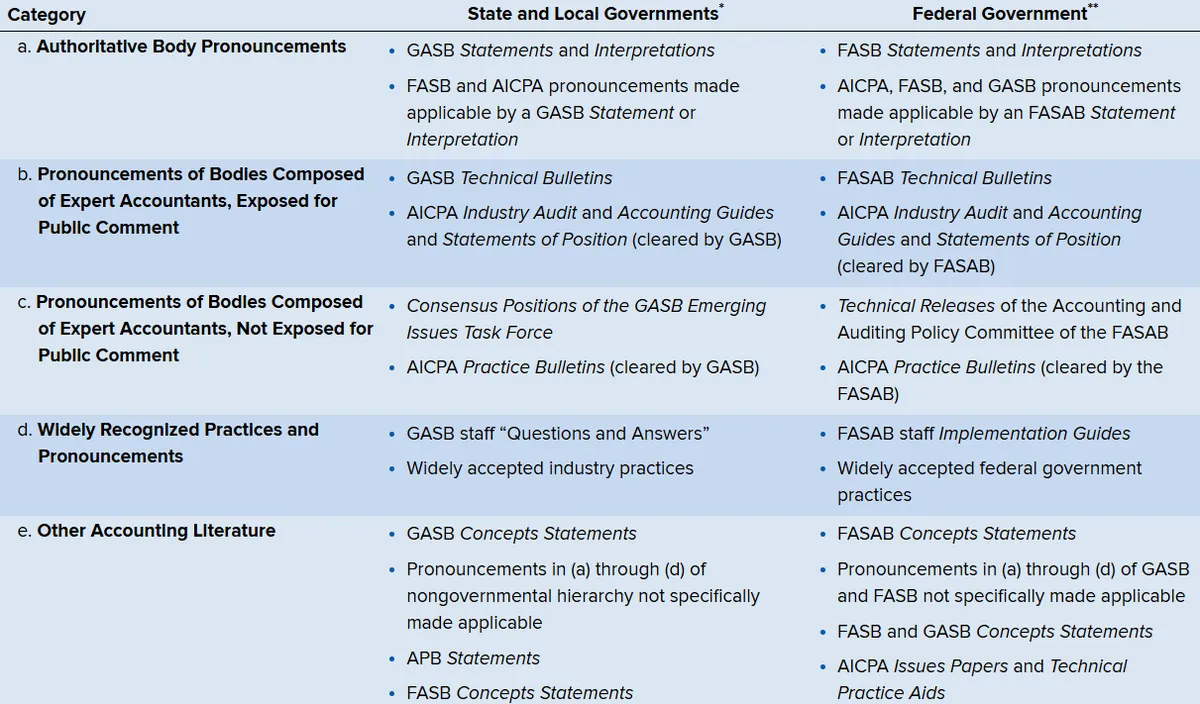 |
A qualified opinion | on financial statements states that except for the effects of the matter to which the qualification relates, the financial statements are fairly presented. |
An adverse opinion
| An adverse opinion states that the financial statements are not fairly presented. |
disclaimer of opinion | Auditors will issue a if they are unable to determine the overall fairness of the financial statements. |
integrated audit | (an audit of both the financial statements and internal control over financial reporting). |
AICPA Clarified Statements on Standards for Attestation Engagements (SSAEs) Organization | 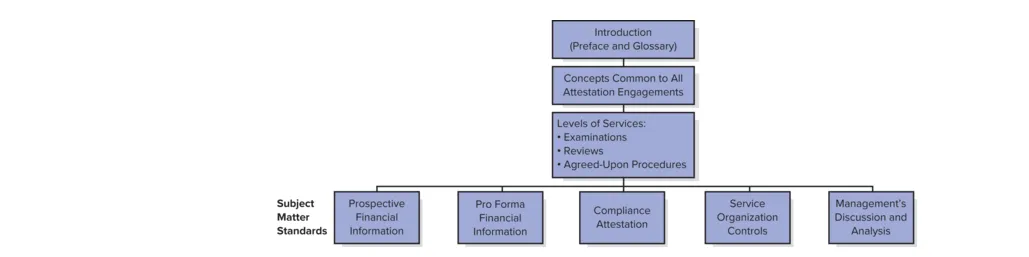 |
PCAOB Attestation Standards* | 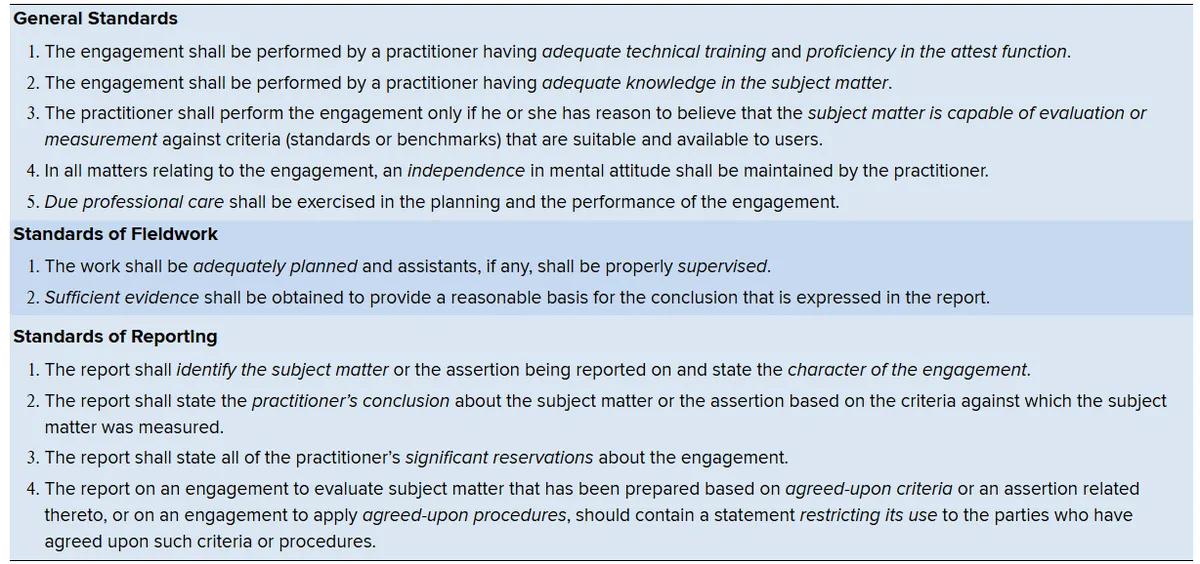 |
system of quality management (system of quality control per PCAOB) | Both the AICPA and the PCAOB have developed CPA firm standards that require a firm to implement a 10 for the firm’s accounting and auditing practice. These standards require CPA firms to design, implement, and operate a system that provides reasonable assurance that the firm follows professional standards and legal requirements on engagements and issues appropriate reports. |
. Quality risks | are risks with a reasonable possibility of occurring and adversely affecting the achievement of one or more quality objectives. |
Components of Quality Management 1-2 | 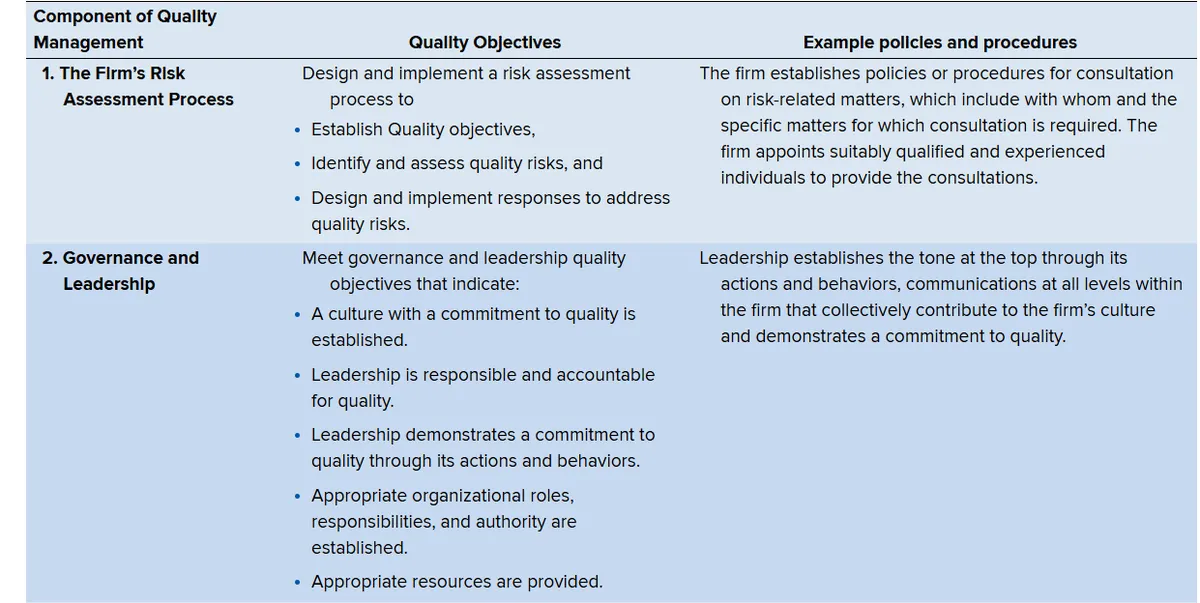 |
Components of Quality Management 3-5 | 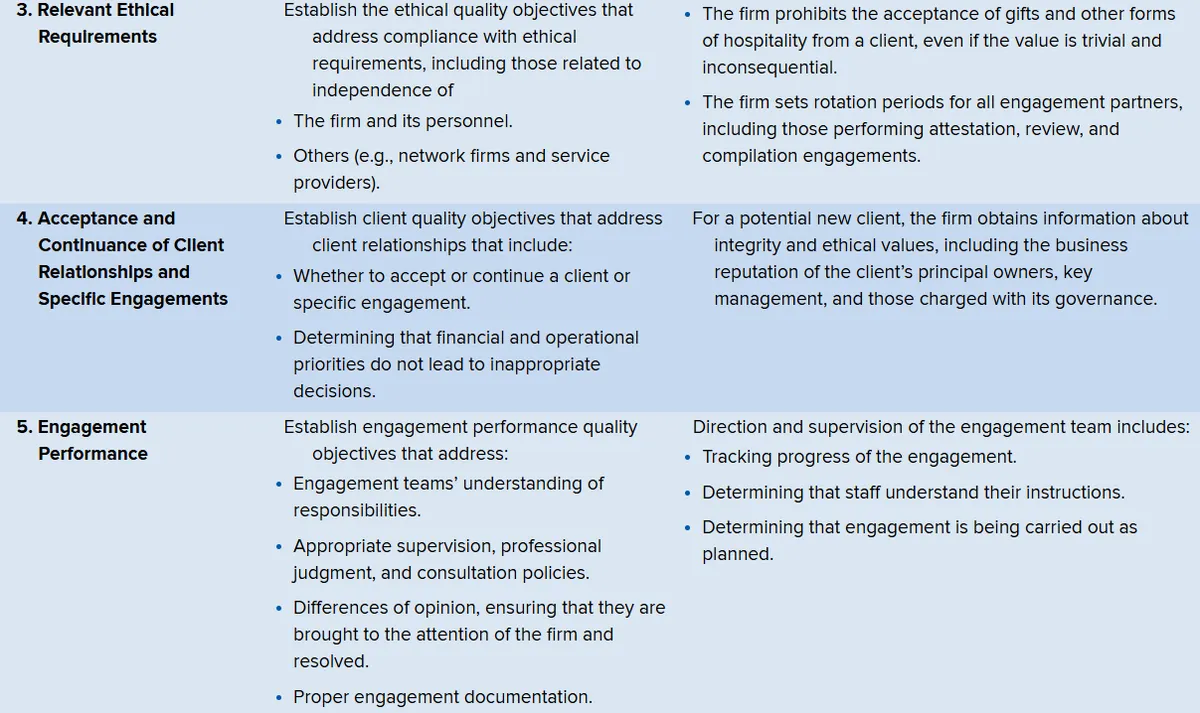 |
Components of Quality Management 6-8 | 8. The Monitoring and Remediation Process
Monitor the entire quality management system and remediate deficiencies, including those related to:
In-process engagements.
Completed engagements and engagement partners.
The firm inspects a completed engagement for each engagement partner performing audits of financial statements once every three years, and for all other engagement partners, once every five years. 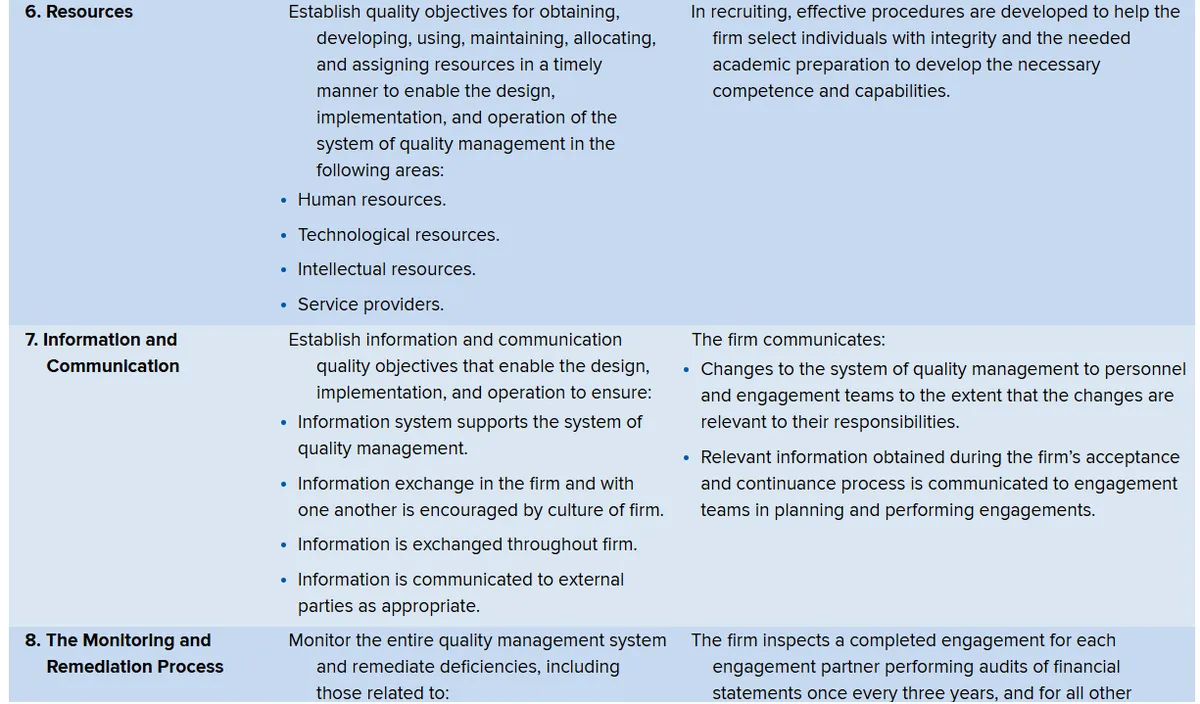 |
An engagement quality review | is performed prior to issuance of the engagement report by a quality reviewer who is otherwise independent of the engagement. These reviews focus on significant judgments and conclusions made by the audit team on the engagement, as contrasted to a complete review of the engagement. |
engagement quality reviewer | A partner, other individual in the firm, or an external individual appointed by the firm to perform the engagement quality review. The engagement quality reviewer should not be a member of the engagement team. |
peer review | Enrollment in this program requires the firm to undergo a every three years performed by another CPA, a CPA firm, or a team of CPAs. |
A system review | involves the peer reviewers’ study and appraisal of a CPA firm’s system of quality management (control) related to accounting and auditing engagements. |
An engagement review | , the second type of peer review, is one in which the peer reviewers select a sample of a CPA firm’s actual accounting and review work, including reports issued and the CPA firm’s documentation, to evaluate whether the work and reports are appropriate |
external inspections | PA firms with SEC registrants as clients are required to have performed by the PCAOB staff. As indicated earlier, inspections are performed annually for CPA firms with numerous public clients and less frequently for those with fewer public clients. |
The Sarbanes–Oxley Act provides that an inspection shall include at least the following three general components: |
An inspection and review of selected audit and review engagements;
An evaluation of the sufficiency of the quality control system of the firm and the manner of documentation and communication of the system; and
Tests of the audit, supervisory, and quality control procedures. |
An engagement quality review | that addresses the engagement’s significant judgments and conclusions reached. Engagement quality reviews, required by the PCAOB, are completed prior to issuance of the engagement report, and ordinarily performed by firm personnel who are otherwise independent of the audit and the client. |
A completed engagement inspection | includes review of engagement documentation, reports issued, and the client’s financial statements to provide support that the firm’s engagements are meeting quality requirements. While these inspections are ordinarily performed subsequent to completion of the audit, in certain situations it may be performed while the engagement is in process. It is ordinarily performed by firm personnel otherwise independent of the audit and the client to assure objectivity. |
Peer reviews and PCAOB inspections | (or inspections required by another regulatory agency) ordinarily consider the firm’s quality management (control) system and engagement performance. Most frequently these engagements are performed subsequent to conclusion of the audit by another CPA firm or a regulatory agency. |
International Financial Reporting Standards (IFRS) | developed by the International Accounting Standards Board (IASB), which has the objective of developing, in the public interest, a single set of high-quality understandable and enforceable global accounting standards. |
The international auditing standards | are developed by the International Federation of Accountants (IFAC)’s International Auditing and Assurance Standards Board (IAASB) for both public and nonpublic companies. |
key audit matters (KAMs) (international) | Most public company international audit reports also include a section on while inclusion for a nonpublic company is dependent upon terms of the engagement.
|
Generally Accepted Government Auditing Standards (GAGAS) | The Government Accountability Office issues Generally Accepted Government Auditing Standards (GAGAS) for federal entities and organizations that receive federal financial assistance. The standards apply to state and local government entities and not-for-profit organizations when the audits are required by law, regulation, or an agreement. |
The Single Audit Act | requires state and local governments, and nonprofit organizations that expend federal financial assistance of $750,000 or more within a fiscal year to have a single audit. |
Under the Employee Retirement Income Security Act of 1974 (ERISA), t | he Department of Labor (DOL) sets standards for most voluntarily established retirement and health plans in private industry with a goal of providing protection for individual members of the plans. These plans must provide annual financial statements and supplemental schedules (e.g., a detailed schedule of assets held and their values as of year-end) to their members. Section 103 of ERISA requires these plans to engage auditors to audit their financial statements in accordance with generally accepted auditing standards and provide an opinion on whether the plan’s financial statements are prepared following generally accepted accounting principles |