Ethics
Ethics has been defined as the study of moral principles and values that govern the actions and decisions of an individual or group.
| Term | Definition |
|---|---|
Ethics | Ethics has been defined as the study of moral principles and values that govern the actions and decisions of an individual or group. |
Ethical dilemmas/conflicts | often involve a mental conflict between differing moral requirements, in which to obey one requirement will result in disobeying another; the AICPA Code of Professional Conduct refers to these as ethical conflicts. |
The steps involved in making any decision generally include
|
Identify the problem.
Identify possible courses of action.
Identify any constraints relating to the decision.
Analyze the likely effects of the possible courses of action on stakeholders.
Select the best course of action. |
External standards | are those that are imposed upon an individual by society, peers, organizations, employers, or their profession. |
Internal standards | may be the result of your religious or other beliefs about the manner in which you should behave and make decisions. These standards involve such concepts as truthfulness, fairness, loyalty, and caring for others. |
All the recognized professions have several common characteristics. The most important characteristics are |
a responsibility to serve the public,
a complex body of knowledge,
standards of admission to the profession, and
a need for public confidence. |
The AICPA Code of Professional Conduct (the Code) | , adopted in 2014, provides guidance and rules to CPAs in the performance of their professional responsibilities. The principles are goal-oriented, positively stated statements on the profession’s responsibilities to the public, clients, and fellow practitioners. The principles provide the framework for the rules, which are the requirements that are enforceable under the AICPA bylaws. |
The principles | are goal-oriented, positively stated statements on the profession’s responsibilities to the public, clients, and fellow practitioners. The principles provide the framework for the rules, which are the requirements that are enforceable under the AICPA bylaws. |
rules | which are the requirements that are enforceable under the AICPA bylaws. |
Interpretations | The AICPA’s Professional Ethics Executive Committee issues to provide guidelines for the scope and application of the rules. |
Relationships of Principles, Rules, and Interpretations in Code of Professional Conduct | 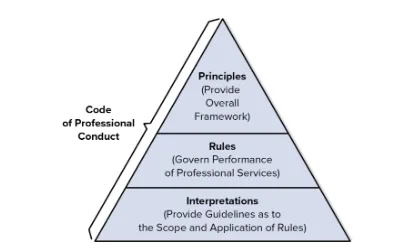 |
Sections of AICPA Code of Professional Conduct | 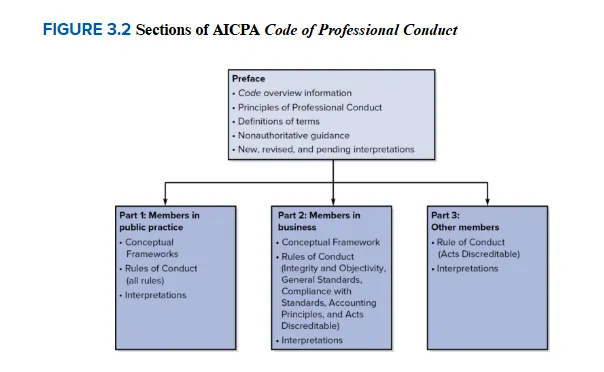 |
AICPA Code of Professional Conduct Principles | Responsibilities
In carrying out their responsibilities as professionals, members should exercise sensitive professional and moral judgments in all their activities.
The Public Interest
Members should accept the obligation to act in a way that will serve the public interest, honor the public trust, and demonstrate a commitment to professionalism.
Integrity
To maintain and broaden public confidence, members should perform all professional responsibilities with the highest sense of integrity.
Objectivity and Independence
A member should maintain objectivity and be free of conflicts of interest in discharging professional responsibilities. A member in public practice should be independent in fact and appearance when providing auditing and other attestation services.
Due Care
A member should observe the profession’s technical and ethical standards, strive to continually improve competence and the quality of services, and discharge responsibility to the best of the member’s ability.
Scope and Nature of Services
A member in public practice should observe the Principles of the AICPA Code in determining the scope and nature of services to be provided. |
Applicability of AICPA Code of Professional Conduct: Rules | 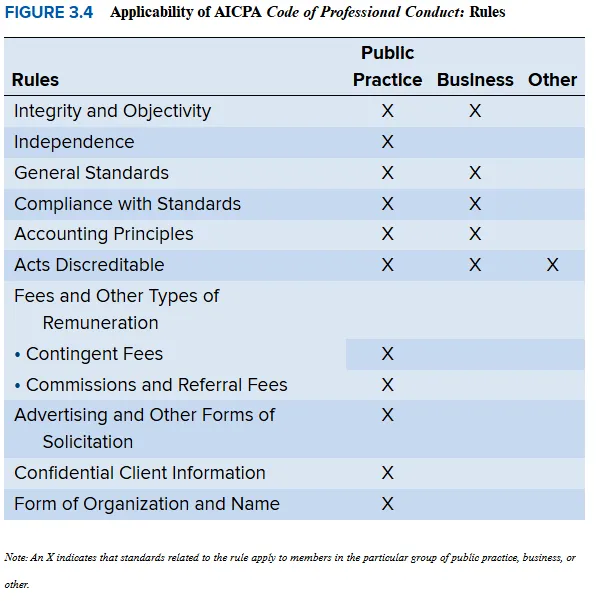 |
Conceptual Framework for Members in Public Practice: Evaluating Threats to Code Compliance | 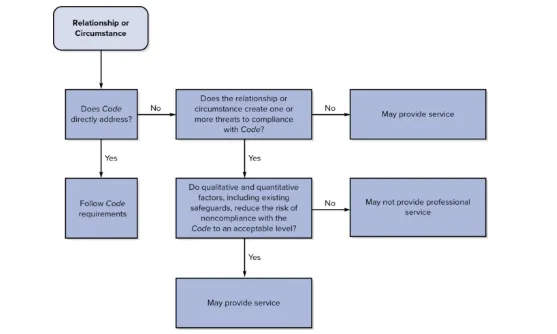 |
threat | When one or more circumstances or relationships are identified that create a situation that potentially might be viewed as a to Code compliance, the first step is to determine whether the Code directly resolves the situation. |
acceptable level of risk of noncompliance | A threat is at an acceptable level when a reasonable and informed third party who is aware of the relevant information would be expected to conclude that the threat would not compromise the member’s compliance with the Code. |
Broad Categories of Threats to Compliance with Rules | Adverse interest
Accountant will not act with objectivity because of interests opposed to the client’s interests.
1. Threatened or actual litigation between accountant and a client.
Advocacy
Accountant will promote a client’s interests or position and compromise objectivity or independence.
Promoting a client’s securities.
Endorsing a client’s services or products.
Familiarity
Accountant will become too sympathetic to the client’s interests or too accepting of client’s work or product due to a long or close relationship.
Accountant’s immediate family, close relative, or friend is employed by client.
A former partner or professional employee joins the client in a key position and has knowledge of CPA firm’s policies and practices.
Management participation
Accountant will take on the role of client management or otherwise assume management responsibilities.
1. Accountant assumes a client’s role while performing nonaudit services.
Self-interest
Accountant could benefit, financially or otherwise, from an interest in, or relationship with, a client.
Accountant has a financial interest in a client, and the outcome of an engagement may affect the value of the interest.
Accountant’s spouse enters into employment negotiations with a client.
Accountant excessively relies on revenue from a single client.
Self-review
Accountant will not appropriately evaluate results of a previous judgment made or service performed or supervised by the accountant or the accountant’s firm.
Accountant performs bookkeeping services for a client.
A partner in the member’s office was associated with the client as an employee, officer, director, or contractor.
Undue influence
Accountant will subordinate judgment to that of an individual associated with a client due to client’s reputation, expertise, dominant personality, or attempts to coerce or excessively influence the accountant.
CPA firm is threatened with dismissal.
An individual associated with a client threatens to withdraw or terminate a professional service unless the accountant reaches certain judgments or conclusions. |
Safeguards | are controls that mitigate or eliminate threats to independence. For members in practice, there are three broad categories of safeguards:
Safeguards created by the profession, legislation, or regulation (e.g., education requirements, and competency requirements for professional licensure).
Safeguards implemented by the attest client (e.g., management with suitable skills and experience to make managerial decisions, or effective oversight by an independent board of directors).
Safeguards put in place by the CPA firm, including policies and procedures for implementing professional and regulatory requirements (e.g., firm leadership that stresses the importance of complying with the rules, internal policies and procedures designed to monitor compliance with firm policies and procedures, and a disciplinary mechanism designed to promote compliance with policies and procedures). |
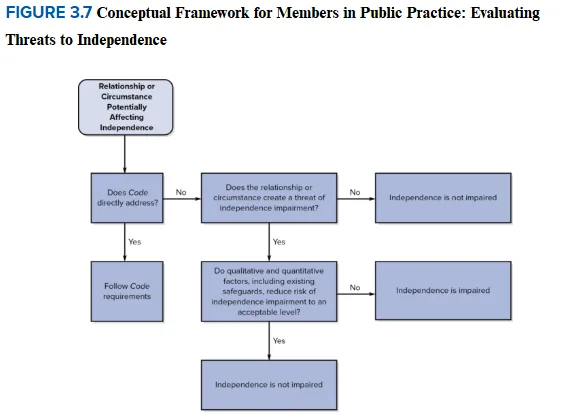
Independence Rule: | A member in public practice shall be independent in the performance of professional services as required by standards promulgated by bodies designated by Council. |
Independence of mind | is a state of mind that permits the CPA to perform an attest service without being affected by influences that might compromise professional judgment, thereby allowing that individual to act with integrity and to exercise objectivity and professional skepticism. |
Independence in appearance | requires the avoidance of circumstances that might cause a reasonable and informed third party, aware of all relevant information, including safeguards applied, to reasonably conclude that the integrity, objectivity, or professional skepticism of an audit firm or member of the attest engagement team has been compromised. |
Conceptual Framework for Members in Public Practice: Evaluating Threats to Independence
|  |
Broad Categories of Threats to Independence | Adverse interest
Actions between the public accountant and the client that are in opposition
1. Threatened or actual litigation between the public accountant and the client
Advocacy
Actions promoting an attest client’s interest or position
Promoting client securities as part of an initial public offering
Representing a client in U.S. Tax Court
Familiarity
Accountants having a close or long-standing relationship with client personnel
A spouse or close friend holds a key position with the client (e.g., chief executive officer)
A partner or partner equivalent has provided attest services for a prolonged period
An accountant for the CPA firm recently was a director or officer at the client firm
Management participation
The accountant taking on the role of client management or otherwise performing management functions
Serving as an officer or director of the client
Establishing and maintaining internal controls for the client
Hiring, supervising, or terminating the client’s employees
Self-interest
A potential benefit to the accountant from a financial interest in, or some other financial relationship with, an attest client
Having a direct financial interest or a material indirect financial interest in the client
Having a loan from the client
Excessive reliance on revenue from a single attest client
Having a material joint venture with the client
Self-review
As a part of an attest engagement, using evidence that results from the firm’s nonattest work
1. The CPA firm has provided nonaudit services relating to the information system and the accountant is now considering results obtained from that information system in the audit
Undue influence
An attest client’s management coerces the public accountant or exercises excessive influence over the accountant
Threat to replace firm over a disagreement on the application of an accounting principle
Pressure to reduce audit procedures for the purpose of reducing audit fees
A gift from the client that is other than clearly insignificant
|
A covered member | is an individual, firm, or entity that is capable of influencing an attest engagement. Covered members include:
An individual on the attest engagement team.
An individual in a position to influence the attest engagement (e.g., a partner who directly supervises the partner who is in charge of the attest engagement).
A partner or partner equivalent5 in the office in which the partner in charge of the attest engagement primarily practices in connection with the attest engagement.
Certain partners, partner equivalents, or managers who provide nonattest services to the client.
The public accounting firm, including its employee benefit plan.
Any entity controlled by one or more of the above.6 |
A financial interest | is an ownership interest in an equity or a debt security issued by an entity; such an interest may be either direct or indirect. |
A direct financial interest | includes an investment in the client, such as owning capital stock or providing loans to the client |
An indirect financial interest | generally involves an intermediary of some sort; for example, assume that a CPA invests in a mutual fund, which in turn owns stock in a client of that CPA. |
Concerning direct and indirect financial relationships of covered members: | All direct financial interests are prohibited, regardless of amount.
Material indirect financial interests are prohibited. |
Effect on Independence of Family Members, Relatives, and Friends* | 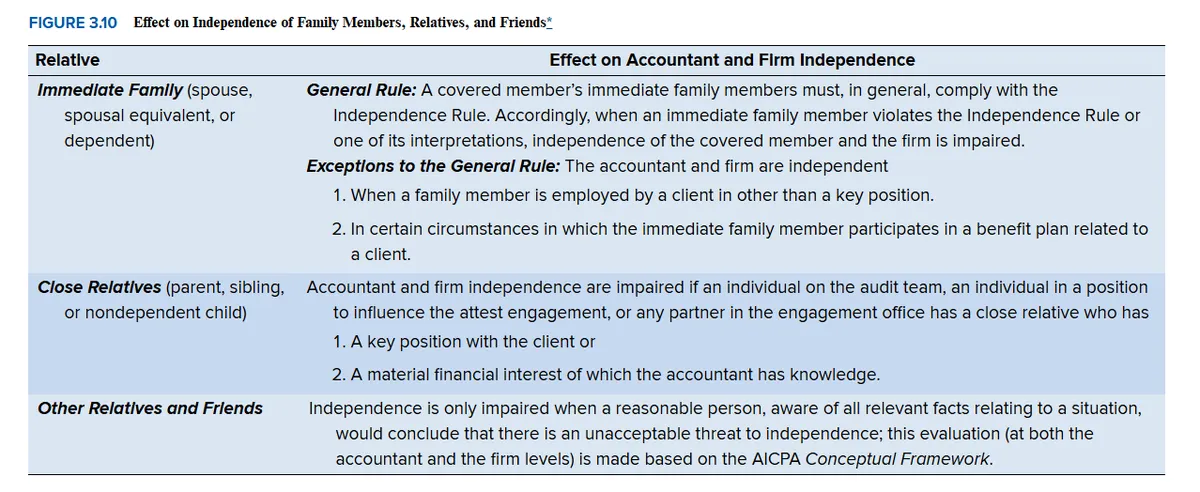 |
Acceptable levels of threats to independence | Threats to independence are at an acceptable level when unpaid fees are clearly insignificant and relate to professional services provided less than one year prior to the issuance date of the current report.
Threats are not at an acceptable level when unpaid fees are at a significant level and relate to professional services provided more than one year prior to the issuance date of the current report.
Other situations may require judgment as to whether they should be considered threats to independence depending upon the facts involved. |
Concerning the design and installation of an information system, the Code outlines services that do not impair independence and those that do. Services that do not impair independence: | Relate to a system other than the financial information system (e.g., certain information systems used only for controlling efficiency and effectiveness of operations).
Relate to implementation (using vendor-available settings) of commercial off-the-shelf financial information system software where the service does not include activities such as those listed in the following bullets. |
Services that impair independence: (info system installation) | Relate to modification of commercial off-the-shelf financial information system software (e.g., design, development, customizations, the building of interfaces, or the creation of data translation programs).
Relate to a financial information system the CPA designs or develops. |
The PCAOB standards resolve this by stating that when a provision of the SEC’s independence requirements is more restrictive—or less restrictive—than that of the PCAOB, the accounting firm must comply with | the more restrictive rule (PCAOB Rules 3500T and 3520). |
Comparison of Sarbanes–Oxley and AICPA Requirements Regarding Providing Nonattest Services to Audit Clients (1) | 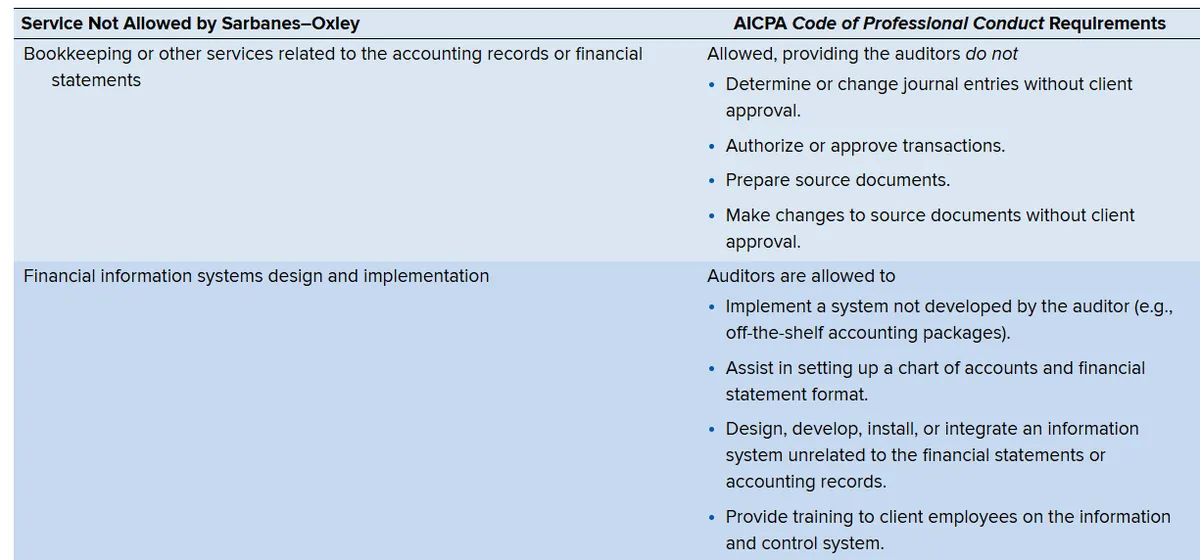 |
Comparison of Sarbanes–Oxley and AICPA Requirements Regarding Providing Nonattest Services to Audit Clients (2) | 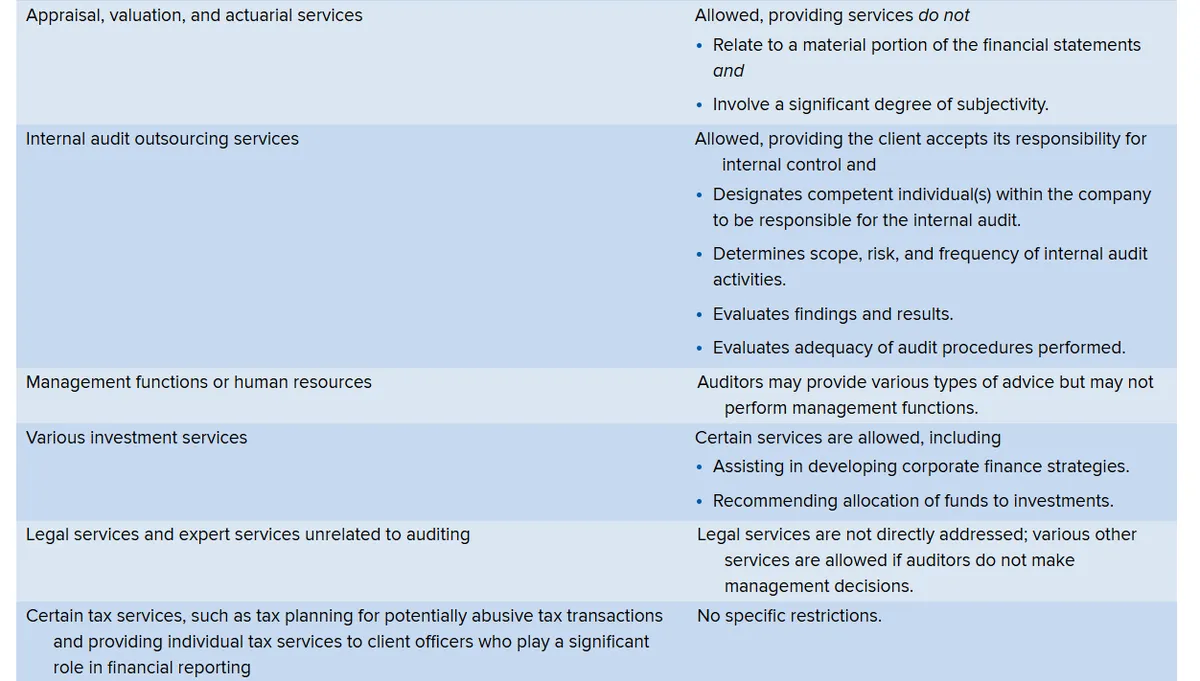 |
In the performance of any professional service, a member shall maintain objectivity and integrity, shall be free of conflicts of interest, and shall not knowingly misrepresent facts or subordinate his or her judgment to others. | Integrity and Objectivity Rule: |
General Standards Rule: | A member shall comply with the following standards and with any interpretations thereof by bodies designated by Council.
Professional Competence. Undertake only those professional services that the member or the member’s firm can reasonably expect to be completed with professional competence.
Due Professional Care. Exercise due professional care in the performance of professional services.
Planning and Supervision. Adequately plan and supervise the performance of professional services.
Sufficient Relevant Data. Obtain sufficient relevant data to afford a reasonable basis for conclusions or recommendations in relation to any professional services performed. |
Technical Bodies and Their Authority | Public Company Accounting Oversight Board
Auditing and related attestation standards, quality control independence ethic, and other standards for public (issuer) companies.
General Standards
Compliance with Standards 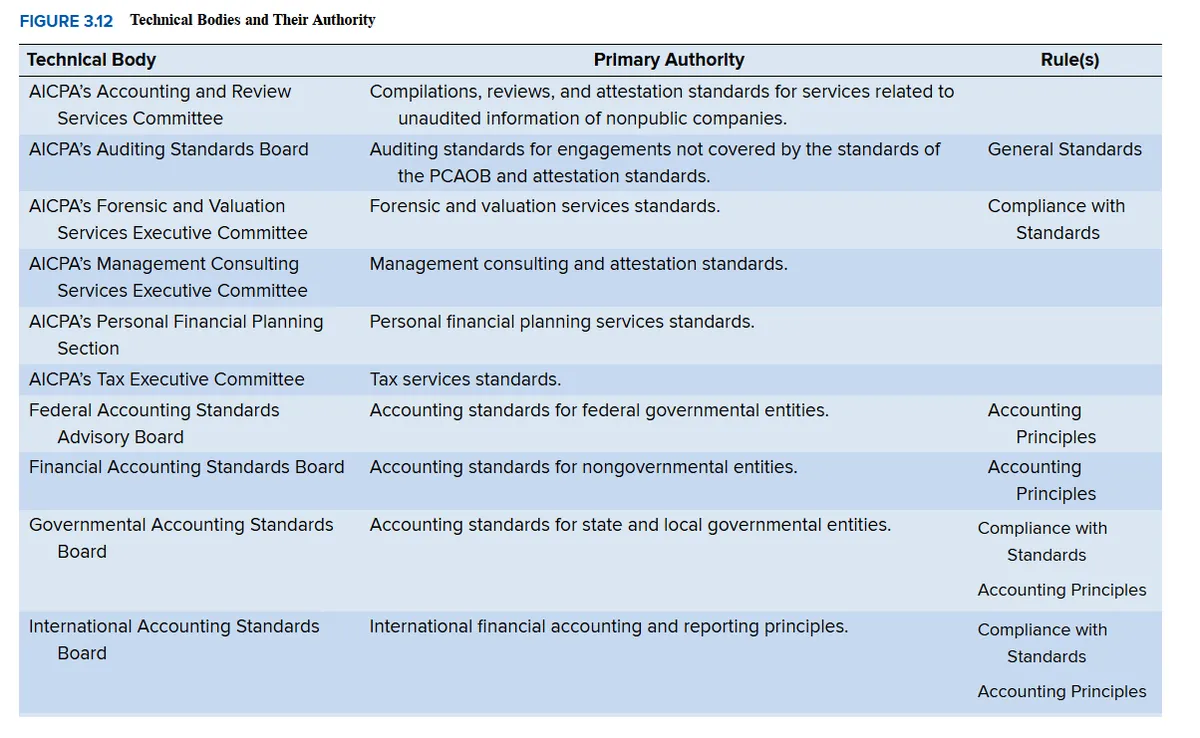 |
Compliance with Standards Rule: | A member who performs auditing, review, compilation, management consulting, tax, or other professional services shall comply with standards promulgated by bodies designated by Council. |
Accounting Principles Rule: | A member shall not
express an opinion or state affirmatively that the financial statements or other financial data of any entity are presented in conformity with generally accepted accounting principles or
state that he or she is not aware of any material modifications that should be made to such statements or data in order for them to be in conformity with generally accepted accounting principles, if such statements or data contain any departure from an accounting principle promulgated by bodies designated by Council to establish such principles that has a material effect on the statements or data taken as a whole.
If, however, the statements or data contain such a departure and the member can demonstrate that due to unusual circumstances the financial statements or data would otherwise have been misleading, the member can comply with the rule by describing the departure, its approximate effects, if practicable, and the reasons why compliance with the principle would result in a misleading statement. |
Acts Discreditable Rule: | A member shall not commit an act discreditable to the profession. |
Contingent Fees Rule: | A member in public practice shall not:
Perform for a contingent fee any professional services for, or receive such a fee from a client for whom the member or the member’s firm performs:
An audit or review of a financial statement; or
A compilation of a financial statement when the member expects, or reasonably might expect, that a third party will use the financial statement and the member’s compilation report does not disclose a lack of independence; or
An examination of prospective financial information; or
Prepare an original or amended tax return or claim for a tax refund for a contingent fee for any client.
The prohibition in (1) above applies during the period in which the member or the member’s firm is engaged to perform any of the services listed above and the period covered by any historical financial statements involved in any such listed services.
Except as stated in the next sentence, a contingent fee is a fee established for the performance of any service pursuant to an arrangement in which no fee will be charged unless a specified finding or result is attained, or in which the amount of the fee is otherwise dependent upon the finding or result of such service. Solely for purposes of this rule, fees are not regarded as being contingent if fixed by courts or other public authorities, or, in tax matters, if determined based on the results of judicial proceedings or the findings of governmental agencies.
A member’s fees may vary depending, for example, on the complexity of services rendered. |
Commissions and Referral Fees Rule: |
Prohibited commissions. A member in public practice shall not for a commission recommend or refer to a client any product or service, or for a commission recommend or refer any product or service to be supplied by a client, or receive a commission, when the member or the member’s firm also performs for that client:
An audit or review of a financial statement.
A compilation of a financial statement when the member expects, or reasonably might expect, that a third party will use the financial statement and the member’s compilation report does not disclose a lack of independence.
An examination of prospective financial information.
This prohibition applies during the period in which the member is engaged to perform any of the services listed above and the period covered by any historical financial statements involved in such listed services.
Disclosure of permitted commissions. A member in public practice who is not prohibited by this rule from performing services for or receiving a commission and who is paid or expects to be paid a commission shall disclose that fact to any person or entity to whom the member recommends or refers a product or service to which the commission relates.
Referral fees. Any member who accepts a referral fee for recommending or referring any service of a CPA to any person or entity or who pays a referral fee to obtain a client shall disclose such acceptance or payment to the client. |
Advertising and Other Forms of Solicitation Rule: | A member in public practice shall not seek to obtain clients by advertising or other forms of solicitations in a manner that is false, misleading, or deceptive. Solicitation by the use of coercion, overreaching, or harassing conduct is prohibited.
Source: AICPA Code of Profess |
Confidential Client Information Rule: | A member in public practice shall not disclose any confidential client information without the specific consent of the client.
This rule shall not be construed
to relieve a member of the member’s professional obligations of the Compliance with Standards Rule or the Accounting Principles Rule,
to affect in any way the member’s obligation to comply with a validly issued and enforceable subpoena or summons, or to prohibit a member’s compliance with applicable laws and government regulations,
to prohibit review of a member’s professional practice under AICPA or state CPA society or Board of Accountancy authorization, or (4) to preclude a member from initiating a complaint with or responding to any inquiry made by the professional ethics division or trial board of the Institute or a duly constituted investigative or disciplinary body of a state CPA society or Board of Accountancy.
Members of any of the bodies identified in (4) above and members involved with professional practice reviews identified in (3) above shall not use to their own advantage or disclose any member’s confidential client information that comes to their attention in carrying out those activities. This prohibition shall not restrict members’ exchange of information in connection with the investigative or disciplinary proceedings described in (4) above or the professional practice reviews described in (3) above. |
Form of Organization and Name Rule: |
A member may practice public accounting only in a form of organization permitted by state law or regulation, whose characteristics conform to resolutions of Council.
A member shall not practice public accounting under a firm name that is misleading.
Names of one or more past owners may be included in the firm name of a successor organization.
A firm may not designate itself as “Members of the American Institute of Certified Public Accountants” unless all of its owners are members of the AICPA. |
CPA Responsabilty | 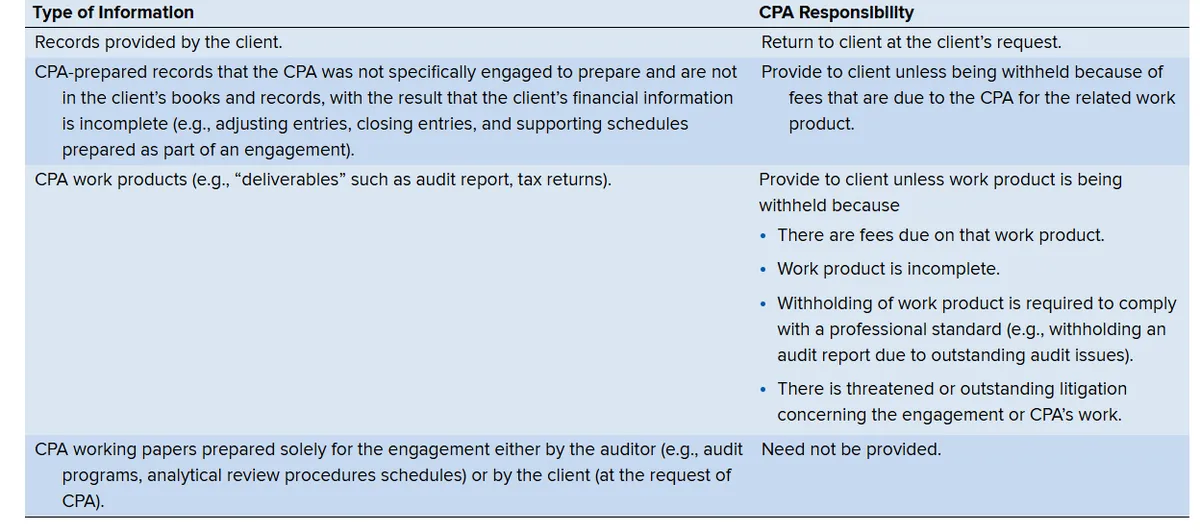 |
Illustration of an Alternative Practice Structure |  |