| Term | Definition |
|---|---|
LOGICAL POSITIVISM & NEOBHAVIORISM | |
What is positivism (Comte’s view)?
| Science should study only observable phenomena and avoid metaphysical speculation. |
What did Ernst Mach contribute to positivism?
| He argued that knowledge is based on sensations, and science should describe relationships between sensations. |
What is logical positivism?
| A 1920s movement (Vienna Circle) combining empiricism + logic, allowing theoretical concepts if they link to observation. |
What is the key difference between positivism and logical positivism?
| Positivism = only observable data
Logical positivism = allows theoretical terms if they are logically tied to observations |
What are observational terms?
| Terms that refer to directly measurable, observable events. |
What are theoretical terms?
| Abstract concepts used to explain observations (e.g., memory, intelligence). |
What is the verification principle?
| A statement is meaningful only if it can be verified through observation. |
OPERATIONISM | |
Q: What is operationism (Bridgman)?
| Scientific concepts must be defined by the operations used to measure them. |
What is an operational definition?
| A concept defined in terms of measurable procedures or tests. |
Example of an operational definition (anxiety)?
| Anxiety = increased heart rate, sweating, and self-report rating scales. |
Why was operationism important in psychology?
| It made concepts clear, measurable, and scientifically testable. |
NEOBHAVIORISM | |
What is neobehaviorism?
| Behaviorism combined with logical positivism and operational definitions. |
What are key features of neobehaviorism?
| - Theoretical terms allowed (if operationalized)
- Focus on learning
- Use of animal research
- Emphasis on prediction and control |
Why did neobehaviorists use animals?
| Behavior is easier to control and generalizable across species. |
EDWIN GUTHRIE | |
What is Guthrie’s single law of learning?
| A stimulus pattern paired with a movement will tend to produce that movement again. |
What principle underlies Guthrie’s learning theory?
| Contiguity (association by timing). |
What is one-trial learning?
| Learning happens in a single exposure, not through repetition. |
Why does practice improve performance (Guthrie)?
| It builds multiple stimulus–response associations for different movements. |
What is a movement (Guthrie)?
| A specific response to a specific stimulus — learned in one trial. |
What is an act?
| A group of movements that occur across varying conditions. |
What is a skill?
| A combination of many acts (e.g., driving, typing). |
What is reinforcement (Guthrie’s view)?
| It changes stimulus conditions, not satisfaction or reward. |
How is Guthrie different from Thorndike?
| Guthrie rejects satisfaction/punishment effects, focusing only on stimulus change. |
What is forgetting (Guthrie)?
| Old associations are replaced by new S–R associations, not decay |
What is a habit (Guthrie)?
| A learned act tied to many different stimulus situations. |
How do you break a habit (Guthrie)?
| Perform a new response in the presence of the old stimulus. |
What is punishment (Guthrie)?
| Effective only if it produces a new incompatible response, not because it causes pain. |
What did Estes contribute?
| Stimulus Sampling Theory — formalized learning mathematically from Guthrie’s ideas. |
What did Voeks contribute?
| Formalized Guthrie’s theory into testable postulates and experimental predictions. |
Logical positivism in one line?
| Scientific theories are valid only if linked to observable, testable data. |
Guthrie in one line?
| Learning happens in one trial through stimulus–response contiguity, not reinforcement. |
CLARK L. HULL (1884 - 1952) | |
Who was Clark Hull? | An American neobehaviorist who created a highly formal, mathematical learning theory using hypothetico-deductive logic. |
What shaped Hull’s early life and career? | Rural upbringing, illness (typhoid, polio), engineering background, and shift to psychology due to physical limitations and interest in systematic theory. |
What is Hull’s hypothetico-deductive method?
| A scientific system where:
- Postulates are proposed
- Theorems are logically derived
- Predictions are tested experimentally
- Theory is revised based on results |
What was Hull trying to achieve in psychology?
| A Newtonian-style formal science of behavior with precise, quantitative laws. |
What are intervening variables in Hull’s theory?
| Internal, unobservable processes (like drive and habit strength) inserted between stimulus and response. |
What is habit strength (SHR)?
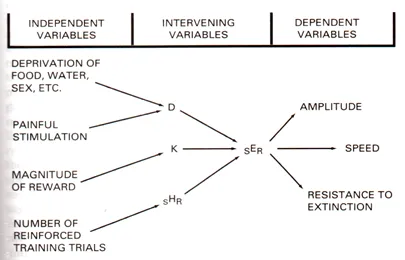 | A learned association strength based on the number of reinforced S–R pairings. |
What is reaction potential (SER)?
| The likelihood of a response:
SER = habit strength × drive |
What is Hull’s view of reinforcement?
| Reinforcement = drive reduction (learning occurs when a biological need is reduced). |
What was Hull’s main influence on psychology?
| Introduced formal, mathematical learning theory and influenced later cognitive and computational models. |
Why did Hull’s theory decline?
| It was overly complex, rigid, and difficult to apply compared to simpler systems like Skinner’s. |
BURHUS F. SKINNER (1904 - 1990) | |
Who was B. F. Skinner?
| A radical behaviorist who focused on operant conditioning and environmental control of behavior. |
What is Skinner’s version of positivism?
| A strict empirical approach focusing only on observable behavior-environment relations, rejecting inner mental causes. |
What is functional analysis of behavior?
| Studying behavior by identifying:
- antecedents (what comes before)
- consequences (what follows) |
What is operant behavior?
| Behavior emitted by an organism that is shaped and maintained by its consequences. |
How does Skinner define reinforcement?
| Anything that increases the probability of a behavior. |
What is the role of the environment in Skinner’s theory?
| The environment “selects” behavior through reinforcement, like natural selection. |
What is positive behavioral control (Skinner)?
| Shaping behavior using reinforcement instead of punishment. |
What is Skinner’s view on punishment?
| Punishment is ineffective long-term and produces negative side effects; reinforcement is preferred. |
What is Skinner’s view of theories?
| He rejected internal theoretical constructs and preferred direct description of behavior-environment relations. |
What are applications of Skinner’s work?
| - Behavior therapy
- Education (programmed learning)
- Token economies
- Animal training
- Social design (Walden Two) |
How does Hull differ from Skinner?
| Hull: internal variables (drive, habit strength), mathematical theory
Skinner: no internal constructs, focuses only on observable behavior |
How do Hull and Skinner define reinforcement differently?
| Hull: reinforcement = drive reduction
Skinner: reinforcement = increase in behavior frequency (no internal mechanism needed) |
What is the biggest philosophical difference between Hull and Skinner?
| Hull: theoretical + inferential + formal system
Skinner: descriptive + empirical + anti-theoretical |
What is neobehaviorism?
| A form of behaviorism that incorporates theoretical terms and internal variables but keeps them operationally defined. |
How does neobehaviorism differ from early behaviorism (Watson)?
| It allows theoretical constructs (like drives, cognition) as long as they are tied to observable operations. |
Why is Hull considered a neobehaviorist?
| Because he used internal constructs (drive, habit strength) but defined them operationally. |
EDWARD C. TOLMAN | |
Who was Edward Chace Tolman?
| An American neobehaviorist who combined behaviorism with cognitive concepts like purpose, expectancy, and cognitive maps. |
What is purposive behaviorism?
| The idea that behavior is goal-directed (molar) and organized around purposes, not just stimulus-response reflexes. |
How did Tolman use rats in research?
| He used rats in maze experiments to study learning, showing they form mental representations of environments (cognitive maps). |
What are Tolman’s intervening variables?
| Internal but scientifically defined processes (e.g., purpose, expectancy, cognition) that explain behavior between stimulus and response. |
What is a cognitive map?
| A mental representation of the environment that allows organisms to navigate and plan routes to goals. |
What did Tolman mean by expectancies and beliefs?
| Learned expectations about how the environment works (e.g., “this path leads to food”). |
What was Tolman’s view of reinforcement?
| Reinforcement is not required for learning; it mainly affects performance, not acquisition. |
What is the learning–performance distinction?
| Learning = internal acquisition of knowledge (cognitive maps)
Performance = observable behavior influenced by motivation or reinforcement |
What is latent learning?
| Learning that occurs without reinforcement but is only shown when motivation or reward is introduced later. |
What is Tolman’s influence on psychology?
| - Helped bridge behaviorism and cognitive psychology
- Introduced cognitive maps and latent learning
- Influenced information-processing theory and social cognition
- Preserved mental concepts in objective form |
How has behaviorism changed today?
| It moved from strict S–R theories to a more flexible, integrative science that includes cognitive and biological influences. |
What is radical behaviorism (Skinner)?
| Behavior is shaped by environmental consequences (reinforcement), with focus on observable relationships. |
What is ABA?
| A structured, evidence-based application of behaviorism used to increase helpful behaviors and reduce harmful ones. |
How does modern behaviorism include cognition?
| It treats thoughts and beliefs as intervening variables that influence behavior indirectly. |
What is CBT’s relationship to behaviorism?
| It combines behavioral principles with cognitive concepts (thoughts influence behavior and emotion). |
What characterizes modern behaviorist methods?
| - Precise measurement
- Experimental control
- Computational modeling
- Operational definitions |
What remains central to behaviorism today?
| Commitment to observable, measurable behavior and empirical validation, even when studying internal processes. |
Where is behaviorism used today?
| - Education
- Therapy (ABA, CBT)
- Organizational psychology
- Animal training |
What is the modern state of behaviorism?
| A flexible, scientifically rigorous field that still emphasizes behavior and environment but now integrates cognitive and biological perspectives. |