| Term | Definition |
|---|---|
Longitudinal wave | particle motion and wave velocity are parallel (e.g. sound waves) |
Transverse wave | particle motion is perpendicular to the direction of the wave velocity (e.g. light/EM waves) |
Sound | the propagation of longitudinal waves through matter |
Sound spectrum | Infrasonic (less than 20 Hz)
Audible (20 Hz to 20 kHz)
Ultrasonic (greater than 20 kHz) |
Sound intensity | rate of sound energy transfer through a given area; measured in W/m^2 (J/s/m^2); expressed in decibels |
Doppler effect | the apparent shortening of wavelength and increase in frequency as a source approaches and lengthening of wavelength and decrease in frequency as the source moves away; also applies to light with redshift (as source is moving away) and blueshift (as source approaches) |
Standing waves | caused by interference of waves traveling down and reflected back along a rope |
Resonance | oscillations with large amplitudes that occur when a periodic driving force has a frequency equal to a natural frequency |
Reflection | a change in direction that occurs when light bounces off of a surface |
Law of reflection | The angle of reflection is equal to the angle of incidence 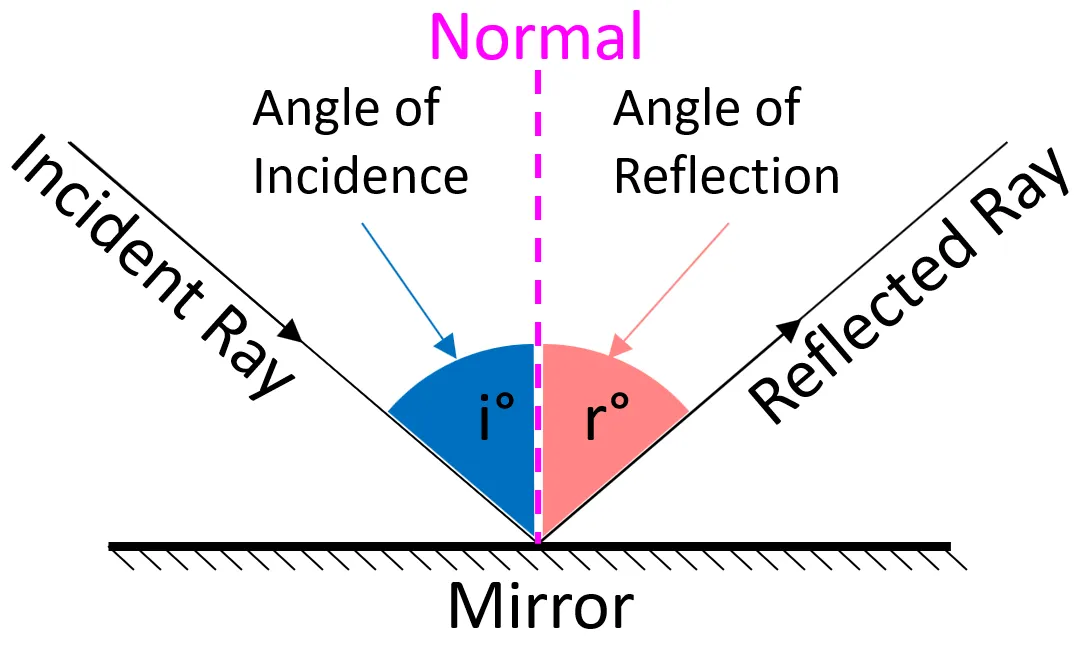 |
Refraction | light bending when it passes from one medium to another |
Index of refraction | index of refraction = speed of light in a vacuum / speed of light in a medium |
Internal reflection | light bouncing back and forth within a material (e.g. what happens with fiber optics and diamonds) |
Critical angle | if an incident ray is at an angle greater than this, the light will be reflected internally, not refracted out into another medium |
Dispersion | occurs when different wavelengths of light are bent at slightly different angles during refraction (white light going through a prism and dispersing into a spectrum of colors) |
Polarization | the preferential orientation of the oscillations of transverse waves (forcing light to only go one direction), cannot happen to longitudinal waves like sound, only to transverse waves |
Diffraction | the bending of a wave that occurs when it is faced with an obstacle, happens to all types of waves |
Principle of superposition | at any time, the combined waveform of two or more interfering waves is given by the sum of the displacements of the individual waves at each point in the medium |
Constructive interference | when multiple waves overlap/interfere and combine to form a bigger wave |
Destructive interference | when two waves interfere and the combined waveform is smaller than either of the pulses |
Electric force | exists between any two charged particles; the attractive or repulsive force on the particles based on the law of charges |
Law of charges | Like charges repel, unlike charges attract |
Coulomb's Law | the force of attraction between two charged bodies is directly proportional to the product of the two charges and inversely proportional to the square of the distance between them
F = kq1q2 / r^2 |
Current | the time rate of flow of electric charge |
Conductor | materials in which electric charge flows readily |
Insulator | materials in which electrons are more tightly bound and do not conduct electrical charge very well |
Voltage | work per unit charge, or, the electric potential energy per unit of charge |
Ohm's Law | voltage equals current times resistance
(V = IR) |
Electrical power | power equals current x voltage (P = IV) OR
power equals current squared x resistance
(P = I^2R) |
Magnetism | closely related to electricity, caused by moving and spinning electrons |
Curie temperature | temperature at which a material ceases to be ferromagnetic |
Magnetic declination | the angle between true (geographic) north and magnetic north |
Electromagnetism | interaction of electrical and magnetic effects, consist of oscillating electric and magnetic fields |
Motor | a device that converts electrical energy into mechanical energy |
Generator | a device that converts mechanical energy into electrical energy |