define memory
the set of processes uses to encode, store, and retrieve information over different periods of time
"network of neurons firing in specific patterns"
| Term | Definition |
|---|---|
define memory | the set of processes uses to encode, store, and retrieve information over different periods of time
"network of neurons firing in specific patterns" |
what are the three types of encoding? | semantic, visual, and acoustic (not auditory?) |
what type of encoding gives the best memory of verbal information? | semantic, because you have a deeper understanding/better connection between that and other nodes in memory net
* bonus points if it's self referential |
what is the self-reference effect | the tendency to have better memory of things we can relate to ourselves/our experiences |
describe the Aktinson-Shiffrin model of memory | 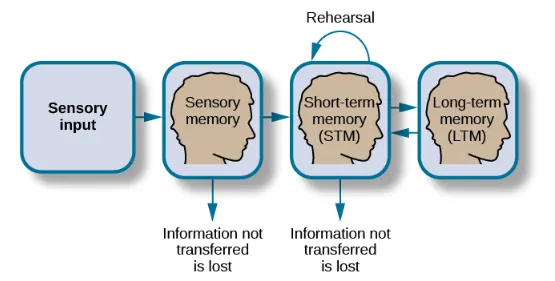 |
what are two types of rehearsal we use to move info from working to long-term memory? | active and elaborative; active is repetition, elaborative is linking it to info you already know |
what are two things that affect short-term memory retention? | memory trace decay and interference |
what is proactive interference? | prior info blocks new info |
what is retroactive interference? | new info blocks retrieval of prior info |
describe three processes that memory involves | encoding, storage, and retrieval |
describe two types of long-term memory, and subcategories of those two types (5 total) | explicit (aka declarative) and implicit; explicit is the stuff we consciously remember (e.g. facts), implicit is like the program that runs in the background - observable, but hard to put into words
explicit: episodic and semantic
implicit: procedural, priming, and emotional conditioning (smell association example) |
what are the three ways we retrieve memories from long-term storage? | recall, relearn, and recognition |
what are the 4 brain structures involved in memory? which are involved in automatic vs effortful processing? | hippocampus, amygdala, cerebellum, and prefrontal cortex |
what is the misinformation effect? | receiving new incorrect info about memory causes you to change memory |
two types of sensory memory | echoic and iconic |
what are the two types of processing involved in encoding? | automatic and effortful - automatic done w/o awareness, effortful is, well, effortful (ie studying for a test) |
what role does the amygdala play? | amygdala is involved in encoding memories involving strong emotions (for test: amygdala involves strong emotions -> involved in memories tied w strong emotions)
both implicit and explicit |
what role does the hippocampus play? | temp holds memories, than transfer memories to cortical regions that give them meaning + connect w old memories; explicit memories (st 2 (spindle), st 3 (delta), and REM sleep!) |
what role does the cerebellum play? | implicit memories; not ones we're conscious of making
includes classical conditioning |
what role does the pre-frontal cortex play? | processing/retaining information - semantic tasks; encoding, retrieval |
retrograde vs anterograde amnesia | retrograde is the hollywood "hit head doesn't remember anything before hitting head"; anterograde is being unable to form new memories |
long term potentiation | increase in synapses' firing potential after brief stimulation; |
what role does the basal ganglia play? | procedural, motor movements - this is very deep inside brain |