What is the nervous system?
The body's communication network that receives, processes, and responds to information.
| Term | Definition |
|---|---|
What is the nervous system? | The body's communication network that receives, processes, and responds to information. |
What are the two major divisions of the nervous system? | Central Nervous System (CNS) and Peripheral Nervous System (PNS). |
What structures make up the Central Nervous System (CNS)? | The brain and spinal cord. |
What structures make up the Peripheral Nervous System (PNS)? | All nerves outside the brain and spinal cord. |
What are the two subdivisions of the Peripheral Nervous System? | Somatic Nervous System and Autonomic Nervous System. |
What is the function of the Somatic Nervous System? | Processes sensory information and controls voluntary movement. |
What is the function of the Autonomic Nervous System? | Controls internal organs and automatic bodily functions. |
What are the two divisions of the Autonomic Nervous System? | Sympathetic and Parasympathetic nervous systems. |
What is the function of the Sympathetic Nervous System? | Activates the body for action (speed-up). |
What is the function of the Parasympathetic Nervous System? | Calms the body and conserves energy (pace-down. |
What is the role of the nervous system? | To receive information, process it, and coordinate responses throughout the body. |
What is the endocrine system? | A system of glands that produce and release hormones. |
What are hormones? | Chemical messengers released into the bloodstream. |
How does the endocrine system influence behavior? | Hormones regulate processes such as aggression, mating, parenting, and stress responses. |
How do the nervous and endocrine systems differ? | The nervous system sends rapid electrical and chemical signals, while the endocrine system sends slower hormonal signals through the bloodstream. |
What is a neuron? | A specialized nerve cell that communicates information throughout the nervous system. |
What is the nucleus? | The part of the neuron that contains DNA and directs cell activities. |
What is the function of dendrites? | To receive signals from other neurons. |
What is the function of the axon? | To carry electrical impulses away from the cell body. |
What is myelin? | A fatty covering that speeds the transmission of neural impulses. |
What are axon terminals? | Structures that release neurotransmitters to communicate with other neurons. |
What is a synapse? | The small gap between two neurons. |
How does information travel within a neuron? | Electrically through an action potential. |
What is an action potential? | An electrical impulse that travels down the axon. |
How does information travel between neurons? | Chemically through neurotransmitters at the synapse. |
What is a neurotransmitter? | A chemical messenger that allows neurons to communicate. |
What is a presynaptic neuron? | The neuron that releases neurotransmitters. |
What is a postsynaptic neuron? | The neuron that receives neurotransmitters. |
What is reuptake? | The process by which neurotransmitters are reabsorbed by the presynaptic neuron. |
What is nature in psychology? | Biological influences such as genes and heredity. |
What is nurture in psychology? | Environmental influences such as experiences and learning. |
How do nature and nurture influence behavior? | Behavior results from an interaction between biological factors and environmental experiences. |
What is a genotype? | An individual's genetic makeup inherited from their parents. |
What is a phenotype? | Observable traits produced by the interaction of genes and environment. |
What is behavior genetics? | The study of how genes and environment influence behavior and personality. |
What are three methods used in behavior genetics? | Family studies, adoption studies, and twin studies. |
Can personality and behavior be explained entirely by nature or entirely by nurture? | No. Both genetic and environmental factors contribute to personality and behavior. |
What is the structure of the brain in F and what is one of its functions? 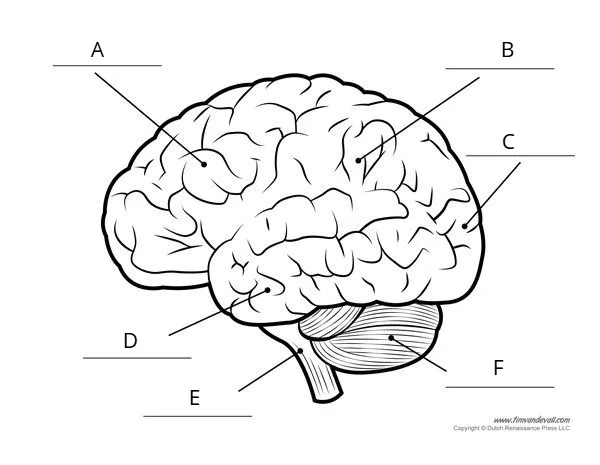 | Cerebellum – Motor coordination |
What is the structure of the brain in E and what is one of its functions? | Brain Stem – Heart rate |
What is the structure of the brain in D and what is one of its functions?
term image | Temporal Lobe – Hearing |
What is the structure of the brain in C and what is one of its functions?
| Occipital Lobe – Vision |
What is the structure of the brain in B and what is one of its functions? | Parietal Lobe – Touch perception |
What is the structure of the brain in A and what is one of its functions? | Frontal Lobe – Thinking |
Where is the motor cortex located and what does it do? | Frontal lobe, planning/coordinating movement |
Where is the prefrontal cortex located and what does it do? | Frontal lobe, impulse control |
Where is the Broca's area located and what does it do? | Frontal lobe, language production |
Where is the primary somatosensory cortex located and what does it do? | Parietal lobe, receives sensory information |
Where is the primary visual cortex located and what does it do? | Occipital lobe, receives information from the eyes |
Where is the auditory cortex located and what does it do? | Temporal lobe, auditory processing |
Where is Wernicke's area located and what does it do? | Temporal lobe, speech comprehension |