| Term | Definition |
|---|---|
the musculoskeletal structures. | Bones, ligaments, cartilage, tendons, muscles & nerves. |
the types of external forces. | Gravity, friction, drag & contact. |
force definition. | energy used to create movement, measured in newtons (N). Two types, internal & external forces. |
Internal force types. | Compressive, tensile & shear forces. |
leaver definition. | a rigid bar used with force to create movement. |
1st class lever definition, example & function. | Load-fulcrum-effort. usually for balancing weight and/or changing direction e.g. a seesaw. |
2nd class lever definition, example & function. | Fulcrum-Load-Flea. Used to move large loads but with loss of distance e.g. a wheelbarrow & calf and body weight. |
3rd class lever definition, example & function. | Fulcrum-Effort-Load. Typically used to move small loads but at a large distance e.g. shovel & bicep, forearm. |
mechanical advantage definition. | when the effort arm is longer, the lever operates at a mechanical advantage. if equal it is neutral. |
functions of bone. | organ protection, rigid kinematic link, sites of muscles attachment & muscle action. |
composition of bone. | inorganic portion of mineral salts (60%), organic matrix of collagen (30%) & water (10%). |
Osteon (Haversian system) definition and function. | the fundamental functional & structural unit of compact bone, designed for strength & nutrient transport. |
compact outer layer bone name. | cortical bone (high density). |
sponge inner layer bone name. | cancellous bone (loose mesh). |
how much force can a bone withstand. | 190 megapascals in compression, 130 megapascals in tension & 70 megapascals in shear. |
tendons definition and function. | connect muscle to bone. transmit tensile load & stabilise joints. |
tendon composition. | (20%) tendocytes, (80%) extracellular matrix. |
extracellular matrix composition. | Elastin (2%), collagen (33-50%), proteoglycan (2%) and water (55-75%). |
collagen definition and function. | collagen is synthesised by tenocytes and functions to sustain large tensile loads. collagen molecules band together in parallel arrangement to form many tendinous layers. |
paratendon | tendons and ligaments are surrounded by loose areolar connectivity tissue called a paratendon. |
crimp | important for biome chancel loading as it allows for the straightening during tensile loading. |
ligaments definition and function. | same general composition as tendons. instead of tendocytes they have ligamentous fibroblasts. collagen fibres are not parallel. multidirectional tensile forces. |
toe region definition. | lag in tensile force. |
factors affecting ligaments and tendons. | aging & maturing (collagen reaches a plateau after which tensile strength and stiffness begin to decline), pregnancy (during pregnancy there is a increased laxity of tendons & ligaments in the pubic area due to increase in the hormone relaxin), mobilisation (like bone, ligaments & tendons appear to remodel in response to mechanical demands), immobilisation (decreases collagen production and thus causes a decreased tensile capacity of ligaments & tendons), comorbidities (diabetes, mellitus/connective tissue disorder/renal disease) & pharmacological agents ( intake of medications have been shown to negatively impact ligaments & tendons. mostly due to inhibition of collagen synthesis. e.g. steroids & into-imflamatory drugs). |
sprain vs strain. | A sprain is a ligament injury. A strain is a muscle/tendon injury. |
function of the spine. | protects spinal chord, movement ( allow, direct and control), load transfer (from head and trunk to the pelvis). |
2 regions of the spine. | anterior (weight bearing zone) & posterior (provides guiding and stabalising elements). |
interpretable disc functions and structure. | centre is made of nucleus pulposus and outside is annulus fibrosus. acts hydrostatically when loaded. uniform distribution of pressure. |
nucleus pulposus function. | a gelatinous mass that acts like a rubber ball giving the disc elasticity and compressibility. no direct blood supply. relies on diffusion for its nutrients. |
annulus fibrosus definition. | tough outer covering made of fibrocartilage. crisscross collagen fibres provide resistance to bending and torsional load. |
disc degeneration. | degeneration in the disc can reduce the hydrophilic capacity. caused by lack of hydration. |
cervicle facet | all movements, rotation, flexion, extension, |
thoracic | rotation, lateral flexion mostly. |
lumbar | sagital |
male vs female spinal ROM. | males have more flex, ext. females have more lat flex. |
gait | pattern of movement when walking and running |
stance vs swing phase. | |
walking vs running. | walking has two feet on the ground at the same time. |
stride length. | the length between an event on one side until the same event on the same side. |
step length. | the length between an event on one side until the same event on the opposite side. |
step width. | the distance covered perpendicular to the direction on location. measured at the heels. |
hip during gate. | 30 degree flexed and 10 degrees extends. fairly neutral amounts of ab/aduction. slight amounts of external and internal rotation, more external. |
knee during extension. | Mostly extended. flexes up to 60 degrees. little bit of ab/adduction. ,maintains state of external rotation. |
running gate cycle. | stance (40%), float (15%), swing (30%), float (15%). double leg support disappears. |
rocking horse gait | muscular weakness / paralysis in the gluteus Maximus. |
trendelenburg gait. | weak gluteus medius, leg length discrepancy. |
knee fusion gait. | joint / muscle ROM limitation. leads to circumducted gait. |
hemiplegic gait. | most commonly seen in stroke patients. neurological involvement. |
joints of the ankle. | talocrural: plantarflexion & dorsiflexion.
subtalar: inversion/eversion, abduction/adduction.
midtarsal: inversion/eversion, abduction/adduction. |
bone injury types: | comminuted, compression, spiral, epiphyseal, depressed, greenstick. |
types of cartilage | articular (hyaline) & fibrocartilage. |
cartilage composition. | chondrocytes, Collagen (15-22%), proteoglycan (4-7%) & water (60-85%). |
tendon anatomy. | tendocytes (~20%) & extracellular matrix (~80%). |
types of tendon injuries. | Grade 1 (some micro failure to collagen fibres. some pain is felt no joint instability).
Grade 2 (partial rupture. severe pain and some joint instability).
Grade 3 (total rupture has occurred (or close to). severe pain and joint completely unstable. |
common tendon injuries. | tendonitis: inflammation of the tendon.
tendinosis: tiny tears in the tissue in and around the tendon caused by overuse. |
ligament injuries | Grade 1 (some fibres stretched or torn) RICER.
Grade 2 (some fibres tom with effusion) RICER.
Grade 3 (complete rupture) SURGERY.
Avulsion Fracture (ligament pulls away with piece of bone. |
Nerve injuries. | neuropraxia. 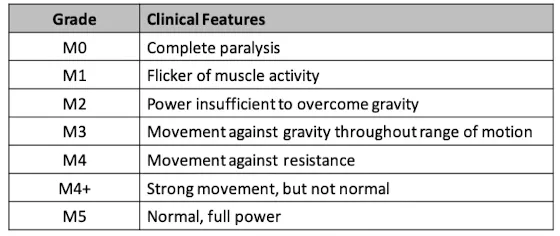 |
effects of body mass. | body mass effects the magnitude of an imposed load, this is explored through somatotyping. |