Jesus' students
Were imperfect, slow learners, self-centered, unexperienced, unprofessional, and impressionable, just as my future students will be.
| Term | Definition |
|---|---|
Jesus' students | Were imperfect, slow learners, self-centered, unexperienced, unprofessional, and impressionable, just as my future students will be. |
Jesus' Characteristics as a teacher | He embodied His message, was comfortable with all kinds of people, compassionate, firm in His identity/goals (self-concept), and He knew HIs learners, which He used to help teach |
Teaching principles Jesus used | Established relationship, began where the students were at, continually directed by his goal, worked on the conscience of the learner, emphasized action more than just knowledge, and He stressed the long term |
Content | 1/3 C's to Jesus as the master teacher, He taught from the overflow of full life, knowing His content |
Compassion | 1/3 C's, Jesus was understanding, sympathetic, and had a soft heart (with thick skin) |
Character | 1/3 C's of Jesus as the master teacher, He was willing to do what it took to make a difference |
What 6 teaching methods did Jesus use when teaching? | Objects, questions, stories, discussion, lecture, and reports |
CIA of Education | Curriculum, instruction, assessment |
Curriculum | the knowledge, skills, and content of a course |
Educationally left | Conservative |
Educationally right | liberal |
Curriculum Spectrum | Note that left is conservative, and right is liberal, though this doesn't always reflect political stances 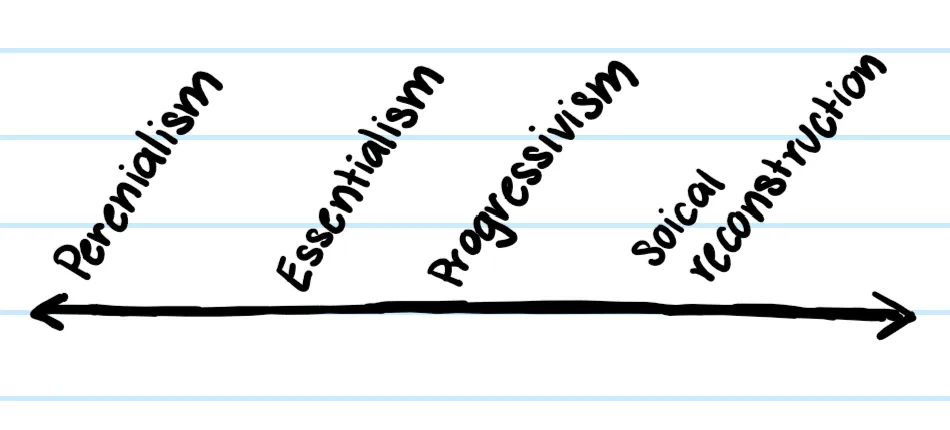 |
Prenilaism | teaches the classics, teacher holds knowledge, and it's the students' job to come to that level of knowledge |
Essentialism | Essential things, the three Rs are taught. (Reading, Writing, Arithmetic) The teacher is seen as a funnel, and students receive information passively |
Progressivism | Standards based, but they have a high focus on the student. Teacher serves as the guide, but the student must be actively engaged. |
Social Reconstruction | total student driven curriculum, and teachers serve as checkpoint |
Most public schools fall between | essentialism and progressivism |
Private, home, and classical education fall ______ | anywhere on the spectrum of curriculum |
Hidden curriculum | Norms and values that are taught, though not part of curriculum
- raising hands, accepting "i don't know" as an answer |
Null curriculum | Things that aren't taught, but are "caught"
- race relations, peer interaction, school culture; can be positive or negative |
The main difference between Null and Hidden Curriculum is ____ | hidden is something you want to happen, while null just happens |
Patterns of curriculum design | - Subject area (separated by subject)
- integrated (all subjects connect)
- core curriculum (looks at main things of course only)
- student-centered (student designs what happens) |
PA Standards | include anchors, benchmarks, and eligible content |
Anchor in PA Standards | a main point set within a standard |
Benchmark in PA standards | key points that students are tested on |
Eligible content in PA standards | smaller points that are tested |
PA Common Core | process-based standards
- less about knowing specific facts, but the processes to get there |
Keystone Standards | end of course exams used to prove content knowledge |
instruction | The I of the CIA of teaching; how content is taught |
Inquiry and Problem Solving | students recognize problem and solve problem
- teachers guide students down that path |
Critical thinking | 5-step process for students to work through an issue with the teacher guiding
1. perception
2. analysis
3. reflection
4. synthesis
5. action |
Cooperative learning | working in small groups to complete an assignment/task |
Problem based learning | organizes curriculum and instruction around a real-world problem |
Direct instruction | formal lectures, scripted curriculum, and teacher-led discussions |
Mastery learning | Madeline Hunter's 7 steps for instruction OR teachers present material until they know students understand with 80% accuracy |
Assessment | the proof teachers did their job
measures what curriculum to use, how instruction should be used, whether instruction has been sucessful |
Formative assessment | carried out while learning is taking place |
summative assessment | happens at the end of a set learning is taking place
involves a grade |
Formative assessment is strategies | - great teachers know what they know, based on their formative assessments
- daily student notebooks, think pair share, questioning, exit paragraph, math boards, show of hands, math journal, background probe, graphic organizer, write quick answer down, before & after definitions, skits, write own math problem, 1-4 fingers to show confidence |
Objective assessment | Has one correct answer, like multiple choice questions |
Subjective assessment | multiple correct possible answers, like short-answer or essay questions (these questions should have a rubric) |
Criterion referenced assessment | grading against a certain set limit or standard |
Norm refrenced assessment | grading where students are graded against each other
best student gets A, worst gets F |
Informal assessment | not used for a grade |
formal assessment | used to determine a grade
tests, quizzes, projects, papers |
Blooms Taxonomy focuses on | creating, evaluating, analyzing, applying, understanding, and remembering |
Webb's DOK | Recalling, Skills & Concepts, Strategic thinking, extended thinking |
DOK | Depth of Knowledge |
DOK 1 | Recall; always has a correct answer |
DOK 2 | Skills and concepts, generally has a correct answer, |
DOK 3 | Strategic thinking |
DOK 4 | Extended thinking, generally helps students connect their experiences to their outside experiences |
John Dewey | university of Chicago, founded the lab school, father of the educationally progressive era. He started by looking at the child, and how they learn, rather than the curriculum |
Growth in the 1920s | Immigration influx, town schools became grade differentiated |
Great Depression | stock market crash, schools closed, students required to bring their own supplies, and school years became shorter
while school systems were developed, gaps in learning existed |
George S. Counts & PEA shifts progressive movement | movement started by Dewey gets a social aspect added, but this was attacked because it seemed too much like socialism/communism |
CCC programs | the first time Federal Government got involved in Education in 1933; programs taught men to read and write |
William C. Bagley & Essentialism | 1934, essentialism moved back to the basics |
WWII | 1941-1945; teachers left to fight wars, enrollment declined |
Sputnik | October 1957, the satellite freaked Americans out, and pushed for more engineering and science education |
1971 | student population declined, and schools merged |
Ronald Regan 1980-1989 | eliminated the department of education |
1983- A nation at risk | said the US was behind on education, and added standards and other accountability measures, it also focused on local school levels |
1996 | teacher decrease, student increase |
Columbine | April 20, 1999, student vs student shooting, was the first school shooting that was televised. This caused a national school safety concern, and added locked doors, metal detectors, and background checks for parents to be in schools |
Sandy Hook Elementary Schooting | Dec 14, 2012- first shooting that was caused by an outside source, which caused security to increase |
Alfred Binet IQ test | 1905, students were given scores on a bell-shaped curve |
Binet- Simon IQ test | given to WWI soldiers to decide where they should serve, it was controversial because the lower IQ were on the front lines
used to this day to assess for special needs |
Brown v. Board of Education of Topeka: May 1954 | Part of the civil rights movement, desegregation of schools
further removed parents as students were bussed to other schools to have mixed student population
also removed black teachers |
NDEA | National defense education act of 1958, went with Sputnik and added federal funding |
Vocational Education act | 1963, quadrupled federal funding for things like votech |
ESEA | 1965, largest federal funding move, created Title 1 schools, which were given funds to help underprivileged students |
Bilingual Education act | 1968, gave funds to provide students with bilungual education |
Serrano v Priest | 1971, how much money in community shouldn't define how a school is funded |
Title IX | 1972, prevented sexual discrimination |
Indian Education Act 1972 | allowed Native Americans to educate their own youth, rather than boarding schools |
Vocational Rehabilitation Act | 1973, increased access to public spaces for people with disabilites |
Equal educational opportunities act | 1974, prohibits discrimination based on race, gender, and origin |
Education for all handicapped children act | 1975, now called IDEIA, this was the first special education legisilation |
National Education Consolidation and improvement act | 1982, consolidated federal education funding |
Goals 2000 | Clinton administration's plan to improve education, this was the birth of standards and standardized testing |
Standards Movement | 1992-2000, more pressure to improve standards, and caused the charter school movement in 1997 |
NCLB | Reauthorization of ESEA, added standardized testing, and AYP |
AYP | Part of NCLB, adequate yearly progress |
Zelman v. Simmons-Harris | 2002, voucher dollars could be used for private schools on certain things |
Race to the top | 2009-2010, included a $100 simulis plan for doing certain things, like implementing the common core |
ESSA | 2015, draws back on some of the NCLB mandates |
Classical education was reborn _____ | 1970s-1980s |
Dorthy Sayers "Lost tools of learning" | a lecture about the flaws in post WWII education, as education had become more about career prep than anything else |
Components of classical education | Transcendent goods, immanent goods, trivium instruction, quadrivium, and Latin |
Key areas of development in Classical Education | intellectual, moral, aesthetic, spiritual, physical, social, and practical |
Transcendent goods | the ideas that everything is
good, true, beautiful, and holy |
immanent goods | healthy, beneficial, neighborly |
trivium instruction | grammar, dilect/logic, rhetoric
one part taught in each level of schooling (grammar for Elementary, ect) |
Flaws with trivium insturction | Coming into the school late, or moving outside of the school can present challenges for students, and there's arrogance within those who have studied the trivium |
Quadrivium instruction | arithmetic, geometry, astronomy
this tends to be a weakness in classical education |