The Function of Chemical Senses
“Gatekeepers” of the body:
• Identify things that should be consumed for survival
• Detect things that would be harmful and should be rejected
• Cause good and bad affective responses
| Term | Definition |
|---|---|
The Function of Chemical Senses | “Gatekeepers” of the body:
• Identify things that should be consumed for survival
• Detect things that would be harmful and should be rejected
• Cause good and bad affective responses |
Basic Taste Qualities | Salty
Sour
Sweet
Bitter
Umami: described as meaty, brothy or savory, and associated with monosodium glutamate (MSG) 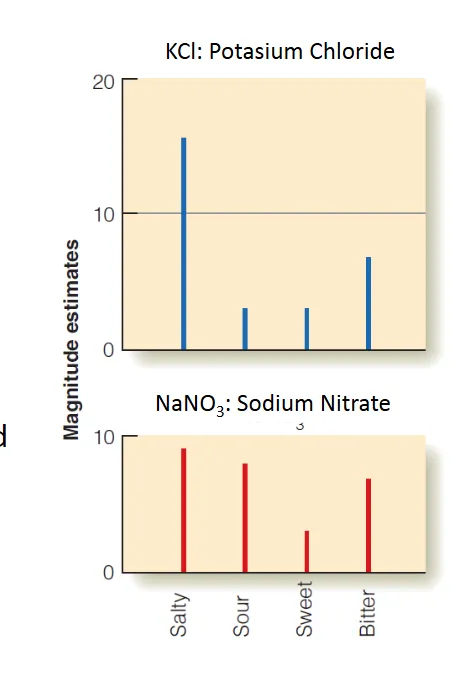 |
Sweet - Associations Between Taste Quality and a Substance’s Effect | usually substances that have nutritive value
no perfect connection between tastes and function of
substances |
Bitter - Associations Between Taste Quality and a Substance’s Effect | usually substances that are potentially harmful
no perfect connection between tastes and function of
substances |
Salty - Associations Between Taste Quality and a Substance’s Effect | presence of sodium
no perfect connection between tastes and function of
substances |
Taste Map | All qualities of taste can be elicited from all the regions of the tongue that contain taste buds
It has been known for many years that the concept of the “taste map” is incorrect |
Tongue has four types of papillae | Filliform (no taste buds)
Circumvallate (50% tb)
Foliate (25% tb)
Fungiform (25% tb) 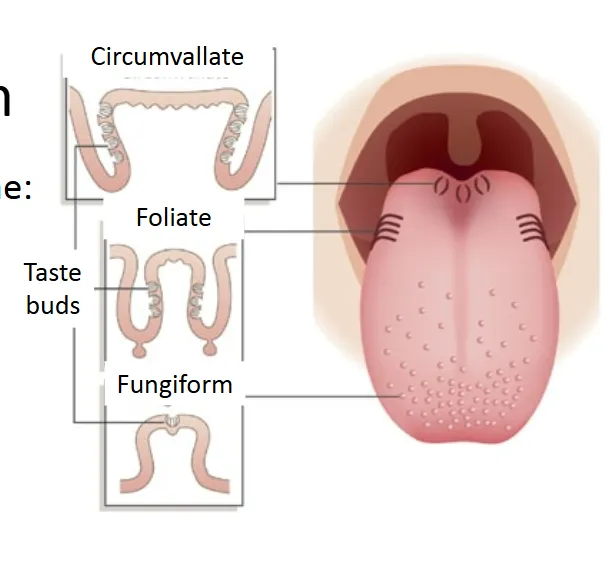 |
Structure of Taste System | Taste buds are located in papillae except for filiform.
Tongue contains approximately 10,000 taste buds.
Each taste bud has 50-100 taste cells with tips that extend into the
taste pore.
Transduction occurs when chemicals contact the receptor sites on the tips. 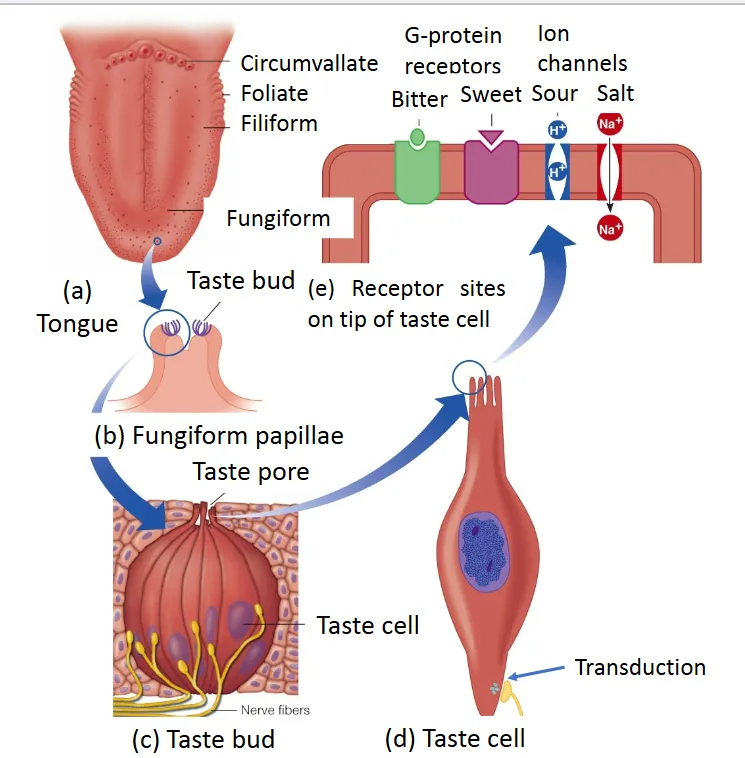 |
Pathways for signals from taste cells | Chorda tympani nerve from front/sides of tongue
Glossopharyngeal nerve from back of tongue
Vagus nerve from mouth and throat
Superficial petronasal nerve from soft palate |
Pathway to brain | nucleus of solitary tract (brain stem) → thalamus → frontal lobe (Insula, Frontal operculum cortex, Orbital frontal cortex) 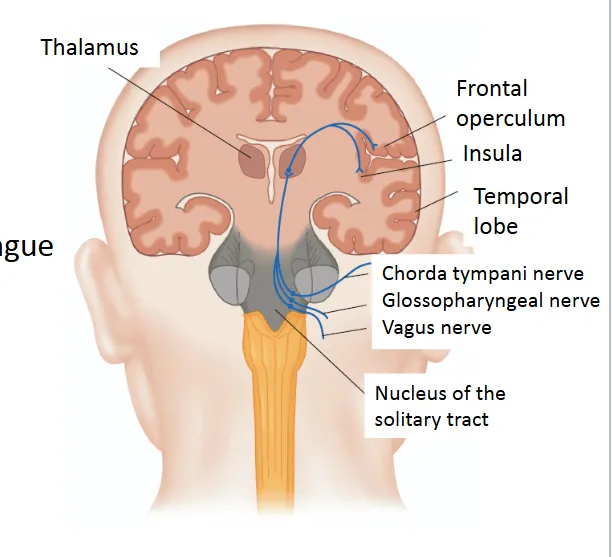 |
Population Coding, Erickson (1963) | Different taste stimuli were presented to rats, and recordings were made from chorda tympani.
Across-fiber patterns showed that two substances (ammonium chloride and potassium chloride) are similar to each other but different from sodium chloride 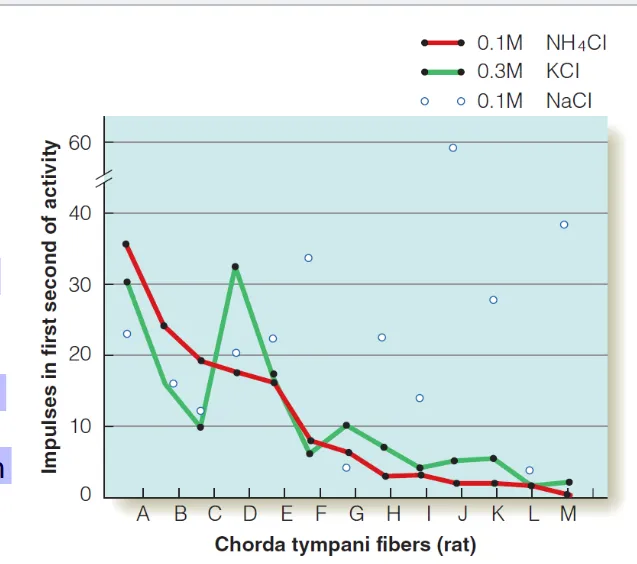 |
Specificity Coding | Applying amiloride to the tongue blocks flow of sodium to taste
receptors.
Causes decrease in the responding of neurons in rat’s brainstem that respond most strongly to salt, but not to those that respond to a combination of salty and bitter tastes 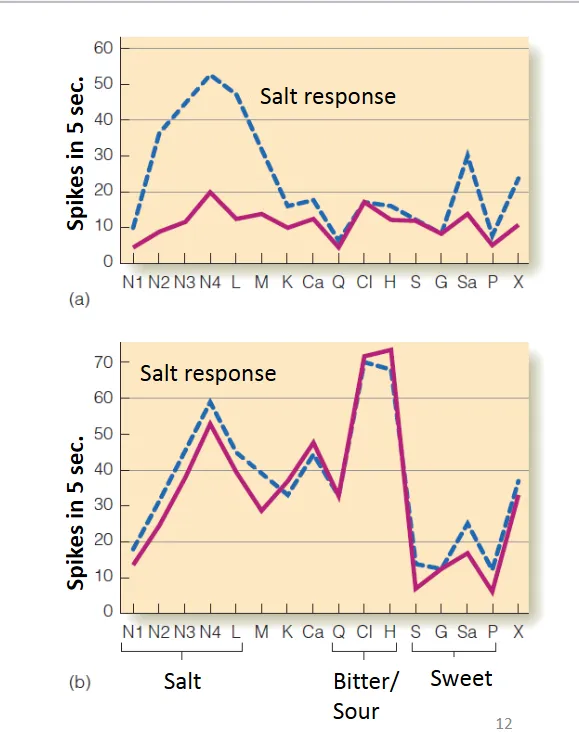 |
Specificity or population Coding | Evidence exists for both specificity coding and population coding but balance of evidence is shifting toward specificity coding.
Some researchers suggest that neural system for taste may function like visual system for color.
Currently no agreed upon explanation for neural system for taste |
Individual Differences in Taste | Different responses to phenylthiocarbamide (PTC) and to 6-n-
propylthiouracil (PROP):
• Tasters, nontasters, and supertasters
• Tasters have more taste buds than nontasters.
• Tasters have specialized receptors for these compounds.
• Supertasters appear more sensitive to bitter substances than tasters.
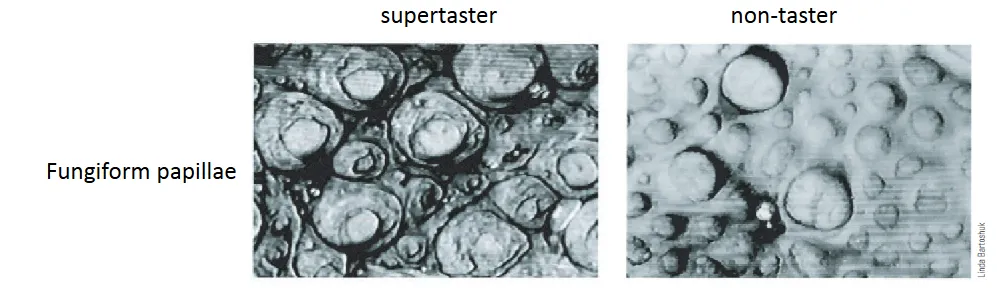 |
Functions of Olfaction | Many animals are macrosmatic: having a keen sense of smell that is necessary for survival
Humans are microsmatic: less keen sense of smell that is not crucial to survival
Singh and Bronstad: showed a relationship between men’s rating of women’s body odors and women’s menstrual cycle |
Detecting Odors | Rats are 8 to 50 times more sensitive to odors than humans.
Dogs are 300 to 10,000 times more sensitive.
However, individual receptors for all these animals equally sensitive.
Difference: number of olfactory receptors (Humans 10M, Dogs 1B). 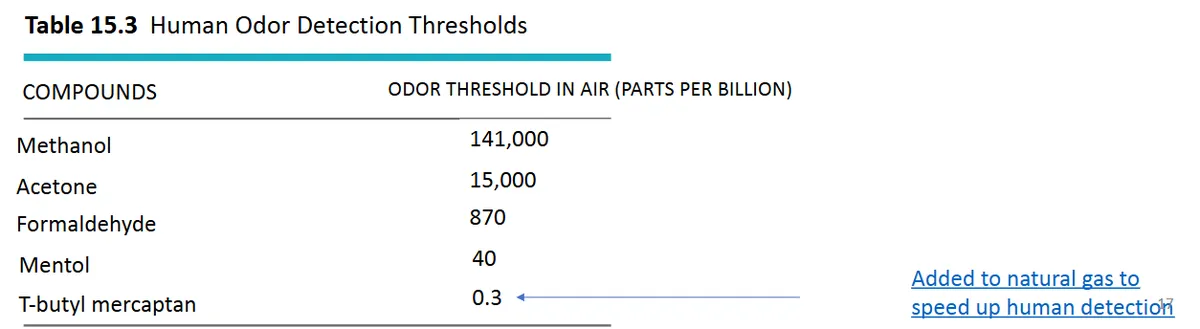 |
Identifying Odours | Humans can discriminate more than one trillion different odours.
• Find it difficult to identify odours
• Only successful half of the time |
The Puzzle of Olfactory Quality | It has proven difficult to map perceptual experience onto physical attributes of odourants.
• No specific ‘language’ for odour quality.
• Some molecules that have similar structure smell different, and some that have different structures smell the same.
• Links found between structure of molecules, olfactory quality, and patterns of activation in olfactory system. 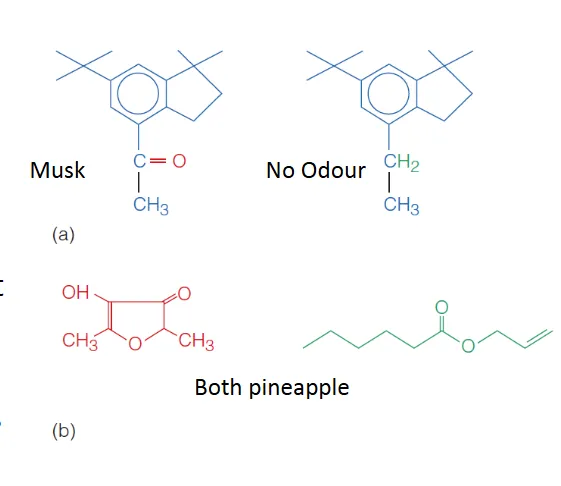 |
The Olfactory Mucosa | located at top of nasal cavity.
• Odourants carried along mucosa contact olfactory receptor neurons (ORN).
• These neurons contain molecules called olfactory receptors (which allow a specific protein to cross membrane).
• Humans: 350 receptor types 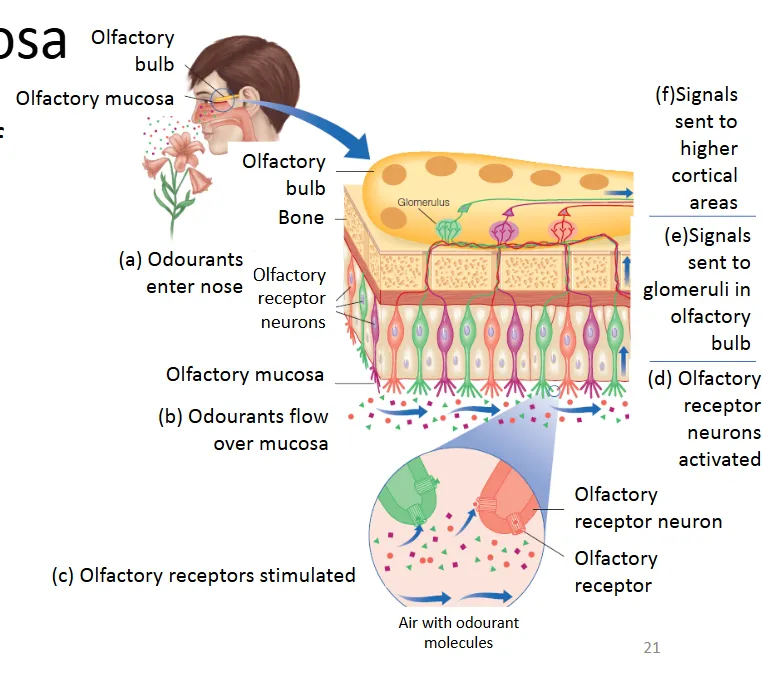 |
How Olfactory Receptor Neurons Respond to Odourants | Calcium imaging method
Calcium concentration inside ORN increases when olfactory receptor responds.
Calcium detected by using chemical that makes neuron fluoresce.
Measuring decrease in fluorescence indicates strength of response. |
Combinatorial code for odor (Malnic et al.) ORN responses | Odourants coded by patterns of activation of olfactory receptors (“recognition profiles”).
Molecules with similar structures but different smell have different recognition profiles. 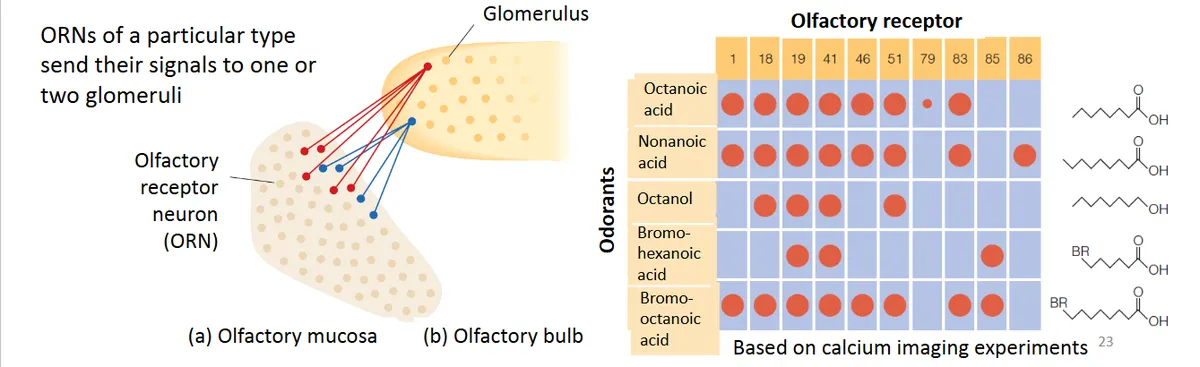 |
Optical imaging method - Search for Order in Olfactory Bulb | Cortical cells consume oxygen when activated.
Red light is used to determine the amount of oxygen in the cells.
Less oxygen reflects less red light.
Measuring amount of light reflected reveals cortical activity |
2-deoxyglucose (2DG [=radioactive]) technique - Search for Order in Olfactory Bulb | 2DG injected, which contains glucose.
• Animal exposed to different chemicals.
• Neural activation is measured by amount of radioactivity present.
• This technique, used with behavioral testing, shows pattern of neural activation is related to both chemical structure and to perception 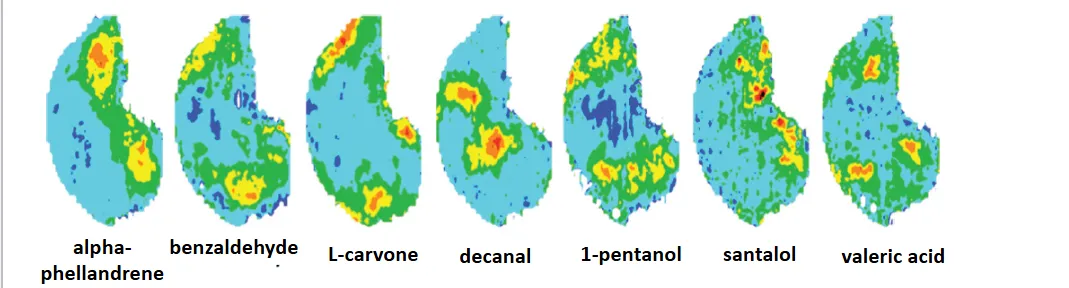 |
Cortical Representation of Odours | Signals from olfactory bulb are sent to:
Primary olfactory (piriform) cortex (temporal lobe)
Then to secondary olfactory cortex (orbitofrontal cortex in frontal lobe)
All interact with amygdala (in emotional reactions to odours) 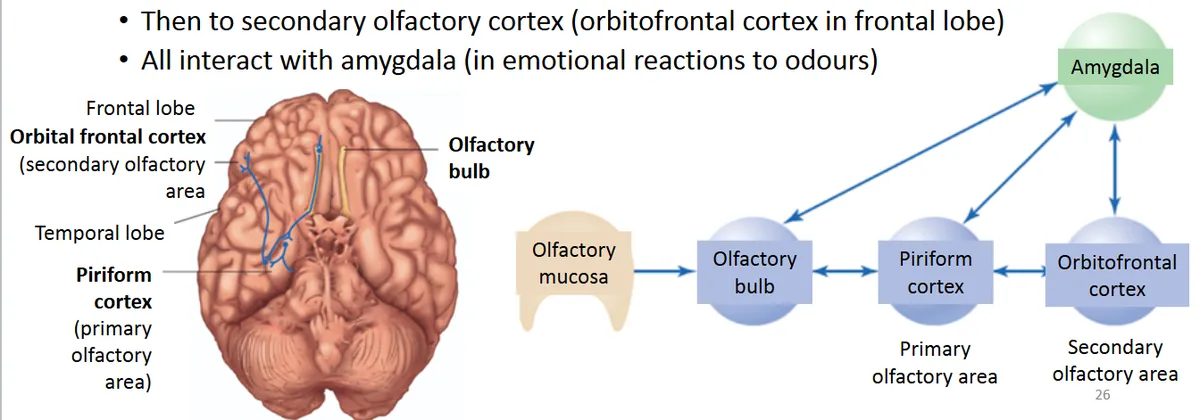 |
Representation of Odourants in Piriform Cortex, Rennaker et a | used multiple electrodes to measure neural responses in piriform cortex
isoamyl acetate causes (widespread) activation across cortex 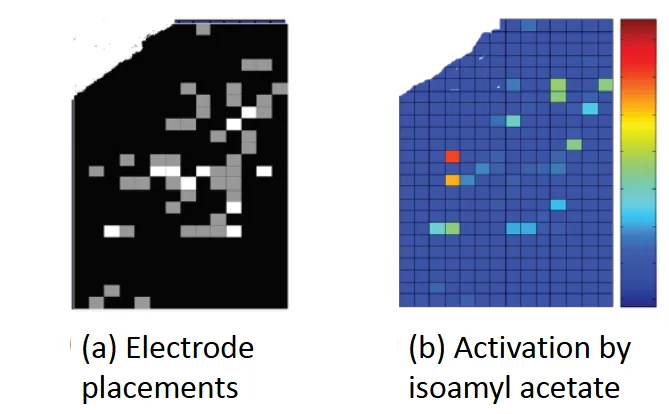 |
How Odour Objects Are Represented/Learned | Wilson measured neural response in rat’s piriform cortex to 2 odourants
• A mixture: isoamyl acetate and peppermint
• A compound: isoamyl acetate alone
With enough exposure, piriform cortex could discriminate between mixture and compound. Effect not found in Olfactory bulb. 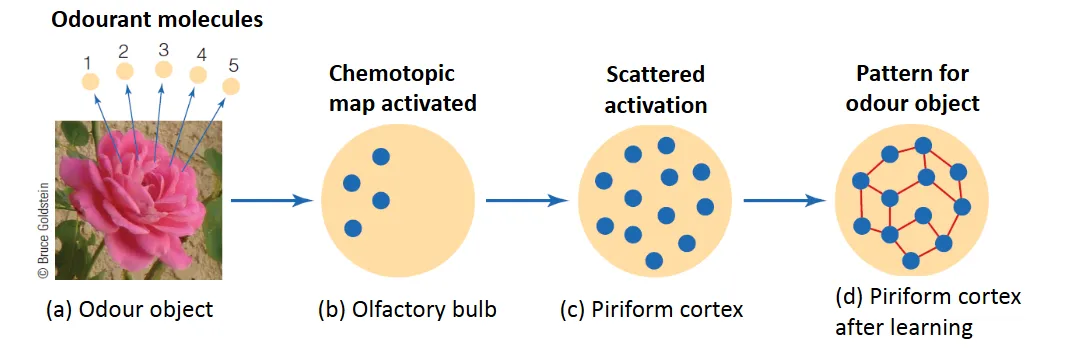 |
Perception of Flavour | Combination of smell, taste, and other sensations (such as burning of hot peppers)
Odor stimuli from food in mouth reaches olfactory mucosa through retronasal route.
Taste of most compounds influenced by olfaction, but a few (e.g., monosodium glutamate) are not. 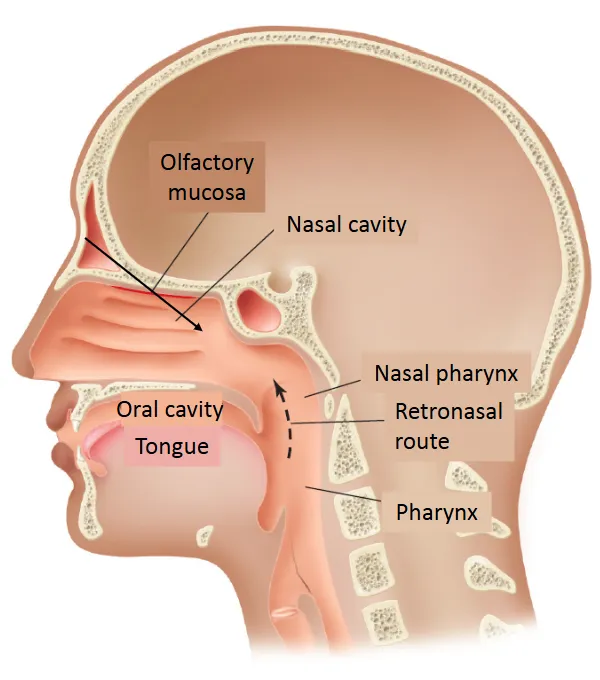 |
Taste and Olfaction Meet in Nervous System | Responses from taste and smell are first combined in orbital
frontal cortex (OFC)
Interactions between taste, olfaction, vision and touch
underscore multimodal nature of our experience of flavour.
Bimodal neurons: responding to more than one sense (typically similar qualities, e.g., taste and smell of sweet fruits)
Not only taste and smell, but also texture, temperature, colour, sound, etc. 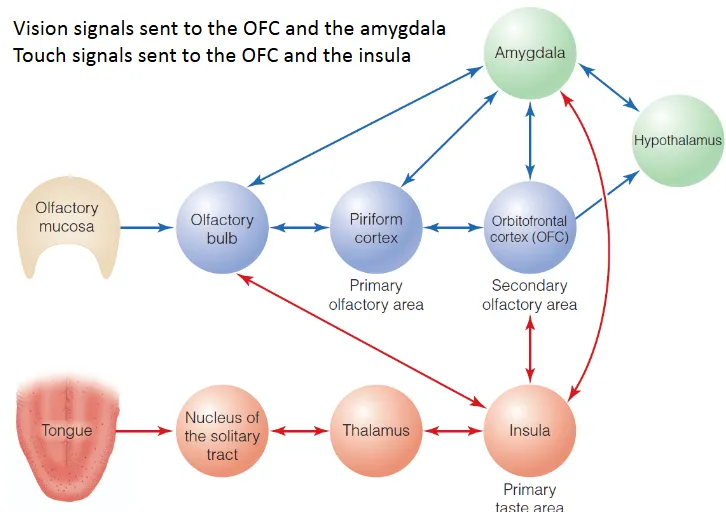 |
Flavour Is Influenced by Cognitive Factors | Plassmann experiment:
Judging taste pleasantness of wine 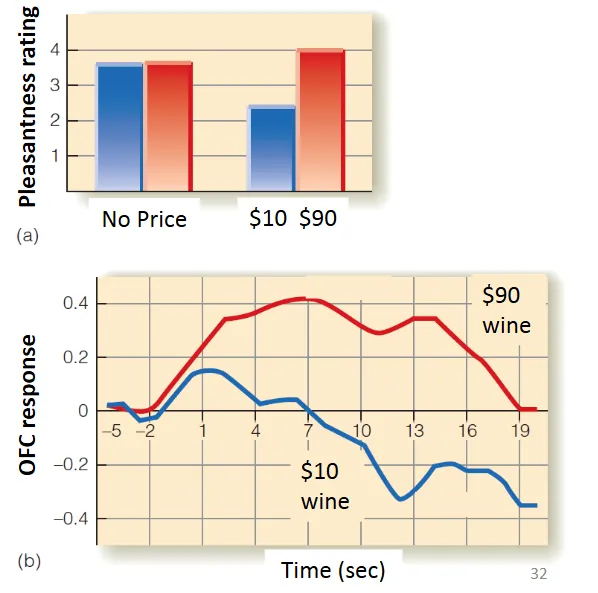 |
Infant Chemical Sensitivity | Steiner: newborns can smell/discriminate between different olfactory stimuli.
• Newborns can discriminate sweet, sour, and bitter stimuli
• Mennella experiment: used combination of carrot juice and water to study infant preferences 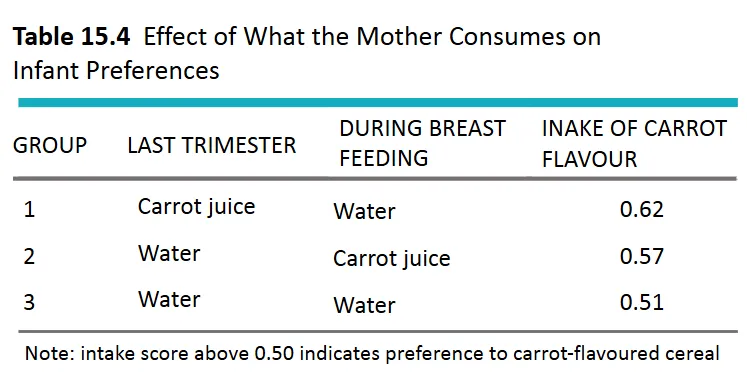 |