Reflected
When light, heat, sound or other energy bounces off a surface instead of being absorbed or transmitted through it
| Term | Definition |
|---|---|
Reflected | When light, heat, sound or other energy bounces off a surface instead of being absorbed or transmitted through it |
Scattered | When solar radiation(sunlight) is dispersed in multiple directions |
Absorbed | When light, heat, sound or other energy is taken in by a material or surface instead of being reflected or transmitted |
Earth’s Axial Tilt | 23 1/2 degrees- Effects climate and dispersal of heat on the earth (atmospheric temp) |
Summer and Winter Solstices | Summer- The longest day and shortest night of the year when the earth's poles has its maximum tilt towards the sun
Winter- The shortest day and longest night of the year when the earth's poles has its maximum tilt away from the sun |
Vernal and Autumnal Equinoxes | When the sun is positioned directly over the equator Vernal=spring Autumnal=fall |
Temperate/Tropical Regions | Temperate= above or below the tropic lines
Tropic= between the tropic lines |
Latitude | Distance north or south from the earth's equator
Effects atmospheric temp |
Tropic Lines Cancer/Capricorn | 23 1/2 degrees |
Density | Thickness- decreases with altitude and air pressure (weight of atmosphere decreases) |
Adiabatic Cooling | The process by which air cools without losing heat to its surroundings-- occur due to the expansion of air |
Hadley, Ferrel and Polar Cells 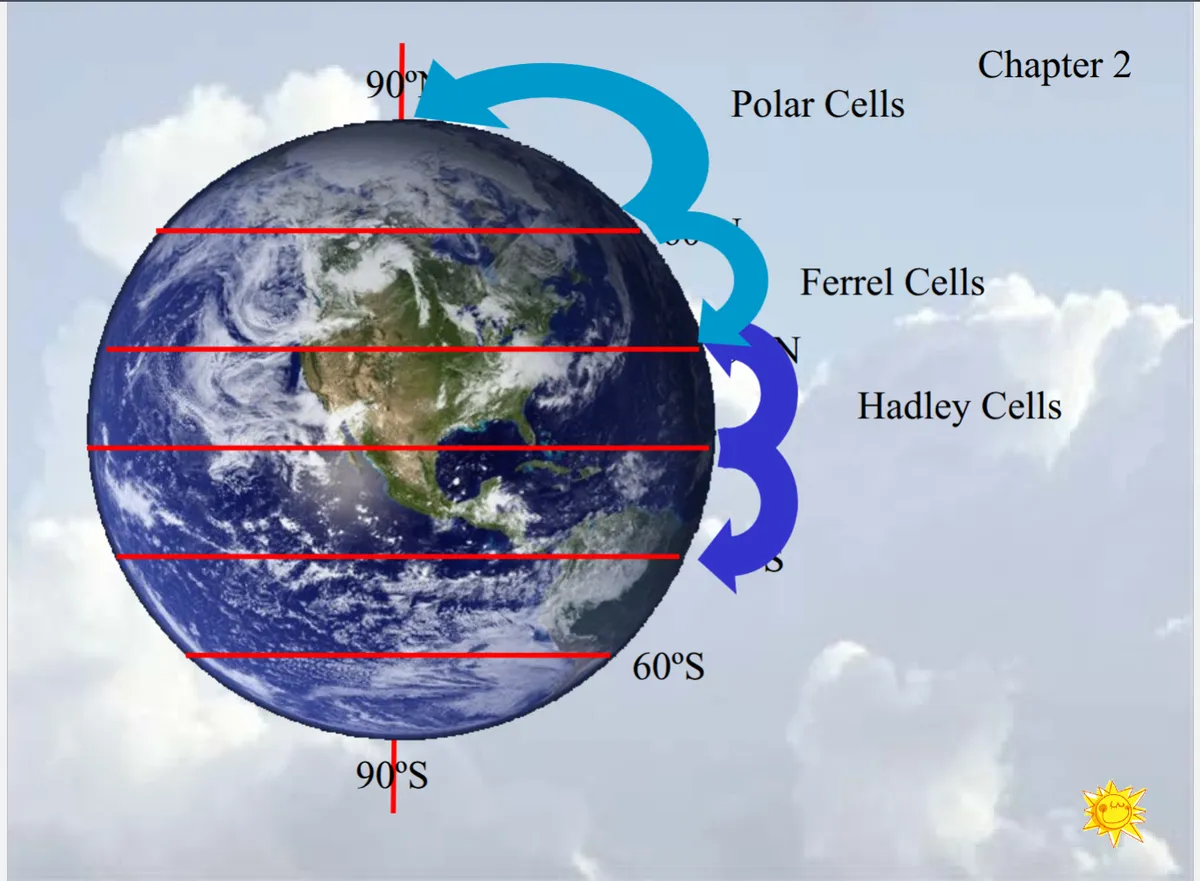 | Hadley= north and south- surround equator
Ferrel= surround hadley
Polar= top and bottom-surround Ferrel |
Horse Latitudes | Sub-tropical high, high pressure, clear weather |
Doldrums (ITCZ) | At the equator
Equatorial low, low pressure, rising air, weather:
severe storms- hurricanes, typhoons, cyclones, etc |
Coriolis Effect | The effect on global circulation (air then water) patterns
Caused by the rotation of the earth
Multiple cells- Hadley, Ferrel, and Polar
Deflection of the circulation pattern to the:
-Right northern hemisphere
-Left in the southern hemisphere |
Saturation Vapor Pressure (SVP) | The maximum amount of water a given volume of air can hold
-warm air has a higher SVP than cooler air |
Actual Vapor Pressure (AVP) | The current amount of water a given volume of air contains |
Vapor Pressure Deficit (VPD) | The difference between SVP and AVP |
Relative Humidity | (AVP/SVP)*100 |
Dew Point Temperature | Precipitation occurs when the AVP equals the SVP |
El Nino/Southern Oscillation (ENSO) | 1. Trade winds blow to the west
2. Surface water moves toward the west
3. Allows an upwelling of deep cold ocean water along the western coast of South America(Peru)
4. Warm water trapped in the western Pacific Ocean
5. Abundant rainfall in the west (Indonesia and Australia)
6. Dry conditions along the coast |
About how much of the solar radiation that reaches the outer limits of the atmosphere reaches the earth's surface? | About half of sunlight |
What two factors explain the variation across the earth’s surface (attitudinally and seasonally)? | The earth's axial tilt and the curvature of the earth |
What are the two major gasses in the atmosphere? | The two major gasses in the atmosphere are Nitrogen at 78% and Oxygen at 21% |
El Nino year steps | 1. Decrease in trade winds
2. Less surface water moves towards the west
3. Decreasing the upwelling of deep cold ocean water along the western coast of South America (Peru)
4. Warm waters are in the Central Pacific
5. Rain follows the warmer water to the east
6. Flood in Peru
7. Drought in Indonesia and Australia (North) |