Frederick Taylor Scientific Management Theory
used science to break down each task and find the best way to do each task. He believed these were the steps to achieve maximum efficiency and motivation.
1. Divide work into specialized tasks (division of labor).
2. Use time and motion studies to find the most efficient methods.
3. Provide workers with proper training and equipment.
4. Pay workers based on output (piece-rate pay).
5. Closely supervise workers to maintain quality and productivity.
| Term | Definition |
|---|---|
Frederick Taylor Scientific Management Theory | used science to break down each task and find the best way to do each task. He believed these were the steps to achieve maximum efficiency and motivation.
1. Divide work into specialized tasks (division of labor).
2. Use time and motion studies to find the most efficient methods.
3. Provide workers with proper training and equipment.
4. Pay workers based on output (piece-rate pay).
5. Closely supervise workers to maintain quality and productivity. |
Criticisms of Taylor | - It assumed that workers only interested in money and that they could be programmed like machines.
- It believed that there was one best way of doing things. this is not true in creative fields.
- It required worker to repeat the same task which is boring and can hurt employee bodies |
Abraham Maslow Hierarchy of Needs | Maslow created a hierarchy of needs claiming that people needed to meet basic needs at work and then achieve higher levels to feel motivated. Each level built on the next one. He also believed that regression was possible. 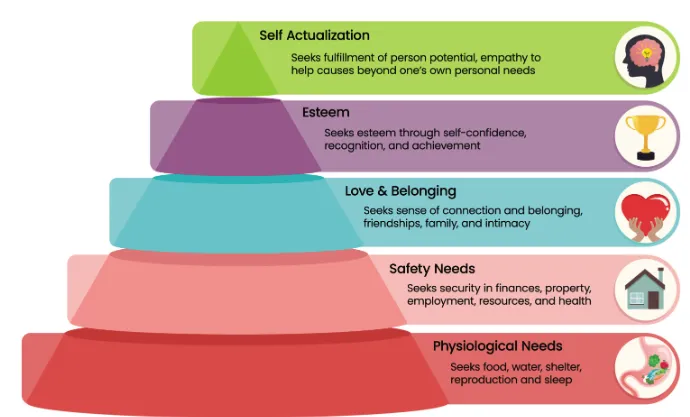 |
Criticisms of Maslow | - People have different needs, so the hierarchy does not apply to everyone equally.
- It is difficult to identify which needs workers have satisfied and what motivates them.
- Self-actualization is not permanent; workers need ongoing challenges and opportunities for growth. |
Frederick Herzberg Two Factor theory | Herzberg discovered factors that led employees to have good feelings about their jobs and factors that led them to have negative feelings about their jobs. |
Extrinsic
Hygiene Factors | Bad environment -> dissatisfaction -> demotivation
Company policy and administration
Supervision
Salary
Relationships with others
Working conditions |
Intrinsic
Motivators | Good environment/influences -> motivation
Personal achievement
Recognition
Interest in the work
Responsibility
Growth and advancement |
Criticisms of Herzberg | - Herzberg assumes satisfaction increases productivity, but motivated workers are not always more productive.
- The theory ignores individual differences. What motivates one worker may cause dissatisfaction for another.
- It assumes money only removes dissatisfaction**, even though it can also motivate many employees. |
David McClelland Acquired Needs theory | He believed that motivation is determined by an individual’s life experiences. So he created three categories that motivate people: achievement, authority/power, and affiliation. |
Need for Achievement | Employees who need achievement aim for excellence. They are motivated by hard work and mastery of tasks.
Businesses should provide this employee with a lot of feedback on progress. These employees have difficulty delegating tasks. |
Need for Affiliation | Employees who need affiliation seek positive relationships from others in the business. The acceptance of other motivates them.
These employees generally succeed in fields like marketing, sales and customer service. Dont make good managers. |
Need for Authority | Aim to hold position of importance. Can be personal power to control other employees, seen as negative. Or can be institutional power to help meet the aims of the organization. Make good managers |
Criticisms of McClelland | - Ignores basic needs such as pay and job security, which are important to all workers.
- Workers may fit into multiple categories, making it difficult to identify what motivates them.
- The three categories are too simple and do not consider factors like personal growth or meaningful work. |
Deci & Ryan Self-determination theory | This is the idea that workers are able to think independently, to manage themselves and make competent decisions. Idea of self-determination
3: autonomy, relatedness, and competence. |
Autonomy | Autonomy is the ability to feel in control of your own behavior.
Employees should be allowed to set their working hours, decide who they work on teams with, and reduce the number of deadlines given to an employee so they can work at their own pace. |
Relatedness | Relatedness is having a sense of belonging to a group and a good relationship with the people in that group.
Businesses can encourage this by creating a sense of team spirit, encouraging collaboration and team work, and building a culture of support not competition. |
Competence | When employees feel they have the skills to perform their jobs well. They are motivated by new challenges, achievable goals, and feedback that helps build confidence and improve performance. |
Criticism of Deci & Ryan | - Ignores extrinsic motivators like payment, praise, working condition, etc.
- Does not talk about to what extent these need to be met and what will happen if not all are met |
John Stacey Adams Equity theory
| It looks at the inputs from employees and the outputs from businesses to see if there is balance.
Why motivation can change rapidly if employee realizes their input is not being as valued as much as a coworkers |
Input vs Output | Input: Knowledge, skills, time, dedication, attitude, effort, etc.
Output: praise, salary, reward, fringe benefits, recognition, etc. |
Criticism of Adams | - Perceptions of inputs and outputs differ, so workers and employers may disagree on what is fair.
- Comparing rewards is difficult because factors like experience, education, and workload vary.
- The theory ignores other motivators such as workplace relationships, challenge, and job satisfaction. |
Victor Vroom Expectancy theory | People will maximize pleasure and minimize pain. The more an employee values the outcome, the more motivated they will be to achieve it.
Expectancy, instrumentality, and valence |
Expectancy | The belief that greater effort will lead to better performance and outcomes. To strengthen expectancy, managers should provide employees with the training, tools, time, and support needed to succeed. |
Instrumentality | Instrumentality is the belief that a certain level of performance will lead to a specific outcome or reward. It's about the connection between performance and rewards. |
Valence | Valence is how much the outcome is valued, if at all. The more an employee values a certain reward, the more satisfied they will be with their efforts. |
Criticisms of Vroom | - Focuses more on employee expectations and may ignore what is realistic or beneficial for the business.
- Motivation is complex, making it difficult to explain using only three factors.
- Rewards are valued differently by different people, so one reward may motivate some employees but not others. |