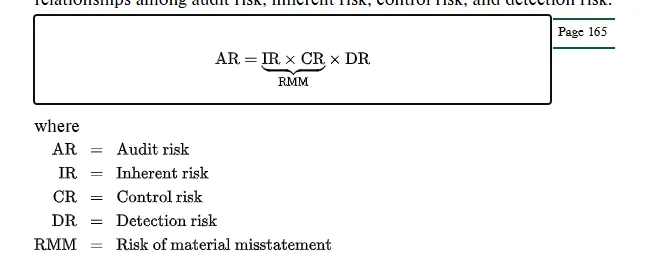
The auditing standards include the following formula to illustrate the relationships among audit risk, inherent risk, control risk, and detection risk.
| Term | Definition |
|---|---|
The auditing standards include the following formula to illustrate the relationships among audit risk, inherent risk, control risk, and detection risk. | |
Appropriateness | relates to the quality of the audit evidence: its relevance and reliability. |
Sufficiency | relates to the quantity of appropriate audit evidence required to sufficiently restrict audit risk. |
Anchoring bias: | Making judgments by starting from an initial belief and then making insufficient adjustments to the belief when contrary information is encountered. For example, the auditors may anchor on the recorded amount of a company’s warranty liability and not sufficiently adjust their belief based on evidence that it is misstated. |
Confirmation bias: | Seeking and treating as more persuasive information that is consistent with one’s initial beliefs. For example, the auditors inadequately consider contradictory evidence that casts doubts on a change in operating results after other potential explanations for a change in operating results after management proposes an explanation that is consistent with the auditor’s belief. |
Availability bias: | Overvaluing information that comes to one’s mind quickly or is easily obtained. For example, the auditors may assume that the cause of an unusual relationship is the same as they have experienced several times in prior audits. |
Overconfidence bias: | Overestimating one’s own abilities to make estimates or assessments. For example, the auditors may be overconfident in their ability to evaluate the accuracy of an accounting estimate and, as a result, not collect sufficient evidence. |
Automation bias: | A tendency to favor output generated from automated systems, even when human reasoning or contradictory information raises questions as to whether such output is reliable or appropriate. For example, an estimate may be made electronically that is based on prior conditions that have now changed. |
Risk assessment procedures | are designed to obtain an understanding of the client and its environment, including its internal control, to assess the risks of material misstatement. |
Tests of controls | are designed to test the operating effectiveness of controls in preventing or detecting and correcting material misstatements. |
Substantive procedures | are designed to detect material misstatements of relevant assertions. Substantive procedures include
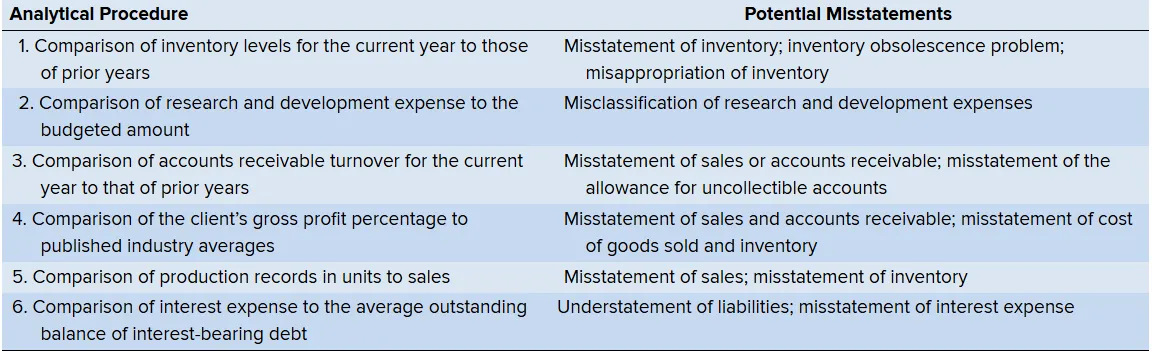
analytical procedures and
tests of details of account balances, classes of transactions, and disclosures. |
The auditors perform a variety of audit procedures to obtain audit evidence, including |
Inspection of records and documents.
Inquiry of knowledgeable persons within and outside the entity.
External confirmation.
Inspection of tangible assets.
Observation of processes or procedures being performed by others.
Recalculation of mathematical accuracy.
Reperformance of procedures.
Analytical procedures. |
 |