| Term | Definition |
|---|---|
What is anatomy? | The study of body structures. |
What is physiology? | The study of body functions. |
What is the smallest living unit of the body? | The cell. |
What is a tissue? | A group of similar cells performing a function. |
What is an organ? | A structure made of two or more tissue types. |
What is an organ system? | Organs working together for major body functions. |
What is the highest level of body organization? | The organism. |
What is the chemical level made of? | Atoms and molecules. |
What is the cellular level? | Cells, the basic living units. |
What is homeostasis? | Maintaining a relatively stable internal environment. |
What is a stimulus in homeostasis? | A change that causes a response. |
What does a receptor do? | Detects a change or stimulus. |
What does a control center do? | Processes information and determines a response. |
What does an effector do? | Carries out the response. |
What is negative feedback? | A response that reverses the original change. |
What is positive feedback? | A response that amplifies the original change. |
Give an example of negative feedback. | Sweating helps lower elevated body temperature. |
Give an example of positive feedback. | Uterine contractions intensify during childbirth. |
What is metabolism? | All chemical reactions occurring in the body. |
What is anabolism? | Building larger molecules from smaller molecules. |
What is catabolism? | Breaking larger molecules into smaller molecules. |
What is responsiveness? | The ability to detect and respond to changes. |
What is movement as a life function? | Motion of the body or substances within it. |
What is growth? | An increase in body size or cell number. |
What is differentiation? | Cells becoming specialized in structure and function. |
What is reproduction? | Producing new cells or a new organism. |
What is digestion? | Breaking food into smaller absorbable substances. |
What is excretion? | Removing wastes from the body. |
What does the integumentary system include? | Skin, hair, nails, and associated glands. |
What is the main function of the skeletal system? | Support, protection, movement assistance, and blood cell formation. |
What is the main function of the muscular system? | Movement, posture, and heat production. |
What does the nervous system do? | Provides rapid control using electrical signals. |
What does the endocrine system do? | Regulates body functions using hormones. |
What is the main function of the cardiovascular system? | Transports blood, oxygen, nutrients, and wastes. |
What does the lymphatic system do? | Returns tissue fluid and supports immune defense. |
What is the respiratory system's main function? | Exchanges oxygen and carbon dioxide. |
What is the digestive system's main function? | Processes food and absorbs nutrients. |
What does the urinary system regulate? | Removes wastes and helps balance water and electrolytes. |
What is the main function of the reproductive system? | Produces sex cells and enables reproduction. |
What does superior mean? | Toward the head or upper part of the body. |
What does inferior mean? | Toward the feet or lower part of the body. |
What does anterior mean? | Toward the front of the body. |
What does posterior mean? | Toward the back of the body. |
What does medial mean? | Toward the body's midline. |
What does lateral mean? | Away from the body's midline. |
What does proximal mean? | Closer to the point of attachment or trunk. |
What does distal mean? | Farther from the point of attachment or trunk. |
What does superficial mean? | Closer to the body surface. |
What does deep mean? | Farther from the body surface. |
What plane divides the body into left and right? | The sagittal plane. 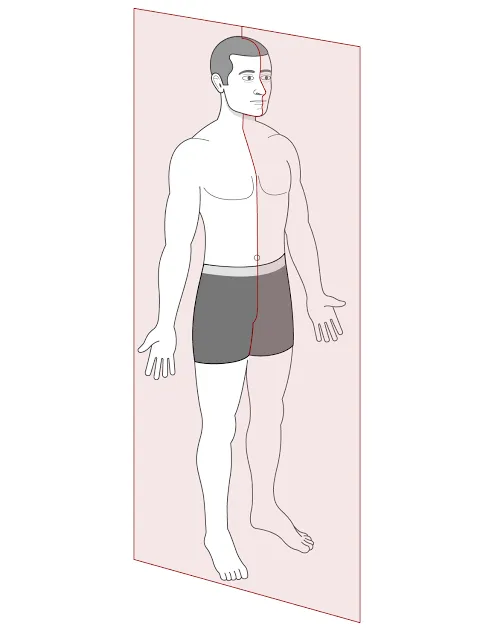 |
What plane divides the body into equal left and right halves? | The midsagittal plane. |
What plane divides the body into front and back? | The frontal or coronal plane. |
What plane divides the body into upper and lower parts? | The transverse plane. |
What cavity contains the brain? | The cranial cavity. |
What cavity contains the spinal cord? | The vertebral cavity. |
What cavities surround the lungs? | The pleural cavities. |
What cavity contains the heart? | The pericardial cavity, within the mediastinum. |
What is the diaphragm? | A muscle separating the thoracic and abdominopelvic cavities. |
What is the largest organ of the integumentary system? | The skin. |
What are the three main layers beneath the skin surface? | Epidermis, dermis, and hypodermis. |
What is the epidermis? | The outer epithelial layer of the skin. |
What is the dermis? | The connective tissue layer beneath the epidermis. |
What is the hypodermis? | Subcutaneous tissue beneath the dermis; it is not skin proper. |
Does the epidermis contain blood vessels? | No; it receives nutrients by diffusion from deeper tissues. |
What type of epithelium forms the epidermis? | Keratinized stratified squamous epithelium. |
What is keratin? | A tough protein that strengthens and waterproofs the epidermis. |
What produces melanin? | Melanocytes. |
What is the main role of melanin? | It helps protect cells from ultraviolet radiation. |
What is the deepest epidermal layer? | Stratum basale. |
What is the outermost epidermal layer? | Stratum corneum. |
What happens in the stratum basale? | Cells divide to replace lost epidermal cells. |
What makes the stratum corneum protective? | Layers of flattened, dead, keratin-filled cells. |
What are the five epidermal strata in thick skin? | Basale, spinosum, granulosum, lucidum, and corneum. |
Which epidermal layer occurs only in thick skin? | Stratum lucidum. |
Where is thick skin found? | Primarily on the palms and soles. |
Where is thin skin found? | Most other body surfaces. |
What are dermal papillae? | Projections of dermis that interlock with the epidermis. |
What gives fingerprints their patterns? | Ridges shaped by dermal papillae and the overlying epidermis. |
What tissue forms much of the dermis? | Connective tissue containing collagen and elastic fibers. |
What do collagen fibers provide? | Tensile strength and resistance to stretching. |
What do elastic fibers provide? | Stretch and recoil. |
What is the hypodermis rich in? | Adipose tissue and loose connective tissue. |
What are major functions of subcutaneous fat? | Insulation, cushioning, and energy storage. |
What glands produce sebum? | Sebaceous glands. |
What is sebum? | An oily secretion that lubricates skin and hair. |
Which glands usually release sweat for cooling? | Merocrine (eccrine) sweat glands. |
What is the main function of eccrine sweat? | Cooling the body through evaporation. |
Where are apocrine sweat glands commonly found? | The armpits and groin region. |
What causes body odor from apocrine secretions? | Bacteria breaking down components of the secretion. |
What are arrector pili muscles? | Small smooth muscles that raise hairs, causing goosebumps. |
What is a hair follicle? | A skin structure from which a hair grows. |
Where does hair growth occur? | In the hair matrix within the hair bulb. |
What is the hair shaft? | The part of hair that extends above the skin surface. |
What is the nail matrix? | The growth region that produces most of the nail plate. |
What is the nail plate made of? | Hard, keratinized cells. |
How does skin help regulate temperature? | Sweating and changes in dermal blood flow. |
How does vasodilation affect heat loss? | It increases surface blood flow and promotes heat loss. |
How does vasoconstriction affect heat loss? | It reduces surface blood flow and conserves heat. |
How does skin help protect against infection? | It forms a physical barrier and supports immune defenses. |
How does skin help synthesize vitamin D? | UVB exposure initiates vitamin D production in the skin. |
Which receptors detect light touch? | Merkel cells and tactile receptors, including Meissner corpuscles. |
Which receptors detect deep pressure and vibration? | Pacinian corpuscles. |
What are the major skin sensory functions? | Detecting touch, pressure, pain, and temperature. |
What is a first-degree burn? | A superficial burn affecting the epidermis. |
What is a second-degree burn? | A partial-thickness burn affecting the epidermis and part of the dermis. |
What is a third-degree burn? | A full-thickness burn destroying the epidermis and dermis. |
Why can severe burns cause dehydration? | Damaged skin loses its ability to limit fluid loss. |
What is melanoma? | A cancer of melanocytes that can spread rapidly. |
What does the ABCDE rule help assess? | Possible melanoma: asymmetry, border, color, diameter, and evolution. |
Why should changing skin pigmentation be checked? | Changes can signal skin damage or possible skin cancer. |
What is the role of hair in skin protection? | It helps protect areas such as the scalp and traps particles in some regions. |
What is the function of nails? | They protect fingertips and toes and assist fine movements. |
Why does skin appear red during inflammation? | Increased blood flow to the affected area. |
What are stretch marks associated with? | Changes that damage or stretch connective tissue in the dermis. |
What is cyanosis? | Bluish skin coloration that can be associated with low blood oxygen. |
What is jaundice? | Yellowing of skin and eyes from bilirubin buildup. |