When newborns take their first breaths...
their bloodstream is forced to reroute from placenta to lungs
| Term | Definition |
|---|---|
When newborns take their first breaths... | their bloodstream is forced to reroute from placenta to lungs |
babies' first form of communication | crying |
Infants and swimming | their voice box is higher, so when water goes into their stomachs rather than into their lungs |
newborn vision | double vison, blurry, because they cannot coordinate vision yet |
newborn's vision is best at ______ | 20 cm from their face, about how far away mom is when she is nursing |
babies prefer ____ colors | bright, primary
this is because they're eyes respond to contrast |
babies spend _____ in REM sleep and don't spend time in ______ | 2 times as much time
NREM 3 |
babies can _______ and feel it in their fingers | hear a loud noise |
babies can _____ a bright light | smell |
babies taste in color and smell in sound because | their brain connections aren't properly organized yet |
affects of infants who have severe elipisy can be operated on, to have half their swollen brains removed | the brain has such high plasticity at a young age, that the baby's brain can bounce back to some regard |
infant's skulls are different from adult skulls in that _____ | not all bones are fused together, which helps them fit through the birth canal |
infants do not form ______ until they have experiences walking and crawling | their kneecaps |
by the time they are 2 yrs old, babies have | grown half their full height |
what part of milk is essential for infant brain development? | fat |
babies prefer ____ | sweet foods, because they are rich in energy |
messy eating can allow babies to _____ | experiment with solids, liquids, and other science |
babies have an aversion to _____ | plants; to protect from poison plants |
what happens when 18-month-olds look in a mirror | they start to recognize their reflection |
how does language development begin | infants start looking at mouth shapes before they can even talk |
infants can | understand/use sign language before they can talk; proving they have thoughts and start to communicate before they can talk |
Infant reflexes | include rooting, sucking, swallowing, stepping, grasping, and Moro
note that while they have these reflexes, there is a lack of consistency |
Moro reflex | when running a finger on baby's foot, their toes will spread out |
The visual cliff | 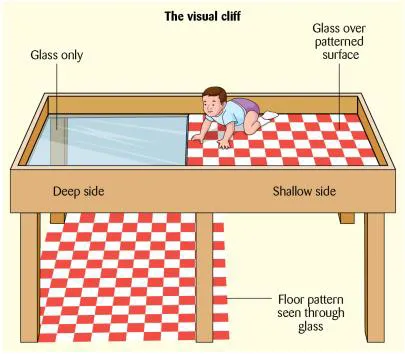 |
Visual cliff responses | 6-month olds will crawl across, but in a few weeks, they will not
this is because they always have depth perception, but as they continue learning to crawl, they gain understanding of the danger of following |
preferential looking | how babies are tested for vision; they are given two objects to see which one they look at (are more interested in) longer, which shows their visual abilities |
potty training | age is the least important, parents should assess if they are ready, and then allow patience and time to learn |
the traditional view of physical development in childhood | this view minimizes environmental effects, children have to be mature and ready, their brains must be mature, they have built in programs for their brains to work |
Esther Thelen's background | was a stay at home mom, and when she got bored, she decided to go to grad school and took a class on animal behavior as a biology major. She did a interdisciplinary study on biology and psychology. |
Dynamic systems theory | Ester Thelen's theory that children are born with built-in brain programs that get modified as children live in their environment |
Esther Thelen's wasp study | Looked at how wasps groomed themselves, with antennae and with antennae removed. The wasps that had their antennae removed still tried to groom themselves, as this was programmed into them. The wasps that had their antennae responded similarly, although since they could feel how they were grooming themselves, their grooming patterns differed. |
Esther Thelen's theories on the infant stepping reflex | She realized that infant kicking motion was the same as their stepping motions, and measured this through EMG. She them put babies in a fish tank and the babies were able to walk, as the water helped support their legs. The stepping motion disappears on land as their legs tend to grow faster than they can learn to support themselves, so the support of the water brought it back |
Esther Thelen and the treadmill | Put 7-month-old on a treadmill, and they were able to walk, even with tracks for different feet going at different speeds, they were able to keep up |
Esther Thelen's experiments prove | Infants have modified experiences and built in motor programs. In real time, infants can learn from their experiences and adapt. |
Sensation | processing basic information in the world through senses |
perception | organizing sensory information and interpreting it |
visual acutiy | how clearly an infant can see, tested with preferential-looking technique |
preceptual consistancy | we perceive a constant shape and size of a moving object, even as it moves different distances from our sight |
object segregation | we can see the lines that show where one object starts and ends |
violation-of-expectancy | used to study infant cognition, and that if they observe something inconsistent with their prior knowledge, they become interested in it again |
infants tend to reach for ________ | objects in the dark; when a room suddenly becomes dark |
optical expansion | a depth cue where as an object gets closer to us, it becomes larger |
binocular disparity | the difference between the retinal image of an object in each eye sends slightly different signals to the brain; the closer the object, the greater the difference between signals |
stereopsis | the visual process in which the eyes view two different things (binocular disparity), and the brain processes those signals to give depth perception
this forms at about 4 months of age |
monocular depth cues | depth perception of one eye; this develops around 6-7 months old. Also known as pictorial cues |
infants prefer _______ singing | infant directed |
infants pay more attention to a _______ of a piece of music | consonant version |
Trainor & Trehub | Found that infants can observe more musical tone changes than adults, probably because they have less experience with western music |
Perceptual narrowing | developmental changes in which experience fine-tunes the perceptual system
ex: musical experience plays a role in developing musical abilities in infants |
early exposure to _____ flavors plays a part in infant's later prefrences | bitter |
timing of exposure to flavors | matters |
infants can recognize their mothers' scents as early as | two days old |
toddler's reject new foods due to | their smell, rather than taste |
infants start with _____ exploration | oral
once they gain control of hand/arm movements, they start exploring by manual touch |
intermodal perception | combining info from two or more sensory systems |
Examples of intermodel perception | infants can recognize images of pacifiers different than the one they were sucking on, and can pick out the audio from multiple videos, when presented two videos |
the development of motor functions tend to _____ | vary across cultures |
affordances | possibilities for action which are offered by situations to encourage movement |
infants that develop better motor skills might have a better ______ later in life | cognitive/perceptual skill |
Reaching | Developed 3-4 months, and once infants start reaching, they can learn even more about their environments and the world |
Self-locomotion | moving around the environment on thier own |
scale errors | young children tend to interact with small replica items as if they were life-sized |
grasp errors | children try to pick up 2D items |
media errors | children try to pass through/receive items through a screen |
Statical learning | infants prefer patterns of variability, not too easy or hard |
Classical Conditioning | the unconditioned stimulus (UCS) becomes the conditioned response (CR), as a UCR (unconditioned response) is combined with the UCS to get a conditioned response (CS) |
instrumental conditioning | children learn that one action causes another |
Instrumental conditioning | infants can imitate behaviors they watch, varying by age |
Observational Learning/immitation | infants can imitate behaviors they watch, and the ability of their imitation varies by age |
Mirror neurons | help in observational learning, these neurons mirror behavior that are watched |
Rational learning | using prior experience to predict what will occur in the future |
Active learning | infants learn from acting in their world, and they learn more from surprising activities |