| Term | Definition |
|---|---|
what is psych | the scientific study of the brain and behaviors |
biology/neuroscience perspective | how body and brain affect behavior and mental processes
-roles of neural networks in thinking
-genetic, genetic determination |
cognitive perspective | how people process information
-rational choice
-how your behavior reflects your thoughts |
humanistic perspective
| how environment reflects personal growth
-positive aspects of psych
-unconditional positive regard
-'peak experience' = one's fullest potential; humanism believe this will lead one to happiness
-ABRAHAM MASLOW
-CARL ROGERS
-1960's-now |
behavioristic perspective
| OVERT BEHAVIORS
-behaviors infer intention
-environment shapes and controls behaviors
-reinforcement
-JOHN B WATKINS
-BF SKINNER
-1920's 1960s |
psychoanalytic/psychodynamic perspective | your unconscious=your basic needs and wants
-you are only aware of a small part of your mentality
-FREUD
-majority of ur behavior is shaped by your unconscious
-1900s to now |
evolutionary perspective | how behavior fits into environment
-how it adapts |
behavior genetics | how genes affect behaviors |
developmental perspective | how psychologically u develop over lifetime |
social-cultural | how social environment and culture affects thinking, feeling, behaviors |
who established first psych laboratory | wilhelm wundt, 1879, PSYCH AS SCIENCE WOOO |
structuralism | most basic and simplest mental processes -- basic elements of mind
-wundt |
introspection | systematic, rigorous observation of conscious experience
- in order to break consciousness into basic elements
-describing experiences w no naming or interpreting
-EDWARD TITCHENER |
functionalism | all mental processesexist to meet certain needs, ie serve certain FUNCTIONS haha
-william james
-darwim -- help species survive -- mind
|
first psych school | HARVARDDDDD |
first female doctoral student | Mary Calkins |
first female w' doctorate | Margaret Washburn |
three levels of analysis | biopsychosocial analysis
-biology=genetics, nat. selection, environment
-psychology=learned fears, emotional responses, learned expectations
-social-cultural influences=presence of others, cultural, societal expectations, group & media influences |
basic research | to build knowledge base |
applied research | to solve problems |
counseling psychology | subfield -- talk therapy, conversations |
clinical psychology | severe mental health issues |
psychiatry | DOCTOR -- can give meds |
action potential | neuron signal -- an electrical charge that travels down axon to send message
-all or none response, goes ONE way down neuron (dendrite, soma, axon) |
first step of action potential | stimulus -- neurotransmitters
bind to receptors on dentrite
open channel and bring sodium in thru dendrites 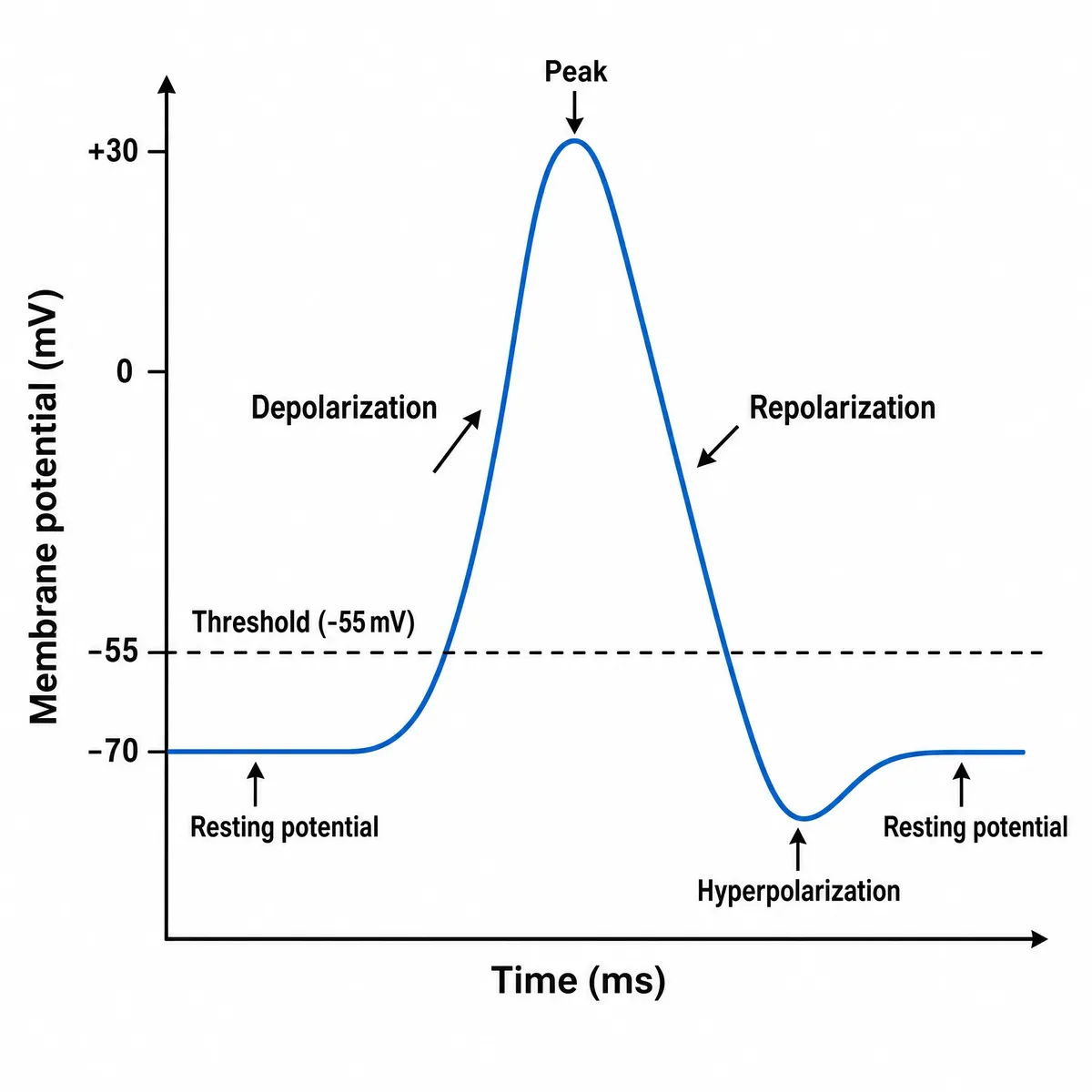 |
-55 millivolts | THRESHOLD
if threshold is reached, neuron will fire! |
step 2 | depolarization
sodium opens gates on voltage channels in axon -- draws more sodium very quickly into neuron
-positive on inside of neuron, negative on outside
|
3rd step |
repolarization-voltage gates close NA
-K+ gates open -- K+ rush outside neuron
|
4th | hyperpolarized (refractory period)
-neuron is recharging -- is extra negative (-90 millivolts)
|
resting potential | neuron is ready to fire -- -70 millivolts
-polarized |
GABA | inhibitory neurotransmitter= STOP |
glutamate e | excitatory= GO
-memory |
acetylcholine | muscle movement, learning, memory |
serotonin | hunger, mood, sleep, arousal |
dopamine | involuntary movement, learning, attention, emotion
-reward one |
endorphin | natural painkilllers -- affect perceptions of pleasure and pain |
motor neurons | carry info from brain and SC to rest of body
-efferent nerves |
sensory neurons | carry sensory info from enviornemnt to body
-afferent nerves |
central nervous system | 'command center'
-brain, spinal cord |
peripheral nervous system | -messengers |
somatic nervous system | -voluntary movement
-recieves sensory signals(touch, temp pain), sends movement instructions |
autonomic nervous ssytem | controls automatic processes-heart, breathing, digestion, BP |
sympathetic | AHHHHHHHHH(fight or flight)
-prepares body for stress, danger(^ heart rate, etc) |
parasympathetic | 'rest and digest'
-promotes digestion |
forebrain | -cerebrum, cerebral cortex
-higher-level thinking |
left hemisphere | controls right side of body
-dominant for language, logic |
right hemisphere | controls left side of body
-dominant for creativity spatial reasoning, emotional perception |
cerebral cortex | thin outer layer of cerebrum
-responisble for majority of info processing
- 4 lobes |
frontal lobe | front-forehead region of cerebral cortex
-descision making, planning, problem-solving
-contains motor cortex(precentral gyrus) -voluntary muscle movement
-contains broca's area -- responsible for language production
|
parietal lobe | processes sensory info --touch, temp, pain
-contains sensory cortex(somatosensory cortex) (postcentral gyrus)
|
temporal lobe | temples, near ears
-processes auditory info
-long-term memory, language comprehension
-contains wernicke's area -- area of brain responsible for language comprehension |
occipital lobe | back of head
-visual information (visual cortex) |
midbrain | brain relay station -- key part of brainstem |
thalamus | egg shape literally in middle of brain
-sensory control center
-traffic control station |
limbic system | in midbrain -- associated w emotions and motivations
-hippocampus-MEMORY
-amygdala-EMOTIONS
-hypothalamus -maintains homeostasis by regulating eating, thirst, body temp |
hindbrain | back of brain -- brain stem and assorted accessory components
- cerebellum -- looks like a little brain (motor coordination
-medulla -lowest part of brain stem (vital involuntary functions)
-pons - connects cerebellum to medulla (bridge for neural signals, helps regulate sleep) 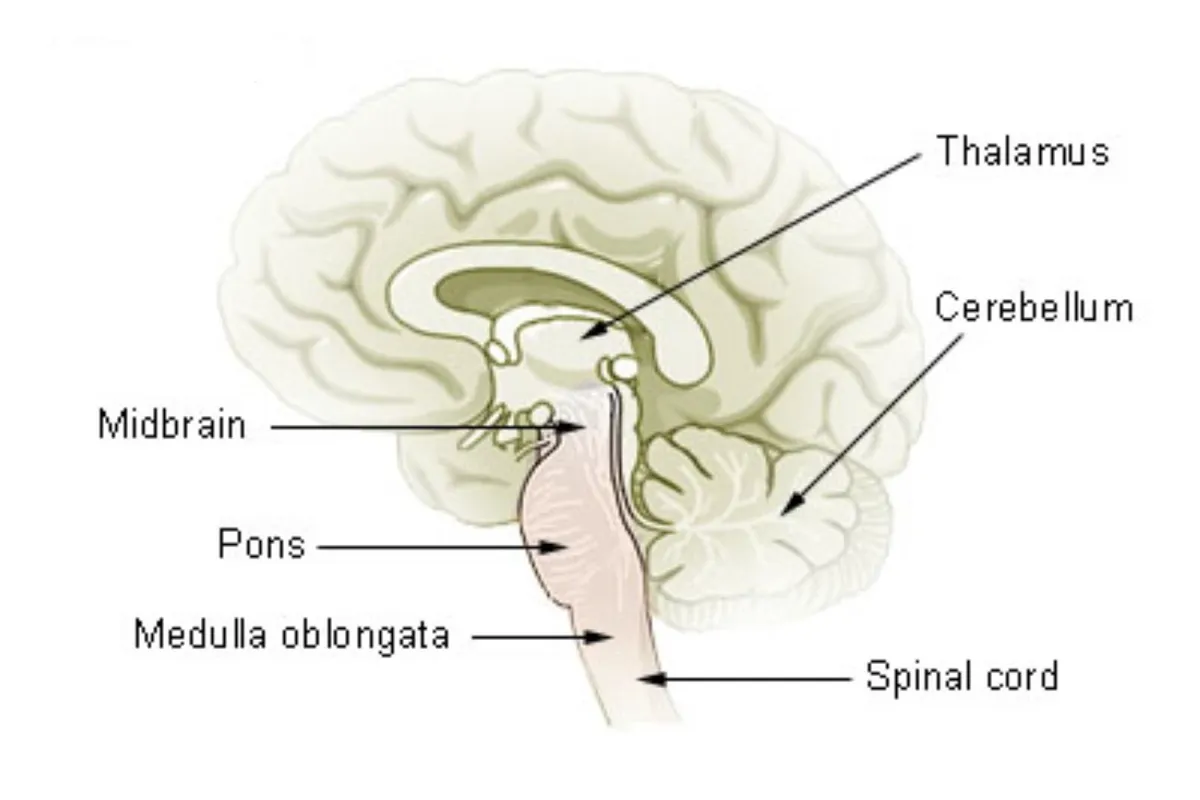 |
consciousness | subjective awareness of self and environment |
innattentinal blindness | inability to notice visible objects (objects in line of sight) when consious mind is focused elsewhere
-conscious mind cna be focused ON ONE THING ONLY |
dual processing | two-track mind for processing
-conscious deliberate 'high road'
-sequential processing= conscious, slow effortful (problem=solving, processing new info) (LOGIC)
-unconscious, automatic 'low road'
-parallel processing-helps w daily routines(muscle memory)
-processes multiple aspects of stimulus at same time (EMOTION) |
NREM 1 | first sleep stage --30 mins |
NREM 2 | -20 minutes
-rapid, rhythmic brain waves
-helps w memory |
NREM 3 | 30 mins
slow waves |
REM | Rapid Eye Movement
-10 mins
-eyes move, dreams occur
-heart rate increases |
paradoxical sleep | body is internally aroused (waking-like brain activity)
drams occur
motor cortex is active, brainstem blocks engagement |
why dream | psychodynamic says wish fulfillment
cognitive psych says for info processing and to file away memories
physiological says to develop and preserve neural pathways
neuroscience says activation synthesis -- to make sense of neural activities
developmental psych says for cognitive development |