Characteristics of Life (give the order)
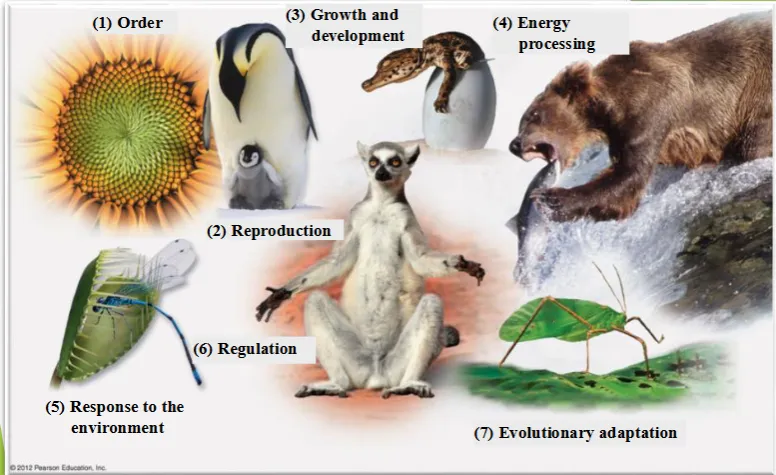
order, reproduction, growth and development, energy processing, response to the environment, regulation, evolutionary adaptation
| Term | Definition |
|---|---|
Characteristics of Life (give the order) | order, reproduction, growth and development, energy processing, response to the environment, regulation, evolutionary adaptation |
what is order? | highly organized and consist of one of more cells |
what is reproduction? | ability of organisms to reproduce their own kind |
what is growth and development? | consistently grow and develop, controlled by inherited DNA |
what is energy processing? | ability to take in and use energy |
define response to environment | ability to respond to stimuli in environment |
what is regulation? | ability to maintain internal environment to support life |
what is evolutionary adaptation? | ability to evolve over many generations as individuals with traits best suited to their environments have greater reproductive success and pass their traits to offspring |
the lowest level of structure that can perform all functions required of life | cellular level |
what do all cells share? | cell membrane, DNA, ribosomes |
what are the two types of cells? | prokaryotic and eukaryotic |
what are the three domains of living organisms? | bacteria, eukaryota, archaea |
what are the four kingdoms of Eukarya? | protists, plantae, fungi, animalia |
what domain is the most widespread of all living organisms? | bacteria |
what domains are prokaryotic, unicellular and microscopic? | bacteria and archaea |
what domain thrives in extreme conditions? | archaea |
what are the extreme conditions of domain archaea? | thermophiles, halophiles, and methanogens |
what domain has membrane bound organelles? | eukarya |
give an example of the kingdom protists | algae and protoza |
provide an example of the kingdom fungi | decomposer |
provide an example of the kingdom plantae | photosynthesis |
provide an example of the animal kingdom | ingestion and cell respiration |
what is the hierarchy of organization in organisms? | atoms, molecules, cells, tissue, organ system, organism |
what is the hierarchy of organization beyond the organism? | population, community, ecosystem, biosphere |
what is an atom? | smallest unit of an element, composed of protons, neutrons and electrons |
what is a molecule? | two or more atoms held together by bonds |
what is a cell? | smallest structural and functional unit of life |
what is a tissue? | groups of cells with common structure and functions |
define the organ system? | groups of organs working together |
what is an organism? | a complete individual |
define population | organisms of same species in a specific area |
define community | several species interacting in a specific area |
define ecosystem | community of living organisms plus the non living surrounding environment |
define biosphere | the entire earth, including the atmosphere |
what are producers for most ecosystems? | plants |
what takes up CO2 from air, H20 and minerals from soil, energy from sun? | plants |
define primary consumers | obtain matter and energy from eating plants |
define secondary consumers | obtain matter and energy from eating the primary consumer |
define decomposers | obtain matter and energy from decomposing waste materials and dead organisms |
what does DNA stand for? | deoxyribonucleic acid |
what contains units of inheritance (genes) | dna |
how many nucleotides are DNA made up of? | 4 |
what is a genome? | entire library of genetic instructions in an organism |
diversity of life arises from the differences of what code? | dna |
changes in genetic code also contributing to evolution is an example of what? | dna |
what is evolution? | species descending from a common ancestor |
this is an example of what occurring: modifications as species diverage from common ancestors? | evolution |
define natrual selection | process of inheriting variations and favors the reproductive success of some individuals over others |
what are the steps of the scientific method? | observation, question, hypothesis, test, analyze, conclusion |
how do you conduct a good experiment? | have a control group, independent variable, dependent variable and a sample size of at least three |
what are control groups used for? | comparison |
what is an experimental group | has all the same conditions except for the one variable you are testing |
define independent variable | the factor you are manipulating |
define dependent variable | the measurement of the effect of the independent variable |
define controlled variables | those factors remaining the same in all groups |
what is the basic form of all matter and cannot be broken down into different components? | elements |
what do all living things consist of? and of what percentage? | C, O, N, H 96% |
what other elements do humans need? and of what percentage? | Ca, P, K, S, Na, CI, Mg 4% |
what are the trace elements that only make up 0.01%? | Fe, I, F |
how many atoms do elements have? | one |
what has two or more atoms joined together chemically? | molecule |
what has two or more different elements joined together chemically? | compound |
what has two or more different molecules not joined chemically and can be separated? | mixture |
all compounds are ___ but not all of these are compounds | molecules |
explain how a compound works | compounds can take on a different physical and chemical property than individual elements and they are difficult to separate into individual elements |
explain how a mixture works | mixtures can be separated using physical means like filtration, density or evaporation |
what is the smallest unit of an element? | atom |
what differs in the number of protons? | elements |
what does an atomic number represent? | the number of protons |
what does an atomic mass represent? | the average mass of an elements naturally occurring isotopes |
where are protons located? | nucleus |
what kind of charge is a proton? | positive |
how does a proton work? | holds the negatively charged electrons close to the nucleus |
where are neutrons located? | nucleus |
how to find the number of neutrons | atomic mass minus number of protons |
what do neutrons do for the nucleus? | stabilize |
where can you find electrons? | in the orbitals around the nucleus |
how to find the number of electrons | equals the number of protons |
what kind of charge is an electron? | negative |