Chemistry
Measuring and analyzing matter and changes, as well as the energy associated with it.
| Term | Definition |
|---|---|
Chemistry | Measuring and analyzing matter and changes, as well as the energy associated with it. |
Matter | Has mass and takes up space. |
Atom | Smallest building block of matter. |
Molecules | Two or more atoms bonded together. |
Three phases of matter | Gas, Liquid, Solid. |
Gas, describe | Far apart and disorganized molecules/atoms; can fill up any space. |
Liquid, describe | Close and disorganized molecules/ atoms and can conform to any/most shapes. |
Solid, describe | Very close and very organized, it doesn't conform to any shapes. |
Pure substance | It has distinct properties and a fixed composition; it doesn't vary from sample to sample. |
Elements | It is matter that can't decompose into anything simpler, (out of 118 known elements only 90 are natural.) |
A few elements exist as molecules, what are they called? | Diatomic molecules |
A few elements exist as molecules, which ones are they? | They are all gasses, Hydrogen, Nitrogen, Fluorine, Oxygen, Iodine, Chlorine, Bromine. |
What is a diatomic molecule? | It is an element that is made up of two atoms, only really part of the gas family. |
Describe what a mixture is. | Mixtures are a composition of two or more substances that are NOT pure, but ARE made up of pure things, the things keep their original properties and can be separated. |
What are substances? | Just basically mixtures that are not a fixed composition. |
What is a homogeneous mixture? Name an example. | It has a uniform composition and appearance. EX) Water, Sugar, Air |
What is a heterogeneous mixture? Name an example. | It does not have a uniform composition or appearance. EX) Chocolate chip cookies, Trail mix, Oil and Water. |
What are physical properties? | They describe the appearance (by itself), and it can be observed without changing physical properties or the composition. |
What are the 12 physical properties. | Color, Luster, Hardness, Melting point, Density, Conductivity, State Phase, Mass, Volume, Length, Thickness. |
What is an Intensive Property? | An intensive property does not depend on the amount of the sample present. (Color, Luster, Melting point, Density, Conductivity, State Phase) |
What is an Extensive Property? | An Extensive property does depend on the amount of the sample present. (Mass, Volume, Length, Thickness) |
What does having chemical properties mean? (2 key points) | 1.) It describes interactions with other substances.
2.) How a substance changes/reacts to form a new substance. |
What are some Chemical properties? Name at least four. | Corrosiveness, Flammability, Acid Reactivity, Base reactivity, Toxicity, Electronegativity, Solubility, Heat of combustion, Radioactivity. |
Who was Democritius and his theory? | He was an ancient Greek philosopher, and he argued that matter consisted of indivisible particles called Atomos. |
Who were Plato and Aristotle? | Came later on than Democritius and they said that there couldn't be indivisible particles and the atomic view/theory fades away. |
Who was John Dalton? | He was and English chemist who brought back the atom concept. |
What was John Daltons four Postulates? You can simplify. | 1.) Each element is composed of extremely small indivisible particles called atoms.
2.) All atoms of one element are identical to one another however are different from all other elements.
3.) Atoms of one element can't be changed into atoms of a different element by chemical reactions; atoms are neither created nor destroyed in chemical reactions.
4.) Atoms combine to form molecules. For a specific molecule, atoms combine is a specific whole number ratio. |
Who made the Atomic Theory Laws? | John Dalton. |
What is the first Atomic Theory Law? | 1.) Law of Definite proportion, (Constant composition).
The "relative number" (ratio), kind (elements) of elements are consistent. (Mass percent). |
What is the second Atomic Theory Law? | 2.) Law of Conservation of Mass.
Pretty easy, the total starting mass MUST equal the ending mass. |
What is the third Atomic Theory Law? | 3.) Law of Multiple Proportions.
The ratio of the mass ratios of two different compounds can be expressed as a whole number. |
What is Mass Ratio? | 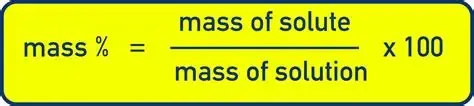 |
What caused revisions to the Atomic Theory? (Hint there is 2) | 1.) The discovery of the subatomic particles, this corrected the notion that atoms are indivisible.
2.) Discovery of isotopes, this disproves that all of on element particle weighs the same. |
What experiment did Joseph John Tomson do? Explain the experiment and its conclusion. | He conducted the Cathode Ray Tube experiment.
The Cathode Ray Tube had a metal plate, and it emits negative cathode rays, those rays bent towards a positive magnetic field, and away from the negative electric field.
Due to opposites attracting, john was able to discover that atoms have particles that are negatively charged. Those are called electrons. |
What experiment did Robert Millikan do? Explain the experiment and its conclusion. | He did the Oil drop experiments, in simple terms her measured how fast oil droplets fell under gravity. Then he added voltage to the oil and observed it than. He was able to deduce the charge of the electron to be negatively charged. |
Joseph John Tomson, along with the cathode ray tube experiments what model did he make, and what did it mean? | He made the Plum Pudding Model, this was a basic idea highlighting that atoms are naturally neutral, there was an even number of "Plums" (Negatively charged atoms), surrounded by "Pudding" (Positively charged). 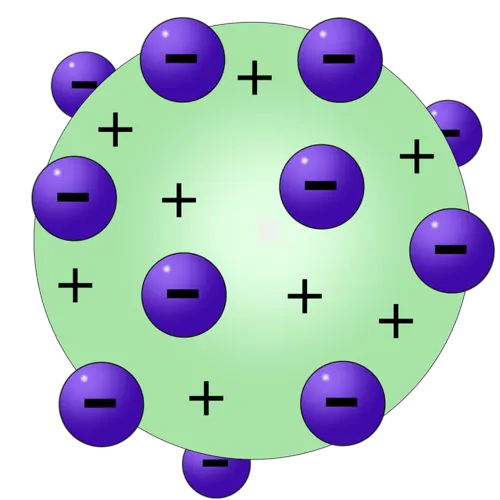 |
Who was Ernest Rutherford and what was his experiment. | Ernest conducted the gold foil experiment. He shot out alpha particles at a gold sheet of foil. Most went through but some shot out in awkward directions and even back towards the original spot it was shot from. This proved that atoms were mostly made up of empty space, causing the discovery of Protons. This of pro- as good as in positive. |
Define Atoms, in depth. | Atoms are mostly empty space occupied by electrons orbiting it on the outside in different levels, the spot that the electrons are on defines what the atom is, in terms of element. The middle is composed of positively and neutrally charged protons and neutrons. This is where the majority of the mass is held. 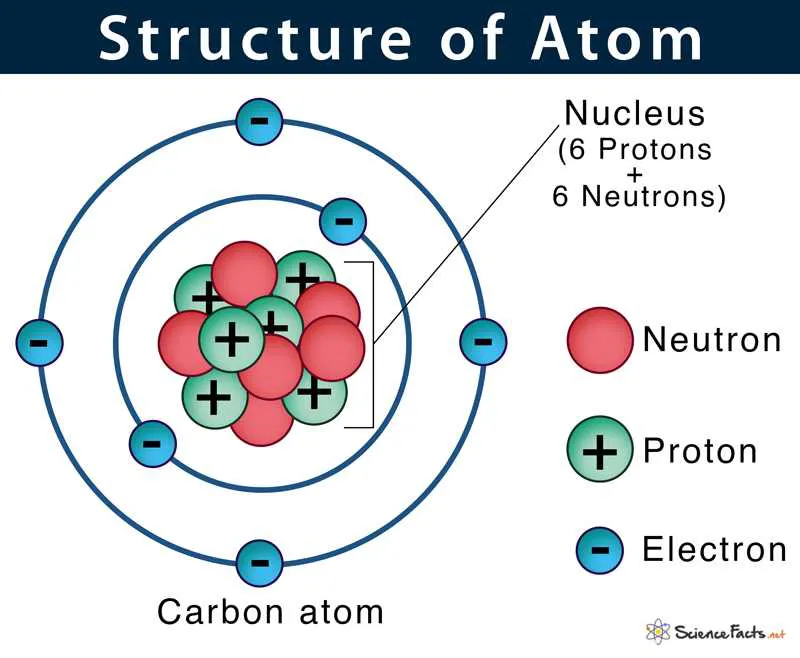 |
What was James Chadwick's experiment, and what knowledge did we gain because of it? | He "bombarded beryllium" with alpha particles from plutonium and produced an uncharged radiation, otherwise known as neutrons. |
The periodic table had two fundamental creators what were their names. | Mendeleev and Mosely |
What was Mendeleev's take on the periodic table and his involvement? | He was given most credit for the creation of the periodic table because he was the one who insisted that elements with similar characteristics be listed in the same column, leaving blanks for undiscovered elements. 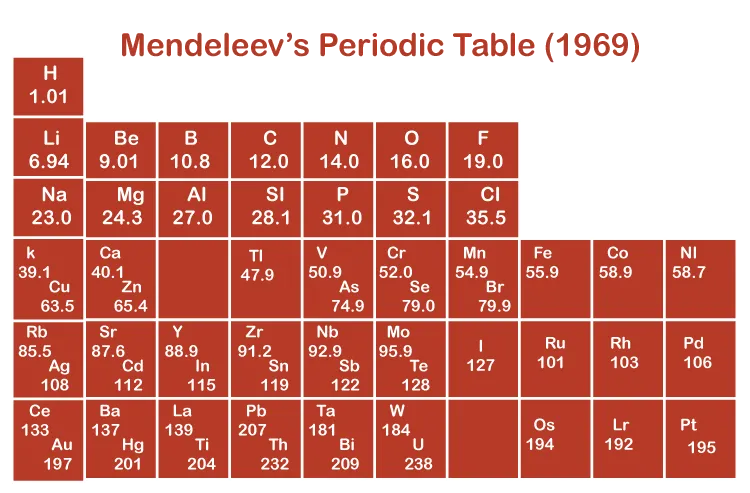 |
What was Moseley's take on the periodic table and what was his involvement? | He was given less credit to the creation of the periodic tables' creation. He studied the x-ray emissions of elements and found that the frequencies of the x rays increased with atomic weight based on the element. (The number of protons in a nucleus.) |
How is the Periodic Table organized? | By the Atomic number (z), and its Electron Configuration. |
What's a period- in chemistry? | Its the trends that repeat themselves across rows -------> |
What's a group? | It's the rows going vertically and groups are elements that share similar properties. |
What are the four Element Classifications? | 1. Metal Elemetns
2. Non-Metal Elements
3. Melatoids
4. Nobel Gasses |
What are some of the Group Names? | 1. Alkali Metals
2. Alkaline earth metals
3. Coinage metals
4. Halogens
5. Nobel gasses |
What is some groups of elements? | 1. Main group elements
2. Transition elements
---Two below are inner transition metals
3. lanthanoids
4. Actinoids |
What's an Atom? | An atom is a single particle of any element. |
What are the three parts to an atom, and what's their charge and weight in comparison to each other, where are they located? | 1. Proton +, same as neutron, middle
2. Neutron, neutral, same as proton, middle
3. Electron -, itty bitty, everywhere else? |
What's an isotope? | Its two or more forms of the same element. |