| Term | Definition |
|---|---|
Monism | The universe exists on one level. |
Tinberg's Four Questions | Physiological, Ontologenetic, Evolutionary, Functional |
Tinberg's physiological question | How does the machinery work? |
Tinberg's ontologenetic question | How does it develop in the industrial? |
Tinberg's evolutionary question | What did it come from? |
Tinberg's functional question | What is it good for? |
Two ethical positions for animal experimentation? | Regulated use: Benefit can justify minimized harm.
Abolitionist: Animals hold the same rights as humans, so no use is permissible. |
Three R's of ethical animal experimentation? | Reduction: Fewer animals
Replacement: Models or alternatives
Refinement: Less pain and/or distress |
Neurons | Receive information to transmit to other cells, around 16 billion in the cerebral cortex and about 69 billion in the cerebellum. |
Camillo Golgi | Developed a silver plate to determine that the brain is a mesh with no separate cells |
Santiago Cajal | Used Golgi's method on infant brains to determine cells were actually separate |
Cell Structure: M, N, R, ER, M | Membrane: Phospholipid bilayer, protein channels
Nucleus: Chromosomes
Ribosomes: Build proteins
Endoplasmic Rectulum: Ships them
Mitochondria: Supplies energy (Have their own genes, inherited maternally) 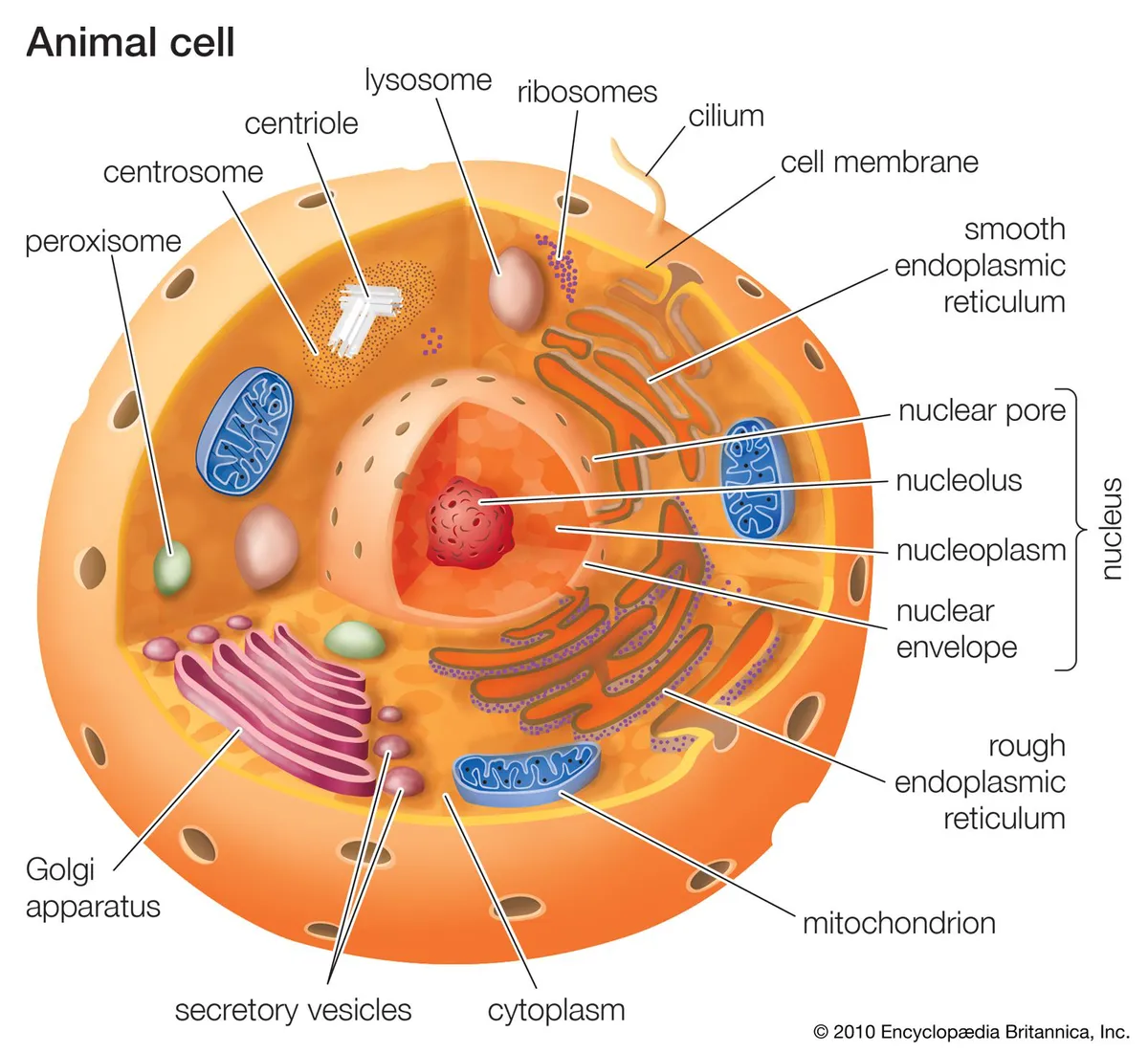 |
Parts of a neuron: S, A, PT, D, I | Soma: Cell body
Axon: One per cell, constant diameter, can exceed a meter
Presynaptic Terminals: Release chemicals
Dendrites: Receive, branching
Interneuron: Dendrites and axons in one structure 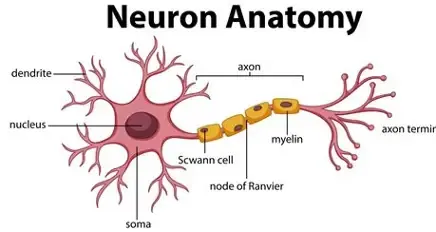 |
Afferent vs. Efferent | Afferent: Into a structure (Admit)
Efferent: Away from a structure (Exit) |
Glia: A, M, O/SC | Astrocytes: Shield synapses, synchronize related neurons, dilate vessels
Microglia: Immune function, prune synapses, brake activity. (Too few causes seizures)
Oligodendrocytes/Schwann Cells: Build myelin 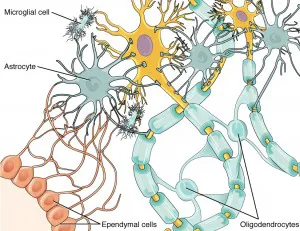 |
Sodium-Potassium Pump | Protein complex that repeatedly pushes three sodium ions out of the cell and pulls two potassium ions in. Costs continuous energy. |
Hyperpolarization | Increased polarization |
Depolarization | Decreased polarization |
Propagation | At each point along the axon, action potential generates a new one, so it arrives at the brain at full strength |
Back-Propagation | Action potential starts in the axon and travels forward, but it also travels backwards into the soma and dendrites. |
Absolute refractory period | No stimulus of any strength can produce an action strength potential |
Relative refractory period | Stronger than normal stimulus is needed to cause an action potential |
Myelin, Nodes of Renvier | Sheath of fat and protein evolved by vertebrates, containing small gaps (NoR) about a micrometer wide |
Saltatory conduction | Action potential spike jumps from node to node |
Charles Scott Sherrington | Established that neurons communicate along a junction, the synapse |
Presynaptic neuron | Neuron delivering a message |
Postsynaptic neuron | Neuron receiving a message |
Temporal summation | If a second postsynaptic neuron arrives before the first has fully faded, they combine. When enough cross the threshold in succession, they create an action potential. |
Graded depolarization | Excitatory postsynaptic potential (EPSP) which results from a sodium ion entering the neuron. |
Graded hyperpolarization | Inhibitory postsynaptic potential (IPSP) produced by the flow of negatively charged chloride ions into the cell. |
Spatial summation | Two contact points can activate sensory neurons whose axons converge onto a neuron in the spinal cord. |
Inhibitory synapses | Input from an axon hyperpolarizes the postsynaptic cell, moving the cell's charge further from the threshold and decreasing the probability of an action potential. |
Spontaneous firing rate | Periodic production of action potentials even without synaptic input |
Sympathetic Nervous System | Set of nerves that accelerates heartbeat, dilates pupils, and regulates other organs |
T.R. Elliott | Found that applying adrenaline to the surface of the heart, stomach, or eyes had the same effect as the sympathetic nervous system. |
Synaptic Cleft | Space between presynaptic and postsynaptic neurons |
Neurotransmitters/Neuromodulators | Chemicals that a neuron releases at a synapse |
Amino Acids, Modified Amino Acids, Monoamines, Neuropeptides, Purines, Gases | Amino Acid: Glutamate, GABA, glycine, aspartate, etc.
Modified Amino Acid: Acetylcholine
Monoamine: Also modified from amino acids
-Indoleamine: Serotonin
-Catecholamine: Dopamine, norepinephrine, epinephrine
Neuropeptide: Chain of amino acids. Endorphins, Substance P, Neuropeptide Y, etc.
Purine: ATP, adenosine
Gas: Nitric oxide (NO) |
Catecholomines | Compounds that contain a catechol group and an amine group |
Acetylcholine | Synthesized from choline |
L-dopa | Precursor to dopamine, helps increase the supply of dopamine |
Tryptophan | Precursor to serotonin, crosses the blood-brain barrier through a transport system it shares with other large amino acids. |
AMPT | Alpha-methyl-para-tyrosine, temporarily blocks the production of dopamine. |
Exocytosis | Caused by calcium entry into a cell, causes a burst of release of neurotransmitter from the presynaptic neuron |
Ionotrophic effect | Receptor receiving the neurotransmitter rapidly opens a channel. Twists receptor to open its central channel to allow one type of ion through |
Channels controlled by a neurotransmitter? | Transmitter-Gated/Ligand-Gated |
GABA | Gamma-amino butyric acid, used by most inhibitory ionotropic effects |
Metabotropic effects | Sequence of metabolic reactions that produce slow, long-lasting effects at a synapse |
G-Protein | Protein coupled to guanosine triphosphate (GTP) |
Number of serotonin receptors? | Seven, each with different subtypes. Anti-depressants stimulate serotonin receptor 2A |
What do hallucinogens resemble? | Serotonin. Attach to Type 2A receptors and stimulate them longer than normal |
Reuptake | A neurotransmitter is taken after activating its receptor. A transmitter protein moves the molecules back into the presynaptic cell |
Autoreceptors | Receptors on a presynaptic neuron that give negative feedback by responding to the transmitter released by the neuron. Inhibit further synthesis and release. |
Gap Junction | Direct contact point of one neuron with another, enabling electrical transmission. |
Hormone | Chemical secreted by cells in one part of the body and conveyed by blood to influence other cells |
Pituitary gland | Endocrine gland attached to the base of the hypothalamus |
CNS | Central nervous system. Brain and spinal cord |
PNS | Peripheral nervous system. Connects CNS to the rest of the body |
SNS | Somatic nervous system. Axons conveying messages from sense organs to CNS and CNS muscles. Part of PNS |
ANS | Autonomic nervous system. Controls organs. Part of the PNS |
ENS | Enteric nervous system. Controls digestive system. Part of the PNS |
Dorsal? Ventral? | D: Toward the back
V: Toward the stomach |
Anterior? Posterior? | A: Toward the front
P: Toward the rear |
Superior? Inferior? | S: Above
I: Below |
Lateral? Medial? | L: Toward the side, away from the midline
M: Toward the midline, away from the side |
Proximal? DIstal? | P: Located close by
D: Located far away |
Ipsilateral? Contralateral? | I: On the same side of the body
C: On the opposite side of the body |
Dorsal Root Ganglia | Clusters of sensory neurons outside of the spinal cord |
Sympathetic nervous system | Network of nerves that prepare the organs for activity. |
Parasympathetic nervous system/Craniosacral system | Facilitates the vegetative, non-emergency responses |
Hindbrain | Posterior part of the brain |
Brainstem | Medulla, pons, midbrain, and central structure of the forebrain |
Medulla Oblongata | Brain structure just above the spinal cord. Could be considered an enlarged extension of the spinal cord |
Amygdala | Temporal lobe structure important for evaluating emotional information |
Thalamus | Most sensory information goes here to be processed and send as output to the cerebral cortex |
Hippocampus | Crucial to memory of individual events, as well as where you are and where you are going |
Temporoparietal junction | Area where the parietal lobe and temporal lobe meet, close to the occipital lobe |
Precentral gyrus | Posterior portion of the frontal cortex, specifically for the control of fine movements |
Default network | Several areas in the prefrontal cortex and the temporoparietal junction. Dominate activity when you don't need to focus on anything specifically. |
Ablation | Removal of brain area |
Optogenetics | Using light to control a limited population of neurons |
Electroencephalograph | Records electrical activity of the brain through electrodes attached to the scalp. |
Genes | Units of heredity that maintain their structural identity from one generation to the next. Most come in pairs aligned along chromosomes. |
Epigenetics | Studies changes in gene expression |
Histones | Bind DNA into a shape like string wound around balls |
Neurotrophins | Steer axonal branches in the right direction |
Fovea | Specialized area meant for detailed vision |
Color constancy | Recognizing colors despite changes in lighting |
Soundwaves | Periodic compression of air, water, or other media |
Prosody | Conveying emotional information by tone of voice |
Planum temporale | Processes the experience of a sound source moving |