Why do the eyes move?
Vision is an active process
• Eye movements compensate for narrow field of vision
Image stabilisation
• If a visual target is moving
Information acquisition
• Humans move their eyes while examining objects and scenes
| Term | Definition |
|---|---|
Why do the eyes move? | Vision is an active process
• Eye movements compensate for narrow field of vision
Image stabilisation
• If a visual target is moving
Information acquisition
• Humans move their eyes while examining objects and scenes |
Perceiving the environment: Selective attention | Some aspects of environment are more important and interesting than others.
• Visual system has evolved to operate in this fashion
• Too much incoming stimulation at retina to process everything.
• Selection is achieved partially through use of fovea 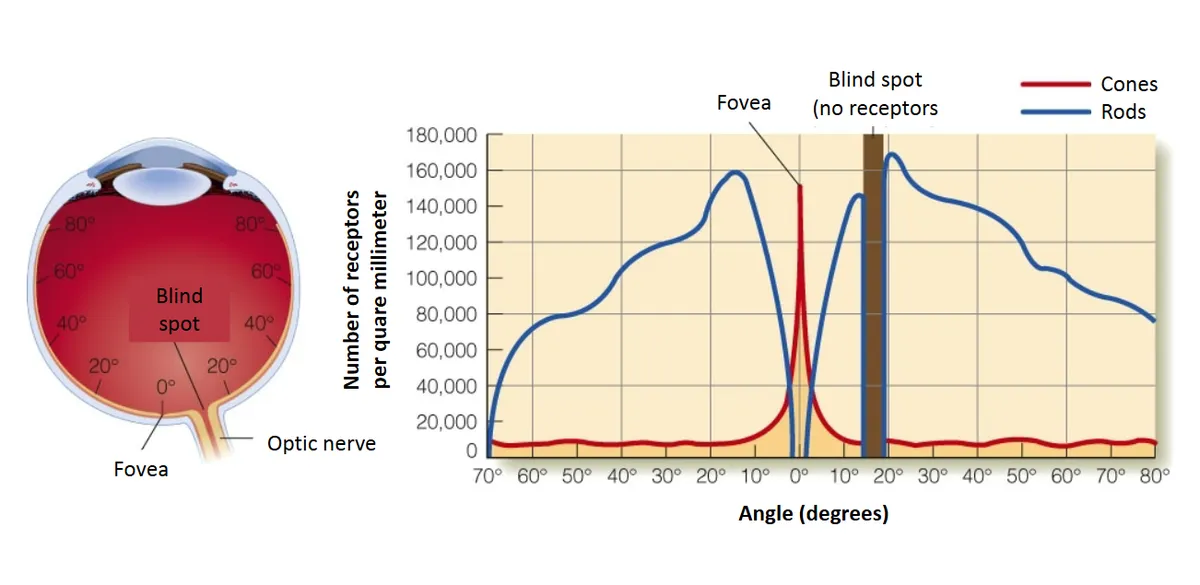 |
How is Selective Attention Achieved? | Scanning a scene - eye movements can take in different parts of a scene
Measuring eye movements with eye trackers
• Saccades - small, rapid eye movements
• Fixations - pauses in eye movements that indicate where a person is attending
• Approximately three fixations per second 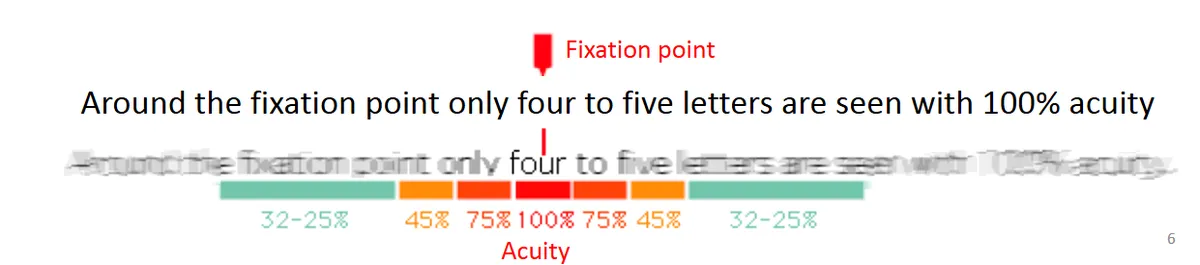 |
What Determines Location of Fixations / our selective attention | Characteristics of the scene
Knowledge about scenes
Stimulus salience - areas of stimuli that attract attention due to
their properties
• Colour, brightness, contrast, orientation
Observer interests/goals
Scene schemas
Demands of the observer’s task |
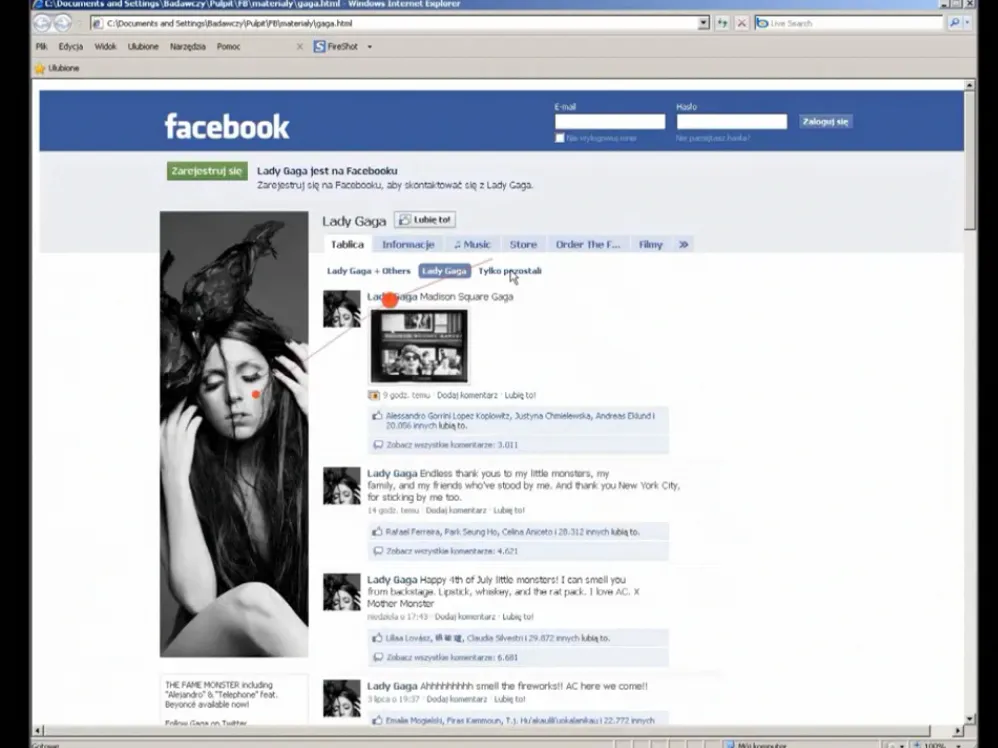
Knowledge about scenes
|  |
Stimulus salience - areas of stimuli that attract attention due to
their properties | 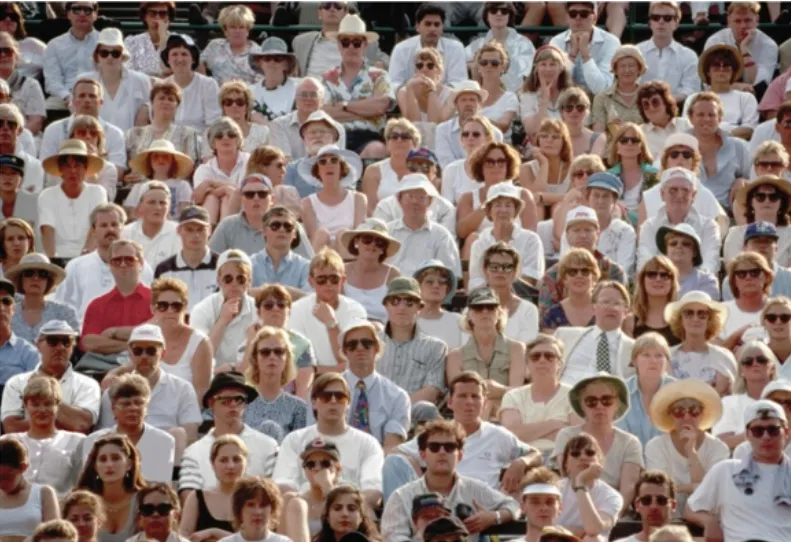 |
Observer interests/goals
| Yarbus (1967) 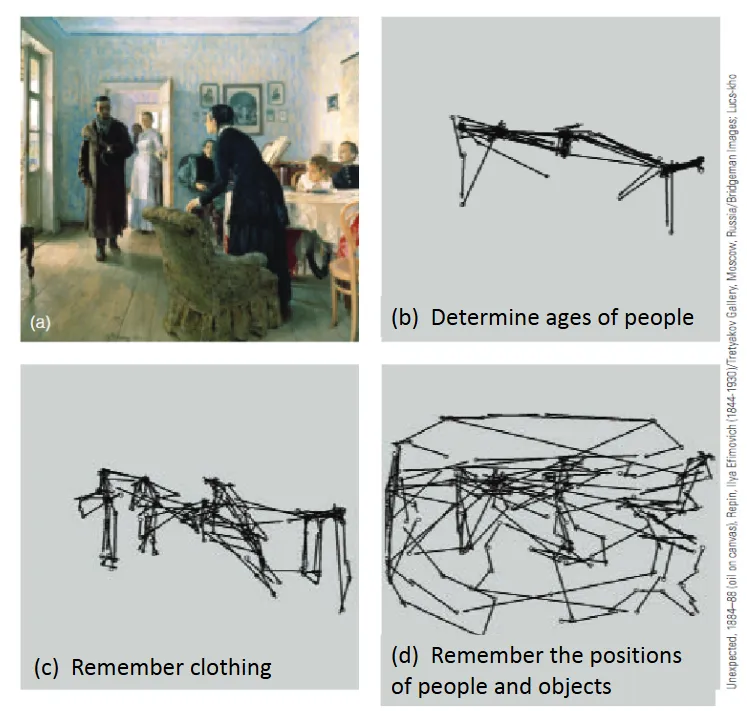 |
Scene schemas
| Experiment by Shinoda et al.
• Observers’ fixations were measured during computer simulated driving.
• More likely to detect stop signs when they were at junctions.
• Learned that this is where stop signs are typically placed.
• Võ and Henderson (2009)
• Less common/expected objects looked at more 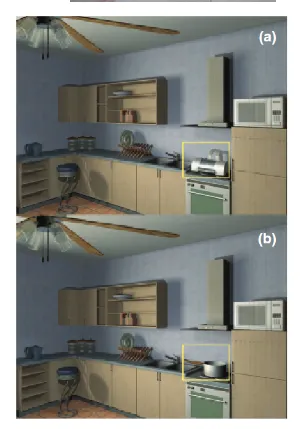 |
Demands of the observer’s task | Looking at location before movement, Land and Hayhoe (2001)
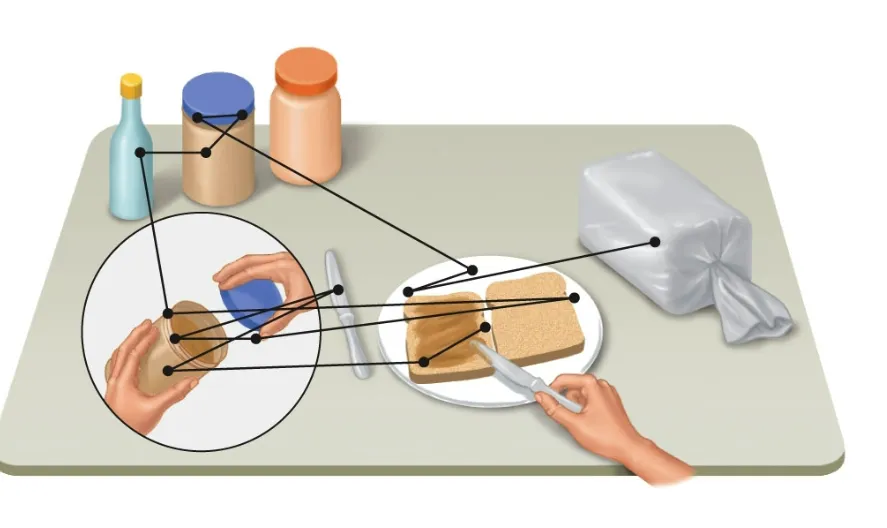 |
Benefits of Attention | Experiment by Posner et al.
• Observers looked at fixation point.
• Arrow indicated on which side stimulus was likely to appear.
• Stimuli appeared that were consistent (valid trial) or inconsistent (invalid trial) with cue.
• Task: push button when target square was seen.
information processing is most efficient where attention is directed. |
Attention Speeds Responding | Egly et al. (1994)
• Observer views two rectangles.
• Cue signals where target may appear.
• Task: press button when target appeared.
• Fastest reaction time was at targeted position.
• “Enhancement” effect for non-target was within target rectangle. 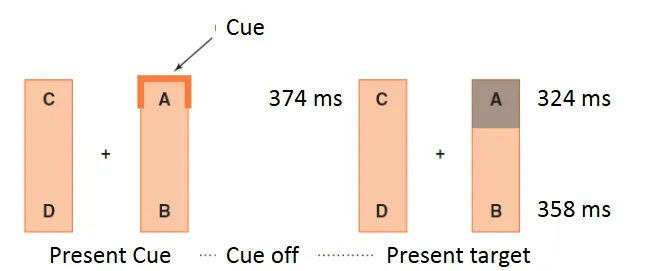 |
Attention Can Influence Appearance | Carrasco et al.
• Task: fixate between gratings and indicate orientation of bars with higher contrast.
• Small dot was flashed very quickly on one side before gratings appeared
Large difference in contrast: no effect of dot.
Same contrast: observers more likely to report grating preceded by dot had higher contrast.
shift of attention affected perception. 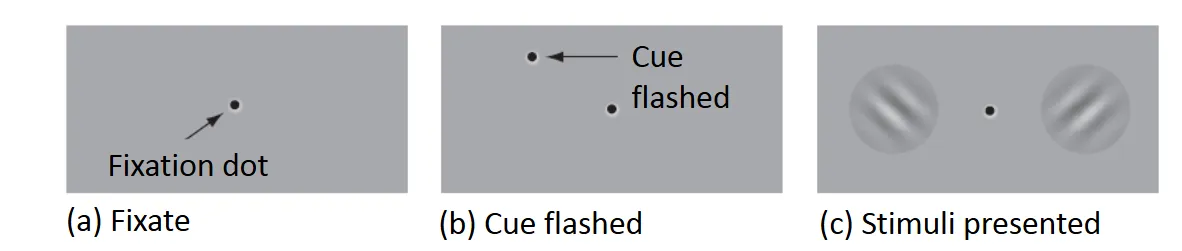 |
Attention Can Influence Physiological Responses | O’Craven (1999): attending to moving or stationary face enhanced
activity in FFA and attending to moving or stationary house enhanced activity in PPA
Datta and DeYoe (2009) Directing attention to a specific area of space activates a specific brain area.
Womelsdorf et al. (2006)
Attention can cause MT receptive fields to shift toward place where attention is directed |
Attention and Experiencing a Coherent World | Binding: process by which features are combined to create perception of coherent objects
Binding problem: features of objects are processed separately in different brain areas |
Feature Integration Theory - how does binding occur? | Treisman and Gelade
Preattentive stage - features of objects are separated
Focused attention stage - features are bound into a coherent perception
In 18% of trials participants reported illusory conjunctions, e.g. reporting a small green triangle for display shown here
• →Evidence for problem with/limitation of binding 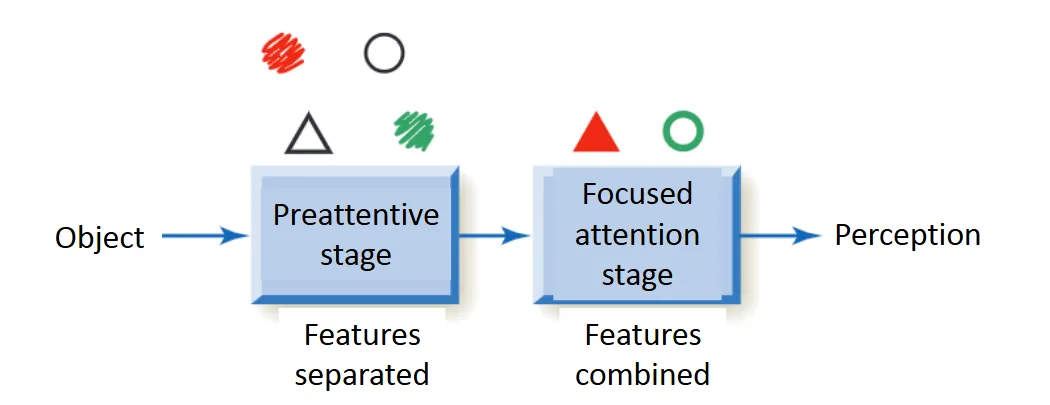 |
Inattentional blindness | Subjects can be unaware of clearly visible stimuli if they aren’t directing their attention to them. |
Change Blindness | Observers were shown picture with and without a missing element in an alternating fashion with blank screen.
Pictures had to alternate a number of times before change was detected.
When cue is added to show where to attend, observers noticed change more quickly. |
Distraction | Task-irrelevant stimuli are stimuli that do not provide information
relevant to task.
Forster and Lavie (2008)
• Load theory of attention
• Perceptual capacity
• Perceptual load
• Low-load tasks 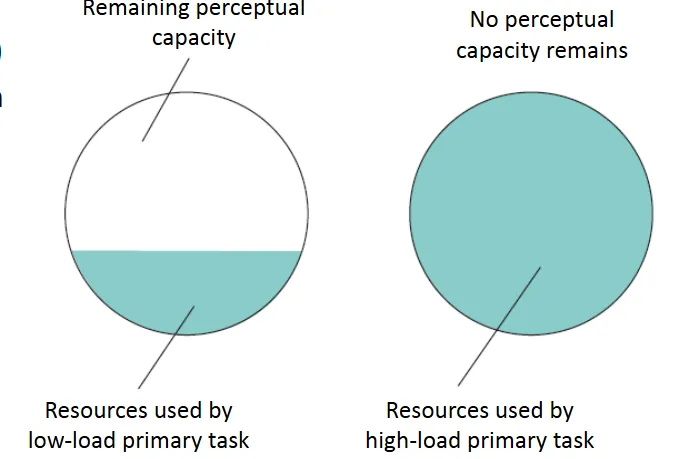 |
Distracted Driving | Driving requires constant attention.
Strayer and Johnston (2001) on cell phone use and driving
Anything that distracts attention can degrade driving performance. |