What is in the vertebral column
33 bones
- 7 cervical vertebrae (convex curve)
- 12 thoracic vertebrae (concave curve)
- 5 Lumbar vertebrae (convex curve)
- 5 Sacrum vertebrae (concave curve -fused)
- 4 coccyx vertebrae - fused
| Term | Definition |
|---|---|
What is in the vertebral column | 33 bones
- 7 cervical vertebrae (convex curve)
- 12 thoracic vertebrae (concave curve)
- 5 Lumbar vertebrae (convex curve)
- 5 Sacrum vertebrae (concave curve -fused)
- 4 coccyx vertebrae - fused |
Cervical spine features | Has 7 individual vertebrae smallest in the column.
Supports the weight of the head and assists in support of the shoulder girdle.
Greatest mobility in the spinal column. |
Thoracic spine features | Has 12 individual vertebrae and is the entire upper back area.
Its posterior convexity houses many vital organs.
Each thoracic is attached to a rib, upper 7 are 'true ribs' attaching directly to the sternum through costal cartilage, lower 5 are 'false ribs' as they connect to the 7th thoracic not the sternum. 11th and 12th known as floating ribs as they don't attach to the sternum at all. |
Lumbar spine features | 5 individual vertebrae, is your lower back.
Curve of the lumber spine is 25-30 degrees, but pelvic tilt can affect this dramatically. |
Sacrum spine features | 5 individual vertebrae fused together forming a triangular plate that narrows inferiorly.
Provides attachment for muscles and distributes forces from upper to lower body. |
Coccyx spine features | 4 vertebrae fused together to form a single bone (sometimes two pieces of bone).
Curves anteriorly and is often known as the tailbone. |
Atlas and Axis vertebrae | First two cervical vertebrae.
This is where the rotational joint is.
Connected to the cranium. |
Intervertebral discs structure | Sits in the spaces between each vertebra. Acting as joints for the spine (cartilaginous joints at the front of the spine).
At the back of the spine each vertebra has seven processes each interacting to great facet joints (Synovial gliding joints).
=> Joints between the discs are cartilaginous joints, and joints between processes are synovial joints.
The nucleus pulpous is a gel like texture and the annulus fibrosis is a fluid component, they act as sponges. 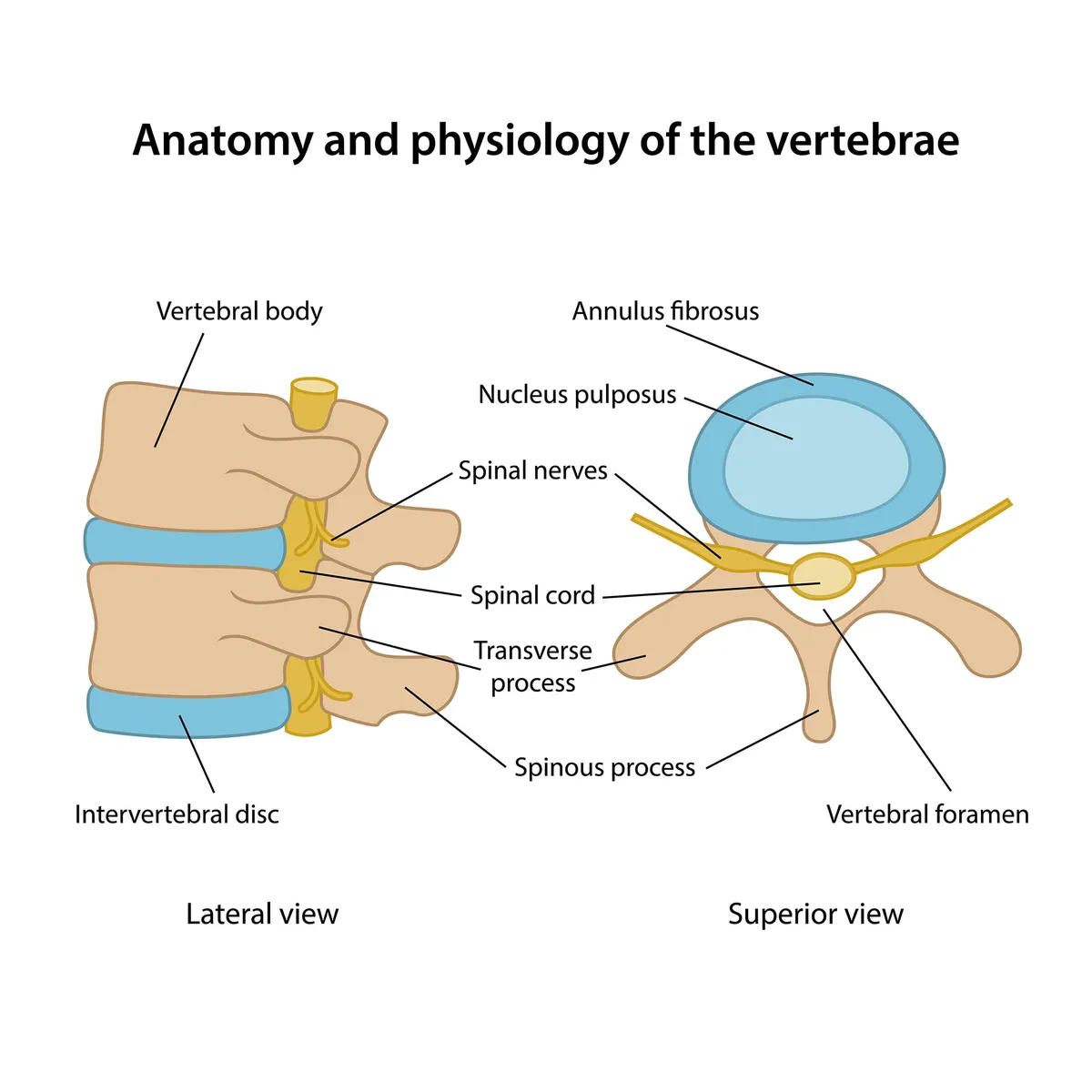 |
Intervertebral discs function | Acting like ligaments they provide stability between adjacent vertebrae's.
Afford a small amount of mobility between intervertebral joints.
Provide protection to spinal cord and nerves.
Absorb shock through spinal column.
When you bend forward the gel like part (nucleus) will move backwards and vice verse => if this happens too often without core stabilisation, this is when damage occurs (prolapsed, herniated discs) |
Neural arch canal | Foreman - the space in which the spinal cord runs through the spine and acts as protection.
Vertebral body - As you go further down the spine to the lumbar, the vertebral bodies get bigger. But with increase in size, there is decrease mobility.
Transverse process - for muscle attachment and back extensors. 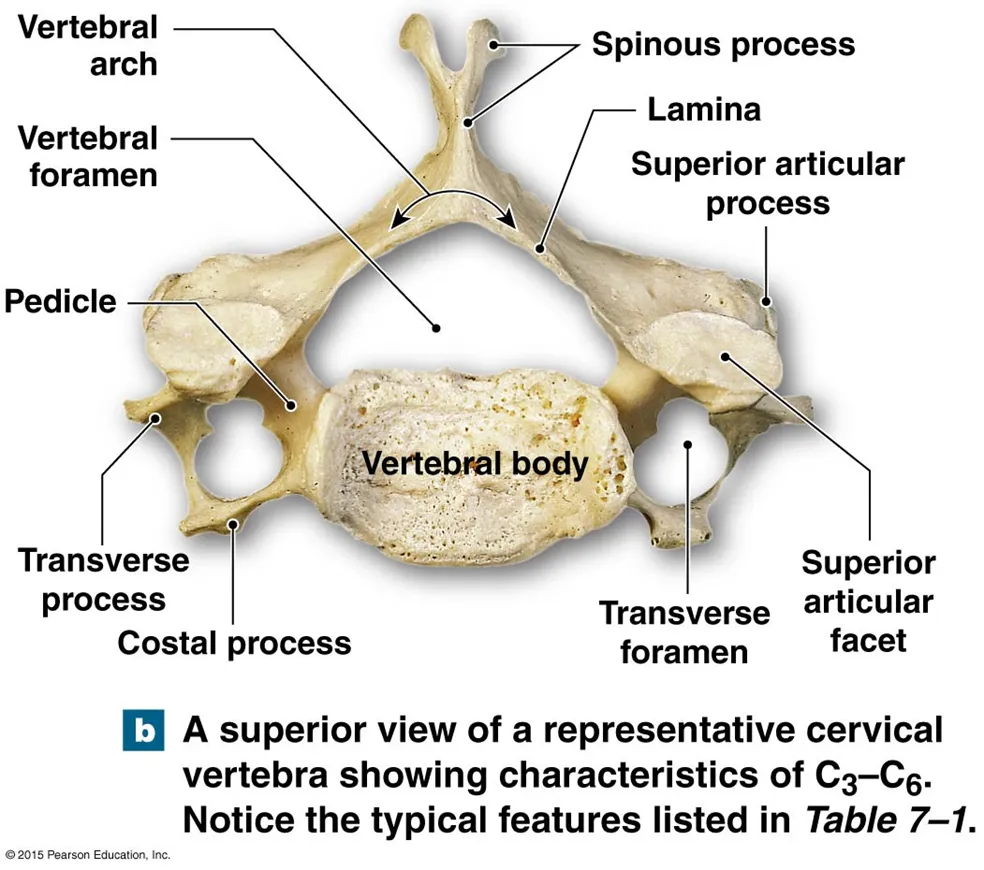 |