Political science
The academic discipline and social science
dealing with the theory and practice of politics and the description of political systems and political behavior
| Term | Definition |
|---|---|
Political science | The academic discipline and social science
dealing with the theory and practice of politics and the description of political systems and political behavior |
Politics | The process of resolving conflicts over how society
should use its scarce resources and who should receive benefits |
Government | The individuals and institutions that make society's rules and possess the power to enforce those rules |
What are the three purposes of government? | Resolving conflicts, providing public services, and defending the nation |
Republic | a state in which supreme power is held by the people and their elected representatives with an elected executive rather than a monarch |
Democracy | a system of government by all the eligible members
of the state, typically through elected representatives; the supreme
political authority rests with the people. |
Autocracy | Government power and authority are in the hands of a single person (or a single political party) |
Divine right theory | the right to govern was derived from God to those of royal birth and not from peoples’ consent |
Totalitarian dictatorship | form of autocracy, in which a single leader
(or single political party) rules, although typically not through inheritance where a leader
seeks to control all aspects of social and economic life |
Referendum | state legislatures send ballot proposals to
the voters for approval or rejection; characteristic of direct democracies |
Initiative | a process by which voters, not the state legislatures, gather signatures to place issues on the ballot for a vote to approve or reject by the votes; characteristic of direct democracies |
Recall | a process where voters circulate petitions for signatures to have a vote by the people on whether an elected official should be removed from office before his term is completed; different from impeachment; characteristic of direct democracies |
What are the two types of representative democracies? | Presidential and parliamentary |
Representative democracy | the will of the majority is expressed through individuals elected by citizens to act as their
representatives; also known as a republic |
Aristocracy | a government which is run by a small privileged class, usually members of old, noble families. |
Plutocracy | a government in which the wealthy exercise ruling power |
Theocracy | a government in which there is no separation of church and state, and the government rules according to religious precepts |
Oligarchy | a government by the few who exercise power for
corrupt purposes |
Meritocracy | a government by the few who rule based on their talents or abilities |
What principle did the Magna Carta establish? | limited government |
What are the two houses in Great Britain's Parliament? | the House of Lords and the House of Commons |
Social contract | a voluntary agreement among individuals to create a
government and give up some of their freedoms so that government would have adequate power to secure the mutual protection and welfare of all individuals |
Who developed the social contract theory? | Thomas Hobbes |
Natural rights | the idea that individuals had certain natural rights and government exists to protect those rights |
Political ideology | a system of political ideas concerning
human nature, society, and government
rooted in religious or philosophical beliefs |
Joseph Stalin's rule in the Soviet Union is an example of a(n) _____. | totalitarian dictatorship |
In the island country of Semanto, quarterly meetings are held at its Civic Centre grounds to discuss and decide upon important issues of the island. Every Semanto citizen participates in the governing assembly and votes on all major issues. Semanto is an example of a(n) _____. | direct democracy |
The traditional American political ideology spectrum refers to the political ideological perspectives of individuals in the United States. Sidlow and Henschen, the authors of the text, place political ideologies on a continuum from left to center to right. Which political ideology is reflected by "A" (located just to the left of center) on the spectrum? 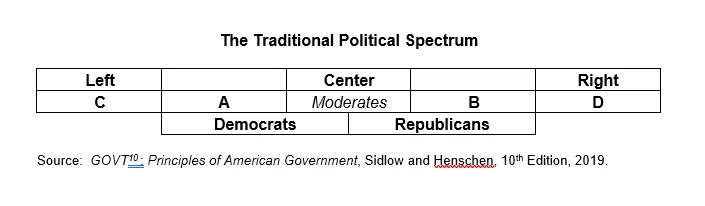 | liberals |
Which of the following statements is true about liberalism? | Liberals support the protection of minority rights of all kinds. |
In a constitutional monarchy, _____. | the monarch's power is limited or checked by other government leaders or perhaps by a constitution |
Which of the following is an example of a public service provided by the government? | Preserving national parks |
(True or False). The two houses of the British Parliament are the House of Representatives and the Senate. | False |
The ideas of John Locke about natural rights influenced Thomas Jefferson in America when Jefferson incorporated some of the same ideas into the writing of the ___. | Declaration of Independence |
A republic is essentially a(n) _____. | representative democracy |
In the context of original American political ideology, conservatives: | wished to keep traditional social and political habits. |
Unlike constitutional monarchs, absolute monarchs: | hold complete and unlimited power. |
Which of the following statements is true of direct democracy? | A high degree of citizen participation is required in government. |
Undemocratic systems that are not supported by tradition are called _____. | dictatorships |
According to your instructor, a form of government in which there is no separation of church and state and where the government rules according to religious precepts, such as using the Koran (Qur'an) as the basis for national law is called a ____. | theocracy |
Which of the following is a basic principle that had evolved in England and was incorporated by the framers of the U.S. Constitution? | Limited government |
The Magna Carta: | formed the basis of the future constitutional government for England. |
_____ is defined as disagreements among people in a society over what the society's priorities should be. | Social conflict |
A system of government in which the wealthy class exercise the ruling power is a/an ___. | plutocracy |
The Philadelphia meeting, which became the Constitutional Convention, was called for the sole and express purpose of: | revising the Articles of Confederation. |
In an attempt to negotiate with the Anti-Federalists during the Constitutional ratification, the Federalists promised to: | add a bill of rights to the Constitution under the new government. |
All the amendments to the Constitution have been proposed by: | a two-thirds vote in the Senate and in the House of Representatives. |
Common Sense, a pamphlet that presented the argument in favor of the colonies' independence from Great Britain and helped sever any ties of loyalty to the British government, was written by ___. | Thomas Paine |
The "traditional" amendment ratification method involves ____. This process has been used by all amendments, except one. | a vote by three-fourths of the state legislatures in favor of the proposed amendment. |
Colonists, dressed as Mohawk Indians, dumped 350 chests of British tea into Boston Harbor in 1773 to protest the Tea Act passed by Parliament. In response to the Boston Tea Party, the British Parliament: | passed the Coercive Acts closing Boston Harbor and placing the government of Massachusetts under direct British control. |
The earliest colonial legislature in America was the _____. | Virginia House of Burgesses |
In the context of the three-fifths compromise, the delegates from the northern states: | did not want slaves to be counted as part of the population. |
As the American colonies transformed themselves into sovereign states, republican sentiment was so strong in many of them that the _____ became all-powerful. | legislatures |
The framers of the Constitution brought with them _____ when they met at the Constitutional Convention in 1787. | their hands-on political experience from governing themselves in their respective colonies (states) |
What power did Congress not have under the Articles of the Confederation? | the power to tax the people directly |
Once the colonies had won their independence from Great Britain, the nation's first national governing document (constitution) that governed the newly independent nation from 1781 to 1789 that was passed by the Second Continental Congress was the ___. | Articles of Confederation |
Which of the following is true of the pamphlet Common Sense? | It argued that America could be economically self-sufficient and does not need its British connection. |
In the context of the Articles of Confederation, the Congress of the Confederation: | did not have the power to enforce its laws. |
At the Constitutional Convention, in exchange for a ban on export taxes, the South agreed to let Congress have the power to _____. | regulate interstate commerce |
As opposed to their opponents, which of the following is an advantage the Federalists had in the debate over the ratification of the Constitution? | They assumed a positive name, leaving their opposition with a negative label. |
For the most part, the delegates to the Constitutional Convention were _____. | from the best-educated and wealthiest classes |
What was the social contract which was the first in a series of contracts among the colonists during colonial America? | Mayflower Compact |
What was the first colony established in the New World by the Pilgrims? | Plymouth |
What was the early New World colony founded by the Puritans? | Massachusetts Bay Colony |
What was one of the first constitutions written in the states by the settlers in Connecticut? | Fundamental Orders of Connecticut |
Proclamation of 1763 | passed by Parliament establishing the western boundary line of the colonies |
Which of the following is a concurrent power? | The power to charter banks and corporations |
Powers that are held by both the national, or central, government and the state governments are called ___ powers. | concurrent |
Article 1, Section 8, Clause 18 of the Constitution often called the necessary and proper clause (the elastic clause), provides that Congress has the power to make "all laws which shall be necessary and proper for carrying into execution the expressed powers, and all other powers ..." The powers provided by this clause are known as ___ powers. | implied |
The term _____ refers to the national, or central, government of the United States. | federal government |
In chapter 3, Sidlow and Henschen discuss different types of government in terms of whether the power resides at the national level, the subnational level, or is shared between the national and subnational levels. The image below shows the power residing with the subnational, or state, level with the central government only having those powers given to it by the states. This type of government is called a ___ system. 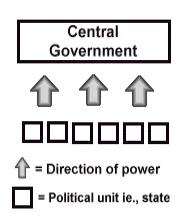 | confederal |
Otlavis and Ferdland are two southern states in the country of Blendland that share a common border. They share water from Lake Clarly, and therefore, sign an agreement pledging the protection of the lake and its premises in order to sustainably use its water. In this scenario, which of the following types of agreements is signed by the two states? | An interstate compact |
Which of the following powers is denied by the Constitution to the states? | The power to enter into treaties with other countries |
The Chief Justice of the United States Supreme Court from 1801 to 1835 who helped establish the independence of the Supreme Court and the judicial branch of government and the supremacy of the national government and federal authority under the Constitution was ___. | John Marshall |
Which of the following illustrates a concurrent power exercised by a state government in a federal system of government? (Refer to the following image on "Powers Granted by the Constitution" and "Powers Denied by the Constitution" to assist in answering the question.) 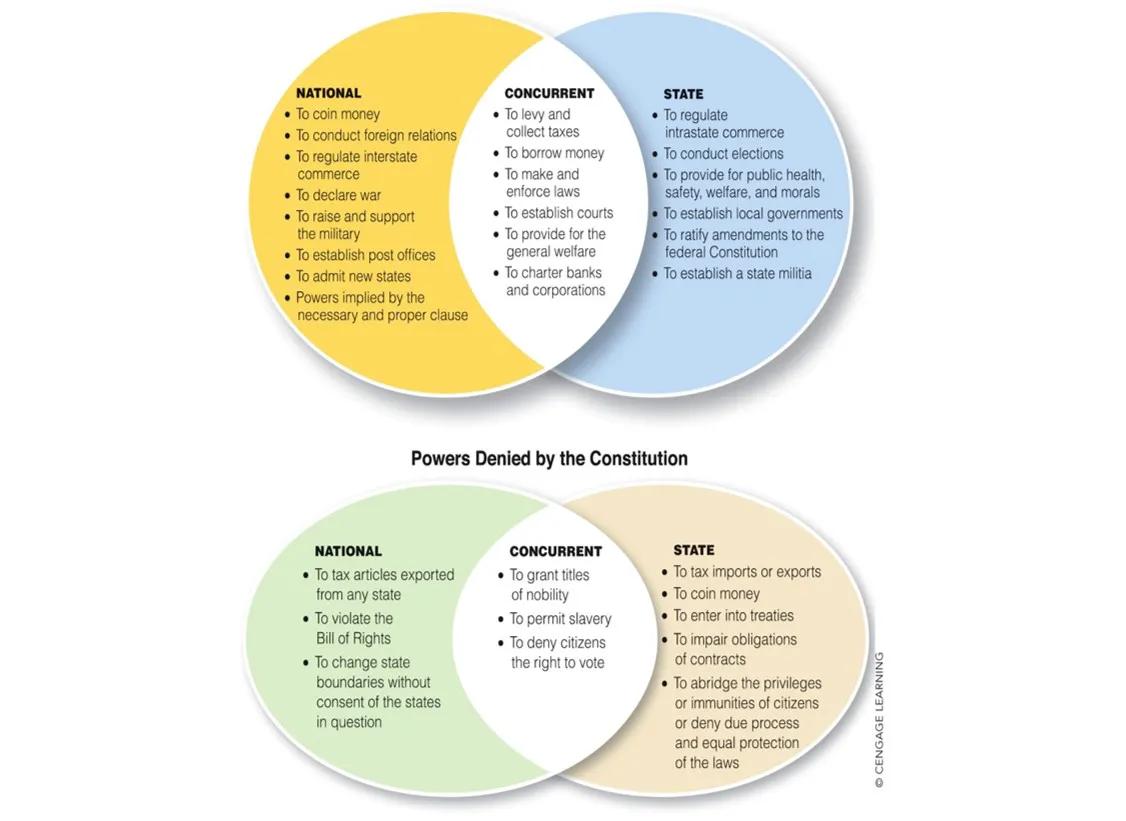 | A state levying an income tax of all its employed citizens. |
Which of the following "powers" of government can best be described as an example of a concurrent power? | the power to levy and collect taxes |
Which of the following is an expressed power of the national government? | Regulating commerce among the states |
Which of the following is true of the Civil War (1861–1865)? | It was a dispute over states' rights versus national supremacy. |
The constitutional basis for the implied powers of the national government is found in Article I, Section 8, Clause 18 of the U.S. Constitution and is often called the _____. | necessary and proper clause |
Most of the powers prohibited to the national government are listed in _____ to the U.S. Constitution. | Article I, Section 9 and in the first eight amendments |
Which of the following is true of the Articles of Confederation? | They did not allow for a sufficiently strong central government. |
Which of the following became an implication of the commerce clause that was upheld by the Supreme Court headed by John Marshall in Gibbons v. Ogden (1824)? | The national government has repeatedly justified its regulation of almost all areas of economic activity. |
The Defense of Marriage Act (DOMA) provided a challenge to the Constitution's _____. | full faith and credit clause |
Which of the following is true of the Defense of Marriage Act? | It allowed state governments to ignore same-sex marriages performed in other states. |
Which of the following is an advantage of federalism in the United States? | State governments can act as "laboratories" for public-policy experimentation. |
Which of the following is true of the Supreme Court case of McCulloch v. Maryland (1819)? | It involved both the necessary and proper clause and the supremacy clause. |