The Product Life Cycle
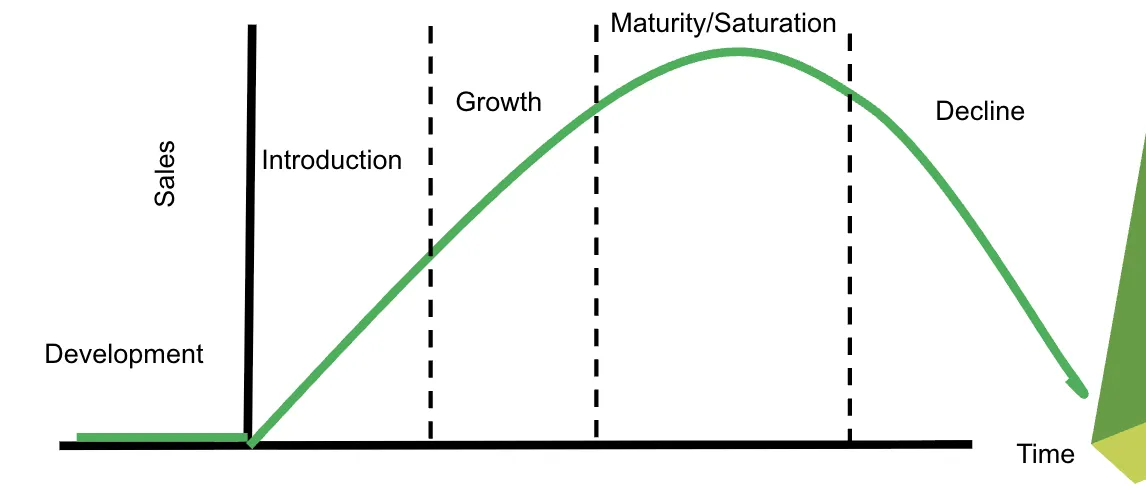
The Product Life Cycle is the stages a product goes through from the research and development stage until its decline and removal from the market in the market
| Term | Definition |
|---|---|
The Product Life Cycle | The Product Life Cycle is the stages a product goes through from the research and development stage until its decline and removal from the market in the market |
Cost-plus Pricing | Calculated by dividing the total production costs by the number of units produced. Then an additional amount is added called the mark up. External factors are not taken into account
Average price + mark-up = price charged |
Penetration Pricing | Setting a low initial price with the aim of gaining customer loyalty and market share quickly. Works best in mass markets |
Loss Leader | When businesses charge prices usually below average costs (losing money by selling it) in hopes of attracting a large number of customers |
Predatory Pricing | When a business sets very low prices to drive out the competition. Once competition is gone, they raise prices |
Premium Pricing | When a business sets a high price for a product that is much higher than its competitors to give the impression of quality and prestige |
Dynamic Pricing | When a business charges different prices based on demand. Higher demand, higher prices |
Competitive Pricing | When a business sets its prices based on the prices the competitors have already set. |
Contribution Pricing | A business sets its price above the variable cost per unit so that each item contributes to paying off the fixed cost
|
Above the Line Promotion | A paid form of communication that uses independent mass media outlets to promote a product. Example: TV, radio, newspaper, billboards, cinema. |
Above the Line Promotion (Advantages/Disadvantages) | Advantages:
- It reaches a large audience
- Helps build brand awareness
Disadvantages:
- Not very targeted
- Can be expensive
- Hard to calculate the impact of the promotion |
Below the Line Promotion | A form of advertising where the business has direct control over its promotional activities. Can target specific customers.
Includes:
Direct Marketing - sending the ad directly to customer
Personal Selling - products sold face to face or over the phone
Social Media - having accounts on different social media platforms
Sales Promotion - short term incentive to increase sales |
Below the Line Promotion (Advantages/Disadvantages) | Advantages:
- Reaches a more targeted audience
- Builds good customer relations
- Easy to measure impact
- Cheap
Disadvantages:
- Must think about cultural issues when targeting markets
- Requires more training if doing personal selling
- Can be time consuming |
Through the Line Promotiom | Involves marketers creating marketing campaigns which include both ALT & BLT strategies |
Social Media Marketing | The use of social media platforms to connect their clients.
Helps build brand relations, sell products, and allows business to track the results of campaigns |
Social Media Marketing (Advantages/Disadvantages) | Advantages:
- Wide reach
- Market information about trends, customer buying habits, feedback on items
- Speed of distribution
- Cost saving
Disadvantages:
- Does not work in all markets/regions
- Consumers do not actually engage with the platforms |
Place | Place refers to how the product reaches it intended users. A business must think about how it is going to be distributed to customers in an easily accessible way that reaches as many consumers as possible. |
People | People refers to the employees need to produce or delivery the product or service to a customer. In service businesses, this is usually one of the most important elements of the marketing mix.
|
Processes | The procedures and policies pertaining to how an organizations product is provided and delivered. This might involve businesses thinking about how they can get their product quicker to their customers when they are in the store or at home.
QR code menus, apps to book gym classes, etc. |
Physical Evidence | Physical evidence refers to everything your customers see and hear when interacting with the business. From the music, to the cleanliness, and fixtures and even the uniforms of the staff. |