Roediger et al (2011) Study 2
6th grade social studies students were studying ancient Rome, Middle Ages, and Africa.
Students were randomly assigned 3 types of questions
some were given multiple no-stakes tests, some were given instruction and simply read facts, and some were only given the main graded test
91% average in testing group, while only 83% and 81% in the other two groups. This proved that massed practice is not efficient in the long-term, and that self-testing and spacing work
| Term | Definition |
|---|---|
Roediger et al (2011) Study 2 | 6th grade social studies students were studying ancient Rome, Middle Ages, and Africa.
Students were randomly assigned 3 types of questions
some were given multiple no-stakes tests, some were given instruction and simply read facts, and some were only given the main graded test
91% average in testing group, while only 83% and 81% in the other two groups. This proved that massed practice is not efficient in the long-term, and that self-testing and spacing work |
What is science according to Stanocich | -Systematic empiricism (systematic observations)
- Publicly verifiable (others can test claims and results will replicate)
-Solvable problems (they are real and somewhat measurable) |
What is science according to Popper? | - everything is subject to revision and rejection, because as humans we can't fully understand absolute truth |
Limitations of science | - there are alternatives in findings- common sense changes over time and cultures
- sometimes the findings don't prove something is moral, even if it is possible |
Correlation | measure of association between two variables |
Correlation coefficent | r
-1 to +1, and the closer absolute value of r is to 1, the closer the correlation |
positive correlation | 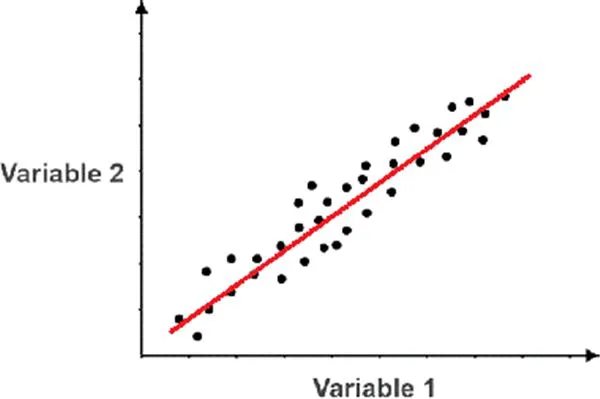 |
negative correlation | 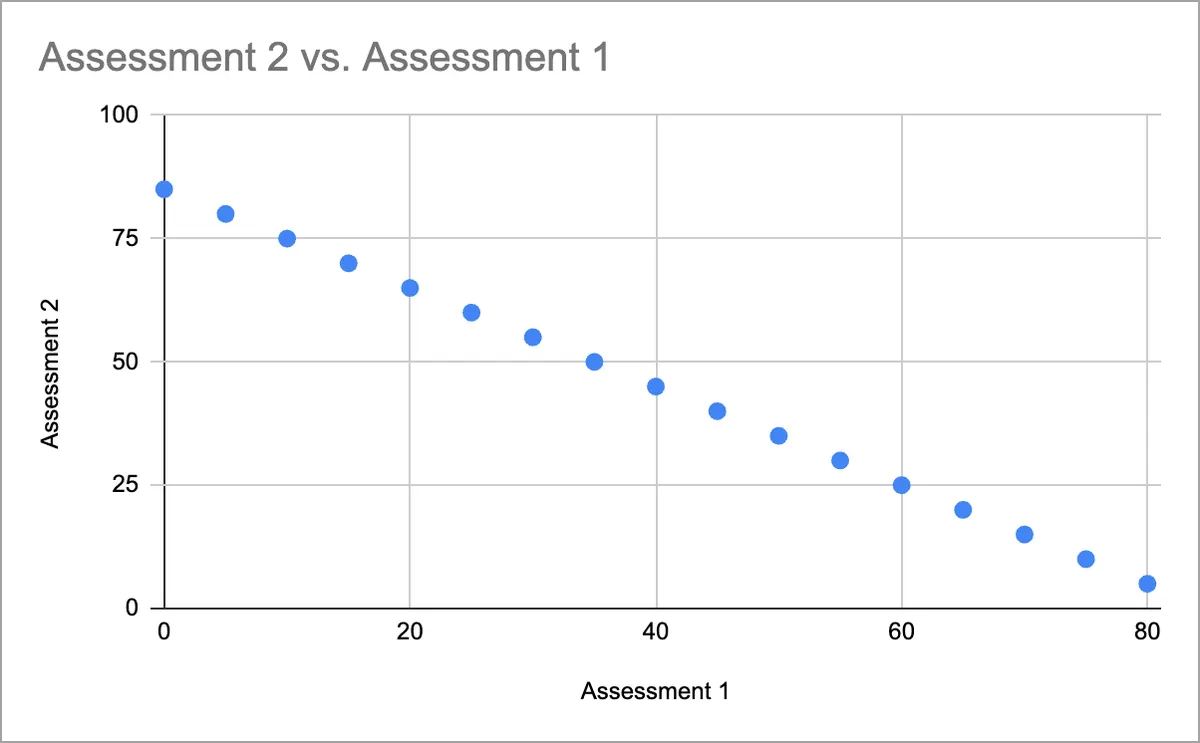 |
Correlation _____ casuation | does not equal |
Spurious Correlation | The idea that two patterns may be correlated, not to each other, but to an outside source or they are correlated but completely unrelated. |
Why should we do correlational studies? | - they are good tests of theory
- they're cheap and easy
- they provide more confidence when certain studies cannot be completed due to ethical concerns |
Compensatory hypothesis | says that compensating for one bad thing helps in another area (suggesting a correlation)
ex: parents with marital troubles mean they're better parents |
Spillover hypothesis | whatever is happening spills over into is
ex: marital troubles in parents spill over into their parenting skills |
Random assignment | Key to casual inferences, the idea that in experiments control and experimental groups are randomly assigned |
Cummings et al (1993) | Children randomly assigned to watch 4 variations of a couple arguing and asked to imagine they couple is their parents. Children who watched the video where the did not make up or only pretended to make up after arguing reported a high distress level, while children who observed a resolution to argument, or the couple resolving off camera reported a low distress level.
While this study was made up (since they were watching a video and pretending to see their parents), it matters because it shows convergence with other studies. |
Independent variable | the thing being changed in an experiment |
Dependent variable | the outcome in an experiment |
External valididy | asking if an experiment's result applies outside of a lab setting
correlational studies tend to apply outside of a lab |
Internal validity | the confidence that A causes B correlational studies tend to have lower internal validity |
Reasons to study child development | - it can assist in raising children
- it can help choose social policies
- it can help us to understand human nature |
Plato believed that children have ______ knowledge. | innate |
Tabla Rasa | John Locke's idea that children are a blank slate whose development reflects nature displayed by parents/society |
Themes in child development | Nature vs nurture, the active child (how do children shape their own development), continuity/discontinuity, how does change occur, how does sociocultural context influence development, and individual differences |
Nature vs nurture | the debate between whether genetics or nurturing of a child have a bigger impact on developing children |
all human characteristics are made up of _____ | joint workings of nature and nurture |
methylation | a biological process that influences behavior by suppressing gene activity and expression
- certain proteins can be turned off/on based on a child's experience as they grow up |
Selective attention | infants selectively choose their mothers' faces over other faces |
Play teaches children __________ | lessons about how to cope with fears, resolve disputes, and interact with others. |
sociocultural context | physical, cultural, economic & historical circumstances that make up a child's environment
- most importantly who they interact with
- institutions that influence their lives are also important
- society, cultures, race, and SES also play a role |
example of how sociocultural context influences cultures | in different cultures, children start sleeping in their own room at different ages, so different children in different cultures respond differently to sleeping alone |
cumulative risk | the accumulation of disadvantages over years of development |
children's resilience reflects their personal qualities, _______ the interactions they have with others. | and |
children can become different from one another for reasons of | - genetics
- treatment by parents/others
- differences in reactions to similar experiences
- different choices in environments |
scientific method | - choosing question to be answered
- formulating hypothesis
- developing method to find solution
- using data to draw conclusions |
reliability | the degree to which independent measurements of a behavior are consistent |
test-retest reliability | the degree of similarity of a participants performance on 2 or more occasions |
Forsyth et al (2007) | - self-esteem and grades
- three groups; one gets study tips daily, one gets daily study tips + promotional internal locust of control tip (tip about having control over your destiny)
- one gets study tip + self-esteem boosting tip
- no change was shown for the first two groups, but self-esteem groups' grades went DOWN
- did they become comfortable with failing? |
Cross sectional study | examining different kids at different ages |
Offord et al (1991) | cross-sectional study; example of cohort effect
examining kids with conduct disorder, depending on age/sex, different percent of children showed symptoms of conduct disorder |
Cohort affect | Something isn't caused by an age-related change, but instead due to historical changes
- things may have been different for children at those ages |
longitudinal study | studying kids at different ages, throughout their life |
Dishion at al (1999) | - intervention for boys at risk for delinquency
- boys were paired, and in the pair, one would be randomly assigned to an intervention group, and others to a control group
- those in the intervention group ended up being more delinquent |
Microgenetic studies | observations made to observe when/how cognitive change happens |
Siegler & Jenkins (1989) | studied children's ability to "count on" when taught new information- studied microgenticily to learn that they gradually use this strategy |